
Brought to you by
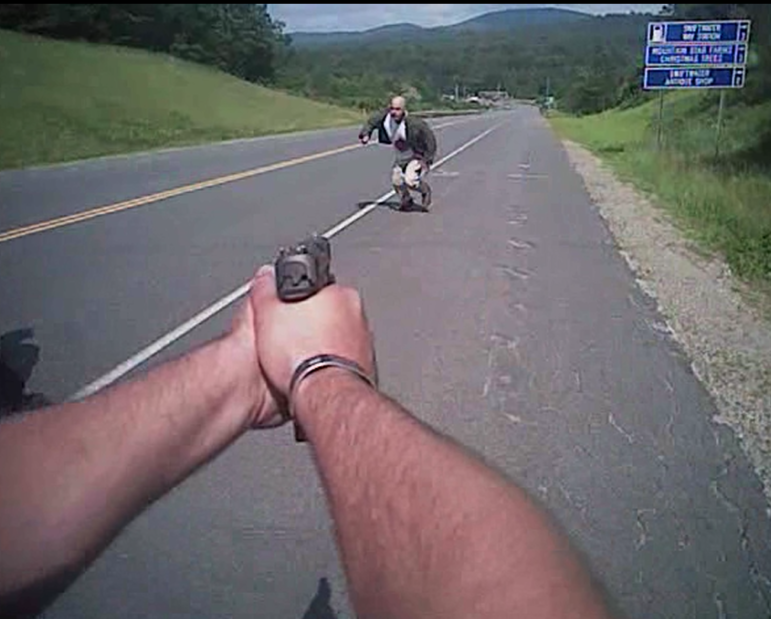
News Update: Judge Peter H. Fauver on Friday ordered release of redacted footage from body cameras worn by the two Haverhill police officers who shot Hagen Esty-Lennon to death in Bath on July 6.
→Read original story here: Landmark case: InDepthNH.org files motion to release police shooting video
On Sept. 4 Fauver ordered release of the videos except for the shooting and bloody “up-close images of (Esty-Lennon) lying in his own blood” after being shot by Officers Ryan Jarvis and Greg Collins.
Fauver ordered footage from the body camera of a third officer who arrived seconds after the shooting and a dashboard camera, along with the audio from all four cameras to be released without redaction. Fauver ordered the Attorney General’s office to oversee the redactions and release them Sept. 21 with the court’s ordered redactions.
Gilles Bissonnette, legal director for the ACLU-NH, praised the ruling, but said it remains to be seen when the videos and audio are released whether lethal force was necessary.
Esty-Lennon’s estate had argued against releasing the videos saying they would harm Esty-Lennon’s minor children.
Judge Fauver ordered redaction of the following footage: “Up-close and graphic images of the officers shooting the decedent, the decedent bleeding profusely while lying on the ground, the officers turning over the decedent to secure him in handcuffs, the officers removing the decedent’s knife from his reach, and medical responders placing the decedent on a stretcher and into an ambulance.”
Fauver explained in his ruling:
“These portions of the body camera videos depicting close-up images of the decedent lying in his own blood do not advance the public interest in assessing police conduct surrounding the decedent’s death.
“However the public’s interest in disclosure of the full audio from all four videos as well as the footage from the dashboard camera and Sergeant Trott’s body camera, both of which show the decedent from a distance, outweighs the privacy interest in nondisclosure,” Fauver wrote in the Merrimack County Superior Court order.
The Valley News and the Concord Monitor sought release of the videos and the ACLU-NH, several other newspapers and InDepthNH.org filed motions to intervene in support of release.
Fauver went on to say: “The full audio from all four videos, the dashboard video, and Sergeant Trott’s body camera video inform the public of the government’s actions throughout the entire incident without publicly disclosing the graphic images of the decedent’s death-scene.
“The redaction of the officers’ videos combined with the full disclosure of the audio and the two other videos, substantially satisfies the public’s right to know while protecting the privacy interests of the decedent’s family,” Fauver wrote.
The estate of Hagen Esty-Lennon motion, which was granted in part and denied in part, argued the victim’s family’s right to privacy, especially his two minor children, outweighed the public’s right to know.
“The Esty-Lennon family’s right to privacy and the emotional and psychological harm which release of Hagen Esty-Lennon’s graphic, violent and gruesome death will have on his family outweigh the public’s right to know,” wrote James Laura of the McGrath Law Firm.
“There is no legitimate reason for the release of the videos,” Laura concluded in the memorandum of law filed Sept. 1.
Laura and Peter McGrath were not immediately available for comment.
Gilles Bissonnette, legal director for the ACLU-NH, praised the ruling, but said it remains to be seen when the videos and audio are released whether lethal force was necessary.
Bissonnette said in an email, “the Court admirably attempted to balance the family’s privacy interests with the strong public interest in disclosure. It appears from the Court’s decision that the public will not have access to the body camera videos of the two shooting officers depicting the actual moment lethal force was used, though the moment force was used will be released from a dash camera that was further away.”
ACLU-NH’s primary concern is that the public has access to enough of the videos to judge for itself whether lethal force was used appropriately, Bissonnette said.
“Whether that will be the case based on the video and audio that will ultimately be released remains to be seen.
“Because we give few government officials as much authority as the power we give to police to take human life based on split-second judgments, the public has a compelling interest in understanding how the police exercise that authority, particularly when lethal force is used on an individual potentially suffering from a mental health crisis,” Bissonnette said.
Fauver said the U.S. Supreme Court has held that the FOIA (Freedom of Information Act) “recognizes family members’ right to personal privacy with respect to their close relative’s death-scene images.”
 You’re one click away! Sign up for our free eNewsletter and never miss another thing