
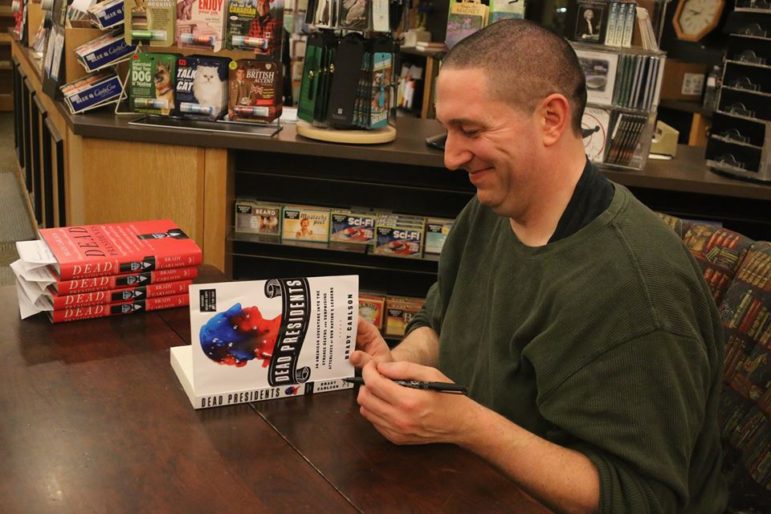
MANCHESTER, NH — Brady Carlson can trace his obsession with the lives and times of U.S. presidents back to his childhood, and one particular book, “Mr. President,” that tickled his brain so much that he couldn’t put it down.
Fast-forward to Feb. 25, 7 p.m., when Carlson will meet-and-greet friends and curiosity seekers who come out for his book talk at Barnes & Noble in Manchester, where they will learn more than they ever thought possible about his current obsession: dead presidents.
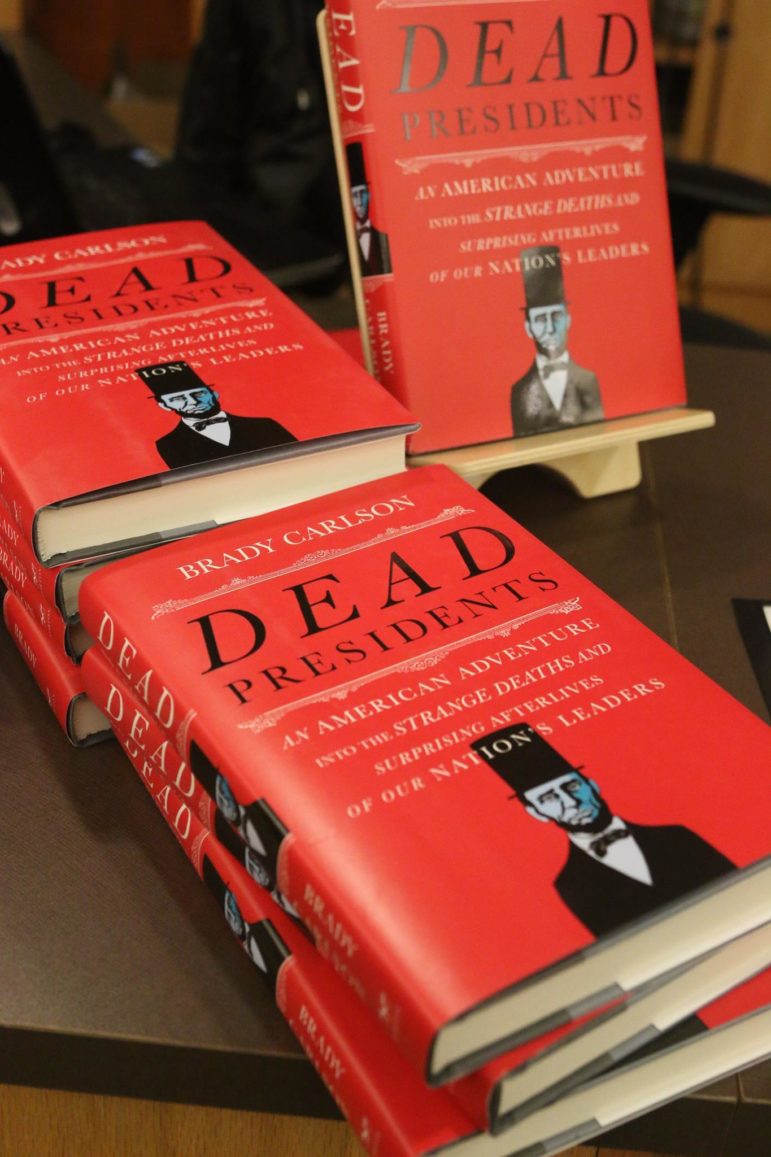
It’s an author event in support of his new book by the same abbreviated name. The extended title is a bit more revealing: “Dead Presidents: An All American Adventure into the Strange Deaths and Surprising Afterlives of our Nation’s Leaders.”
The book is a collection of stories Carlson has compiled over the past four years as a man on a particular mission: Traveling the country to visit every final resting place of every dead U.S. president.
It’s been a bit of a departure from the kind of abbreviated storytelling Carlson’s used to as a longtime New Hampshire Public Radio reporter and host.
So where does a concept for a book like “Dead Presidents” germinate?
The short answer is, not too surprisingly, in the aftermath of the 2012 New Hampshire primary.
“It’s was an informal thing at the beginning. I would call it ‘the project,’ because it was rattling around in my head, but I really had no way of doing it as a book. It’s not like a publisher was beating down my door,” says Carlson.
At least, not right away.
Instead of waiting for a book deal, Carlson decided to just get going and see where it led him. He set out on the journey he’d been formulating in his mind for years, one that would allow his lifelong fascination with the lives of presidents to go down a darker, quirkier side road.
He wanted to dig up the stories that began where our illustrious presidents left the earth, seeking tales that have allowed all of them to live on – and on – discovering that some had become larger and more storied in death than they were in life.
“I like projects that are closed and self-contained anyway, so I figured why don’t I just start doing it, and figure out what the form is supposed to be, whether it was a blog or a video series on YouTube. It also was a way to help me figure out what the point of it was,” says Carlson. “I didn’t want it to be just a travelogue.”
The more research he did, the more he realized that behind each presidential grave site, and beyond all the stories, was a simple truth: Our presidents live on as presidents – long after they are dead and buried.
Or, says Carlson, quoting William Faulkner, “The past is never dead. It’s not even past.”
For practical reasons Carlson made the trips on long weekends, using vacation time from his day job sparingly. He hit as many clusters of presidential graves as he could.
“On a few occasions there were particular events I wanted to go see, for example, traveling in 2013 to Dallas for the 50th anniversary of the Kennedy assassination. It turned out they were having a ceremony. I didn’t want to get into the conspiracy theory stuff — it’s a minefield,” says Carlson. “But because Dallas had a complicated history with Kennedy, I used this event to explore the identity crisis of Dallas, and a more interesting question, which is how it has reckoned itself with what happened there in December of 1963.”
Carlson also lucked into a gathering of thousands of presidential descendants after connecting with George Cleveland, grandson of President Grover Cleveland.
“He actually lives in New Hampshire and sent me a note. He mentioned a festival in Missouri where all the presidential kin gather — I was able to go and meet Truman relatives, Nixon relatives, Clinton relatives — all kinds of offspring of presidents, a fascinating world where everyone is bound by that one connective presidential thread,” says Carlson.
The biggest surprise was learning how often we have moved presidents bodies over the years, says Carlson.
“I found if you peel back the story, of how and where a president was initially buried, in a lot of cases they were moved, sometimes, to a temporary tomb until the permanent tomb was finished. But there were also a lot of cases where presidents were buried, exhumed, re-interred, moved again and, sometimes, for unusual reasons,” says Carlson.
Case in point: James Monroe, our fifth president, was from Virginia, but he died in New York and was buried on Manhattan.
“In a run-up to the Civil War, the governor of Virginia wondered how it was that we had a Southern president buried in a northern state. So he arranged for Monroe to be exhumed 20 or 30 years after his death, and brought back by steamship to be buried in Richmond,” says Carlson.
“Along the way, the North and South were clearly trying to one-up each other, so the northern people had huge parades and a massive public reception for Monroe, and sent him off with a big parade. And when he got to Virginia, naturally they felt they had to show that they loved him more, so they made all kinds of speeches and toasts and planned parades. It was like a battle to see who could honor the president better,” Carlson says.
One question through it all that piqued his interest was: How does the world of dead presidents change as the public’s relationship with the presidency changes over time?
“You know, we’re a lot closer to presidents now, due to mass communication. Sometimes they will even Tweet at us. Some have died a very traditional death, like heart failure or stroke. We’ve only had one that died of cancer, and that will almost certainly change,” says Carlson. “It will all change over time, especially as we have different kinds of presidents — African-American, or a woman eventually, or Latino, or if the Constitution changes and we have an immigrant president. And how will that change the statues we erect in their honor, or school naming, or what we call a presidential library? It really fascinates me.”
Carlson is also intrigued by the evolution of the way we deal with death, both culturally and historically.
“You see the different relationship we have with the presidency and mourning based on the era. The biggest tombs of all presidents tend to be for those relatively unknown. Grant’s tomb is the largest, but one of the the most imposing is for Garfield, who died at the height of the Victorian era, when death was a big part of culture, and mourning was a big part of fashion,” Carlson says. “It reflects less on who they were in history and more of what we did as a culture, to honor them in death.”
About a year into “the project” Carlson got an unexpected call from a literary agent — someone he had met through work had taken an interest in his grave-hopping hobby, and sent the idea along to an agent as part of a pitch.
“The agent called and said, ‘Let’s talk,’ and so we did, and … here we are,” he says.
Carlson is wrapping up the first leg of his Dead Presidents book tour, with the Manchester stop Thursday at Barnes & Noble, and Peterborough’s Toadstool Bookshop on Feb. 27.
He’s satisfied his interest, for now anyway, in post-post presidential history, but says another book could certainly be in his future.
He knows too much.
“One of the greater challenges was finding stories that were lesser known. Like the Lincoln assassination is a well told story. The one I found more interesting was about the funeral train that took him back to Illinois,” says Carlson. “It was making stops along the way so the public could pay their respects, and it was an open casket, so they had to keep redoing his makeup and add more fragrant flowers to mask the obvious.”
As the train rolled, from city to city, the receptions became more elaborate.
“It became a big, extended mourning period, and wherever his remains stopped, the people tried to outdo each other with mourning displays and public grief,” says Carlson. “I found that more revealing than anything. Why did millions of people come to these public receptions to see a dead body? I think, in the end, it says more about the kind of people we are, than anything.”
Click here for more information about the book, “Dead Presidents,” and the book talk with author Brady Carlson Feb. 25, 7 p.m. at Barnes & Noble, 1741 South Willow St., Manchester

You’re one click away! Sign up for our free eNewsletter and never miss another thing