


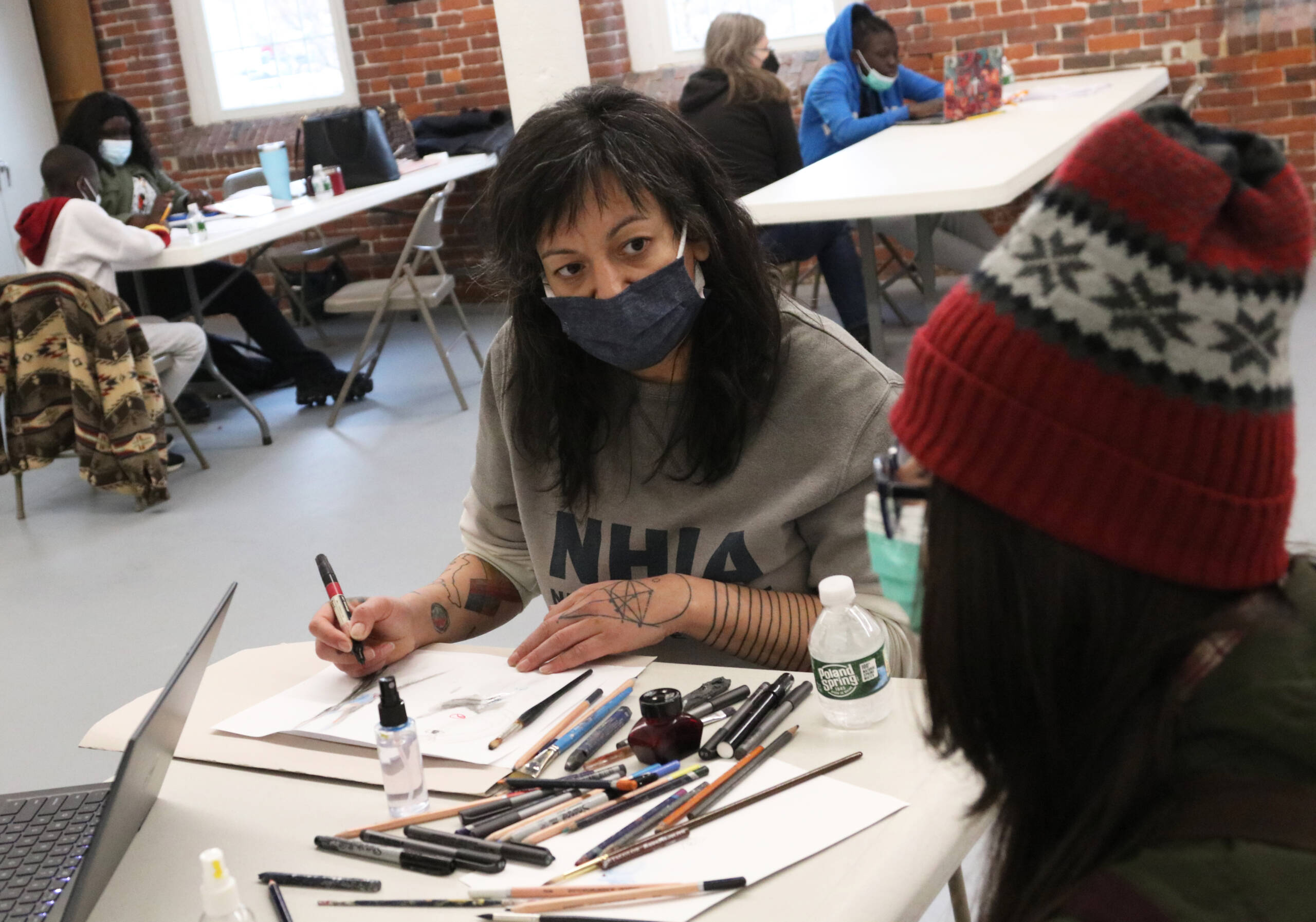
 MANCHESTER, NH – On Sunday afternoons a group of tutors, students and parents meets at the SEE Science Center in Manchester. They’re there for a tutoring initiative organized by the Manchester Community Action Coalition (MCAC), an organization dedicated to serving Black, Indigenous, immigrant and other marginalized communities in Manchester.
Most of the faces in the room are brown and Black, and the voices carry a variety of accents. Many people there would never have set foot in the SEE Science Center if it weren’t for the partnership with MCAC inviting them in, said Kile Adumene, executive director of MCAC.
“They wouldn’t have had the courage to be there. In the U.S., there are some spaces that are deemed white spaces,” she said.
In that way, the tutoring program isn’t just providing educational support, it’s also strengthening the social fabric in Manchester by fostering trust between communities that may view the other with fear or bias, Adumene said.
“We’re breaking the ground,” she said.
A village within a city
The tutoring program, which is available to students of color and immigrant students in Manchester, is the flagship program of MCAC, serving more than 70 students. That program grew out of a need the community expressed, Adumene said, and is emblematic of the larger mission of MCAC: to strengthen connections and provide community-driven solutions within immigrant communities of color in Manchester.
“The mission of MCAC is [to create] an encouraging space where people of color can have an opportunity to grow in leadership that is team-based and community-led, with a chance to build a lasting legacy on issues that are affecting us,” Adumene says.
Since its launch in 2020, MCAC has run other initiatives, including efforts to increase vaccination and voter registration among communities of color in Manchester. Currently the organization is working on a youth initiative to engage teens and young adults. Grace Kindeke, project coordinator for MCAC, describes the organization’s approach as a village model, based on the social structure of communities in Africa, where both Adumene and Kindeke immigrated from.

“In the village model your family is an extended family: the people within your community, relatives, friends, neighbors,” Kindeke said. “[This approach] tries to break through the individualistic nuclear family mindset that you can only rely on [a] small group of people.”
This approach is especially needed in New Hampshire. Immigrants and people of color who were new to the state didn’t have an existing community to drop into, said Adumene. Because of that, many people felt disconnected. They couldn’t utilize and share the skills and expertise they had, because they had little connection to their local communities. Oftentimes, people found they needed more support than they had access to, said Kindeke.
MCAC aims to fill that void by establishing connections and emphasizing the worth of people of color and immigrants.
“Every one of us is an asset to our environment,” Adumeme said. “You belong and you have something to offer.”
The organization invites all community members to bring their expertise, passions and concerns to their community.
“We’ve set up a structure where people can come into MCAC village and bring all the hats that they wear, their own heart and spirit,” said Kindeke. “It becomes a hub to bring people together and incubate solution building.”
The direction of MCAC will be steered by the village members, Adumene said.
“Not everyone has passion for kids or education,” she said. “Some people have passion for health. We also have those rooms available; MCAC is positioned to support any of those interests.”

The challenge of grassroots organizing
Grassroots organizations like MCAC are critical to creating social change, said Michele Holt-Shannon, director of New Hampshire Listens, a civic engagement initiative through the Carsey School of Public Policy at the University of New Hampshire.
“Grassroots organizations are most in touch with people’s lives,” she said. These groups work most closely to the ground, navigating the realities of day-to-day life for the people they serve.
At the same time, “they’ve been chronically underfunded and under-appreciated in the bigger field of philanthropy,” Holt-Shannon added.
Small community organizations often face criticism for being unorganized or not evaluating their impact at the quantitative level that larger organizations do. And yet, it’s the flexibility and low overhead that allow community-led initiatives to make the most impact in their communities, Holt-Shannon said.
“When groups come to us and say ‘we’re trying to build something,’ we’re helping them put things into place that can be supportive, but not wipe away the cachet they have with the local community by making them so formal that they’re not in touch with their communities,” she said.
MCAC needs to address that challenge head-on, said Kindeke.
“It’s not easy work, but we find it much more fulfilling and address some of the systemic challenges that a BIPOC-led organization will continue to face,” she said, using an acronym for Black and Indigenous people of color. “Resourcing support can be performative or shallow, and doesn’t help to support the solutions we’re actually trying to come up with.”
At the same time, authentic partnerships with larger community organizations have been critical to MCAC. Last year, the YWCA stepped in as a fiscal sponsor. That partnership allowed MCAC the time to put financial structures in place, without delaying their mission, Adumene said. Through formal and informal relationships, MCAC also works with Manchester Public Schools, the SEE Science Center, the NAACP, the American Friends Service Committee and others.
“We see them as village members,” Adumene said.
Increasingly, more mainstream organizations are recognizing the value of groups like MCAC, said Holt-Shannon. She’s seen a pattern of people seeking out the grassroots organizations that are most closely tied to the people they serve.
“We are getting better at focusing on and listening to the people who are most impacted by a decision or a policy,” she said.

Evaluating success
Anyone investing time, money or resources into a cause wants to know that they’re having an impact. For non-profits, that oftentimes requires a costly quantitative analysis that can detract from the actual work of an organization, Holt-Shannon said. That’s beginning to shift, as institutions realize that smaller organizations might need a different, less reaching approach to measuring their impact.
“There’s a lot more work that’s been done for people to [conduct] right-size evaluation, so it’s not the tail wagging the dog,” she said.
In small ways, MCAC sees quantitative measures of impact, like when the school system shares that a student’s academics have improved since they began attending the tutoring program. But much more often, they see qualitative indications that they are making a difference.
“We measure it by a shift in narrative,” said Kindeke.
She heard from people of color and immigrants who were frustrated and demoralized with life in Manchester, she said. That’s beginning to change.
“What I want to see — and how I measure our success — is a change in those conversations; what people say is possible for themselves and their children, while living in Manchester,” she said. She also looks to see people maintaining a relationship with MCAC long-term. That demonstrates that MCAC is benefitting them, and accomplishing their mission, she said.
When the tutoring program first started, families were reluctant to get involved, Adumene said. Now, they seek out MCAC.
“They want to be involved, not only on the receiving end. They want to participate,” she said.
The same thing is happening with larger, mainstream organizations around the state.
“When people reach out and say ‘we heard about your work,’ that is an outcome,” said Adumene.
MCAC is walking the fine line that many small organizations face, according to Holt-Shannon. They’re thinking about evaluating their success and shaping future policy, without taking away from the work they are doing within their communities.
“We’re building and learning at the same time,” said Kindeke.

Right now, MCAC is entering a period of strategic planning, where they will focus on distilling their mission into a clear, cohesive plan. That might mean that activity slows down temporarily, Kindeke said, but it’s important for building a sustainable organization in the long term.
“As we grow and respond to community needs, it’s good organizational practice,” she said.
At the same time, the model that MCAC follows empowers village members to craft their own solutions. That ensures the work of the organization can continue even when Kindeke and Adumene are focused on organizational tasks. MCAC is currently supporting a group of young people who want to see more engagement for youth locally.
“It’s them taking leadership of their needs, moving from ‘gimme gimme’ to active participants in their lives and in civic affairs,” Adumene said. “This year, we really want to promote that intergenerational connection and build that out.”
With that in mind, Adumene and Kindeke are hoping to bring more people into the village and continue to strengthen community relationships in Manchester. MCAC will always center the voices of immigrants, people of color and other marginalized groups, but anyone is welcomed to participate, said Kindeke.
“In New Hampshire, we’re such a small state,” she said. “When you start to do community-based work you realize how not removed we are from one another.”
 These articles are being shared by partners in The Granite State News Collaborative. For more information visit collaborativenh.org.