
Story Produced by NH Public Radio, a Member of

CONCORD, NH – A new report from New Hampshire Housing provides a snapshot of short-term rentals in the state and how they affect the state’s housing market.
The report aimed to provide statewide data for common concerns about short-term rentals, such as their impact on long-term housing availability amid a growing housing crisis and their effect on communities and quality of life.
The report used data from AirDNA, which tracks rentals on Vrbo and Airbnb, two popular short-term rental companies. It found that from 2014 to 2023, short-term rentals led to a 14% decrease in the state’s vacancy rate. But they did not appear to significantly increase rents during that same time period.
One reason for the minimal impact on rental prices could be because of a time lag, New Hampshire Housing’s Ben Frost said. He presented the findings at the organization’s Housing and Economy conference last week, where over 300 people gathered to discuss ways to spur housing development.
“It’s possible that in the future, we will see rents going up in a way that could be attributed to the prevalence of short-term rentals statewide,” Frost said.
The study also found that nearly half of short-term rentals statewide were owned by hosts who lived in the same county, and one-third lived in the same town. The majority of new properties listed on Airbnb, Vrbo, and similar sites were already short-term rentals or seasonal units, the report also found.
New Hampshire Housing Director Rob Dapice said the statewide focus of the report might not reflect the nuances of the issue at a local level.
“It’s primarily useful for making policy decisions at the state and county level,” he said. “There’s limitations because of the data that we have, to the conclusions that we can draw on the local level.”
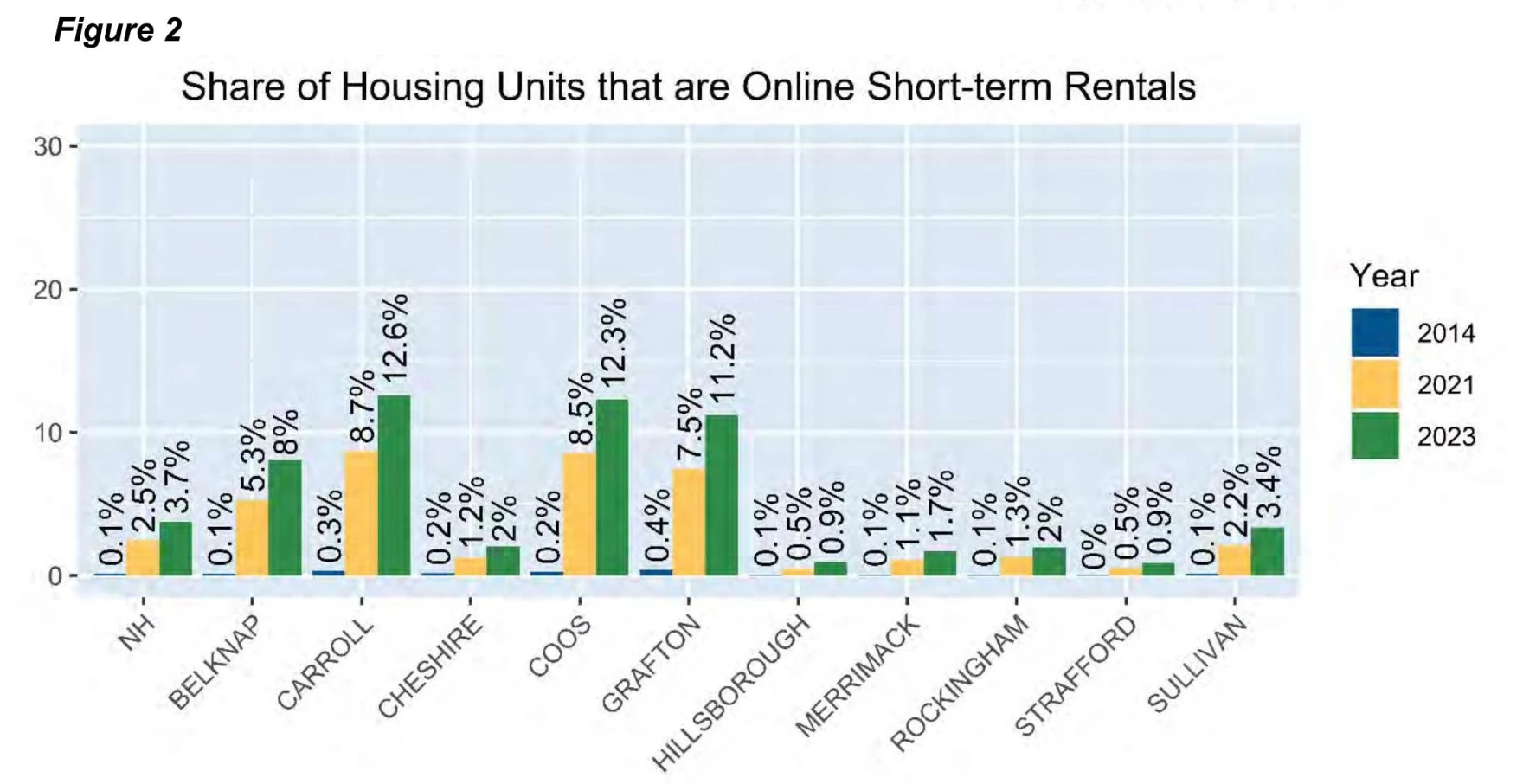
Communities across the state have very different relationships with short-term rentals. In most New Hampshire counties, online short-term rentals account for between 2% and 3% of the total housing stock.
But they’re more widespread in tourism-heavy regions in Carroll, Coos, Belknap and Grafton counties, where 8% to 13% of housing units are online short-term rentals. The town of Lincoln has the highest rate, at 42.5%.
Margaret Byrnes, executive director of the New Hampshire Municipal Association, said the study is a good starting point for residents who are deciding how and, if at all, they want to regulate short-term rentals locally.
“The study confirming that different municipalities have a different level of issue, if any, with short-term rentals really underscores our position,” Byrnes said. “Which is that a one-size-fits-all all approach for handling short-term rentals is not the right approach.”
 These articles are being shared by partners in The Granite State News Collaborative. For more information visit collaborativenh.org.