
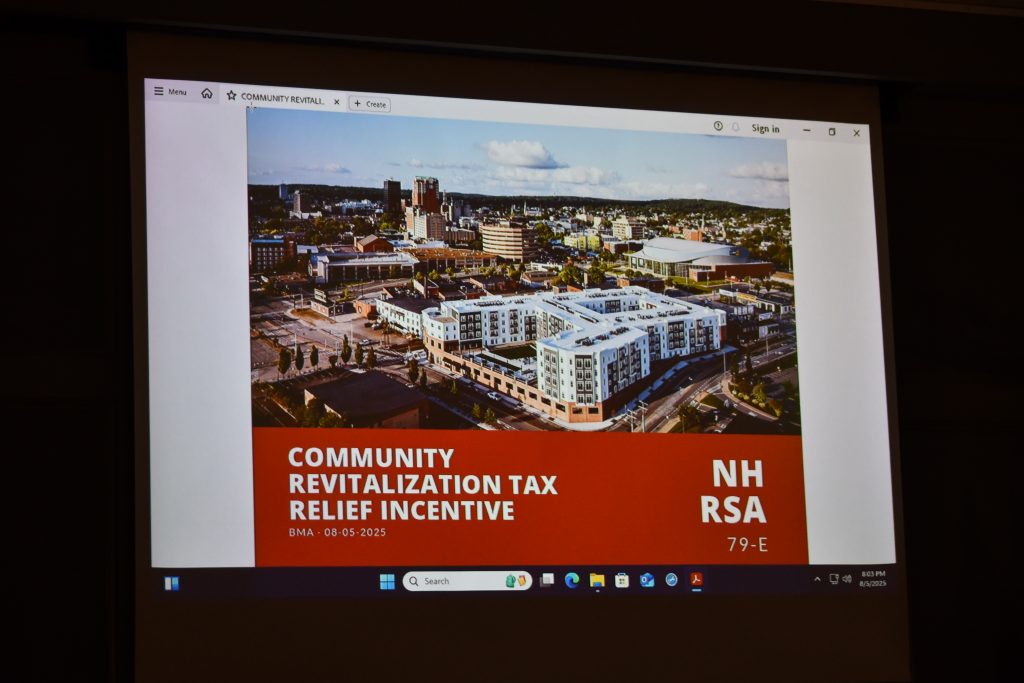
MANCHESTER, N.H. – When does a tax credit’s benefits outweigh its costs? That’s a question that was discussed for a certain program by the Manchester Board of Mayor and Aldermen during their meetings on Aug. 5.
The Community Revitalization Tax Relief Incentive Program, also known as the 79-E program for its place in New Hampshire state statute, has become a significant boon to the City of Manchester as it attempts to revitalize its downtown area. However, the Manchester Board of Mayor and Aldermen have also expressed concern about the lack of clearly defined guidelines when it comes to granting 79-E requests, particularly when granting that request could harm the city.
During a special meeting of the Board of Mayor and Aldermen’s Committee on Administration and Information Systems on Aug. 5, Manchester Economic Development Director Jodie Nazaka provided a set of proposed guidelines for future 79E requests intended to ensure the public benefit of this particular tax incentive.
The first recommendation stipulated that buildings or properties in Tax Increment Financing (TIF) Districts or areas under consideration for becoming a TIF District would be ineligible for 79-E relief. This is because TIF Districts are created when an infrastructure improvement benefits a certain area and increased taxes from higher property values due to that infrastructure are used for a time to repay that infrastructure improvement, making tax relief in that case counterproductive.
Nazaka also recommended going beyond state minimums and requiring that rehabilitation costs exceed at least 200 percent of the pre-rehabilitation assessed valuation, in addition to covenants if additional requirements like affordable housing are proposed as a condition, requiring buildings in the Central Business Service District (CBSD) maintain commercial uses on their first floor and limit the length of 79-E relief to five years unless there are additional deed restrictions.
Thanks to the flexibility of RSA 79-E, the Aldermen have the option of taking all or some of these and other recommendations by Nazaka or enacting others to create a sense of standardization in future requests, something Ward 4 Alderwoman Christine Fajardo felt that would make the program simpler for developers to access in the future.
During the meeting of the full board, Nazaka provided a presentation on the importance of the 79-E program in Manchester and how it has been utilized more in Manchester than other parts of the state. She also urged to the board that the requests are not a handout but an investment in building developers that allows them to renovate distressed properties for the benefit of the community as well as providing increased tax revenue through raised property values.
Fajardo asked Nazaka for additional information on the 79-E relief given to 20 Concord St., better known as the Firefly building, which saw its value rise by $3.1 million, and how much money the city gave up in tax revenue to achieve those long-term gains. Nazaka said that the renovations likely would not have happened without the 79-E relief, but if it had, it would have given the city approximately $33,000 over five years.
In addition to the CBSD, 79-E requests can also be granted to specified rehabilitation areas, with Manchester currently holding one such area to the southeast of the downtown area. Ward 3 Alderman Pat Long asked if additional areas in need of rehabilitation could be added to the list of areas eligible for 79-E relief. Nazaka said it was possible, particularly for some parts of the West Side, although the current form of the law would limit how much relief could be given compared to the requests in the CBSD.