
O P I N I O N
By Keith Howard
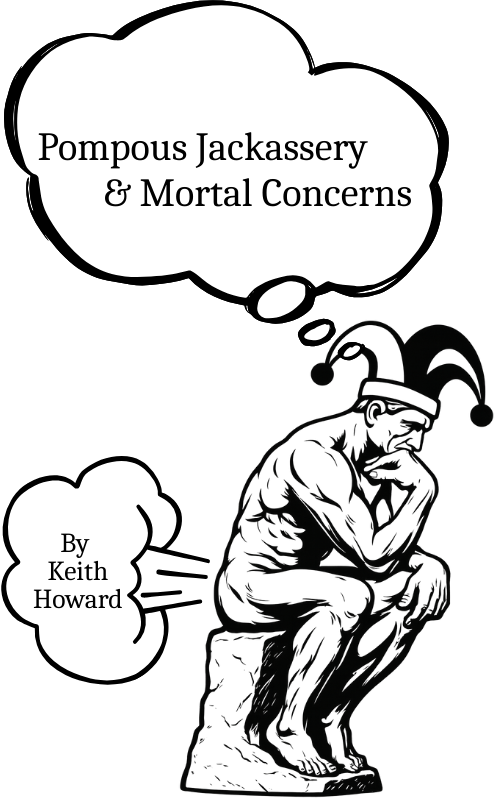
Some kids are cruel. Others just… curious with a mean streak. I wasn’t evil—but wicked? Absolutely. Wickedness is disruption without a mission, a laugh aimed squarely at the wrong authority. This one’s about how one laugh, wrong‑time, wrong‑place, ended up being exactly right.
Wicked, Not Evil
(Step forward. Smile slightly, like you’re about to confess something outrageous. Pause just long enough to make the silence lean in.)
I was not an evil child.
(beat, lean in)
But I was wicked.
(hold it — let them react. Then:)
And trust me, the distinction matters.
It’s the difference between a wildfire—
(gesture: hands spreading wide, unstoppable)
—and a grease fire in your mom’s pristine kitchen.
(pause for laughter)
Evil is an unstoppable force of nature, charging in with all the subtlety of a demolition crew.
Wickedness? (grin, shrug) That’s flicking a match into the air just to see where it lands.
Evil has a mission statement.
(serious tone, finger in the air like a bossy executive)
Wickedness leans back with a grin and says, “I wonder what’ll happen if I…”
(beat. Smile wider.)
My wickedness was never about destroying.
It was about disrupting.
A little chaos here, a little confusion there… all with the air of an amateur magician testing tricks that weren’t quite ready for the big stage.
(Shift tone: reflective, playful.)
Now, I’d like to think I’ve outgrown all that.
But who really knows?
The faint whiff of sulfur still clings to my old antics. Sparks burn out, but memories—
(gesture: wag a finger, mock-serious)
—and scorched curtains—tend to linger.
The thing about being wicked is this:
you don’t always get to decide what people remember about you.
(Change tone: conversational, amused. Mimic reunion small talk.)
Years later, I ran into Dianne—an old schoolmate—at our high school reunion.
She’s a professor now. Calm. Poised. The kind of woman her students either admire… or fear.
After we lied to each other about how great we looked—
(pause for audience chuckle)
—she leaned in, eyes bright, like she’d just unearthed an old diary.
(As Dianne, enthusiastic)
“Keith,” she said, “I tell my students a story about you every semester.”
(beat, back to yourself, incredulous)
“Oh yeah? What kind of story?”
(as Dianne, savoring)
“Do you remember the time you hijacked an entire classroom with your laugh?”
(Shift back to narration: thoughtful, playful.)
I had no memory of this.
But as she described it, the memory began building itself in my head.
Blurry at first… then sharp.
(Paint the scene, slower, voice dropping a notch)
The classroom air—stuffy, with the sour tang of wet boots drying on the radiator.
Sunlight slanting through streaky windows, catching dust motes.
Desks creaking.
Pencils frozen mid-scratch.
And then—our teacher’s voice. Sharp. Brittle. Like a snapped ruler.
(as teacher, furious, finger stabbing the air)
“Keith Howard, go to the office!”
(Back to narration: lean forward, playful.)
But instead of obeying—
I just smiled.
(pause. Let it hang.)
And then, I stood up. Chair screeching across the floor.
The room held its breath.
Finally—normality would be restored.
(beat, drop voice to a whisper)
Except it wasn’t.
(big grin, punch this line)
Because I started laughing.
(Build momentum here, almost reliving it. Let the laugh ripple through your body, but don’t overdo it yet.)
Loud. Uncontrollable.
Bouncing off chalkboards, ricocheting around the linoleum floors.
At first, the kids froze. Wide-eyed. Silent.
Then—like dominoes—one giggled. Another snorted.
Soon, the whole room was shaking.
Pencils flying, hands clamped over mouths, desks rattling with stifled hysteria.
(mimic teacher, red-faced, stomping)
“Stop that! Go to the office!”
(beat, escalate)
“STOP. THAT. LAUGHING!”
But the more she yelled—
(point to self, shoulders shaking, now really laugh a little)
—the harder I laughed.
And then—
(pause, soften, slow)
something cracked.
(lean in, voice conspiratorial, almost tender)
Her lips twitched. Her shoulders shook.
And finally—boom.
She was laughing too.
(spread hands, triumphant, with mock humility)
She threw up her hands and said, “Fine! Sit down! Forget the office!”
(step back, reflective tone)
Dianne was laughing as she told me this. Tears in her eyes.
“Keith,” she said, “it’s my favorite example of how one moment—one laugh—can completely change the energy of a room.”
(pause, softer, let it breathe)
Now, I believe in autonomy, so I won’t question Dianne’s right to use her memory to teach her students.
But my takeaway is different.
(beat, dry, sly smile)
I see contempt for power as an effective catalyst for change.
Or at least a way to get out of going to the office.
(step forward, close strong)
Sometimes, one laugh is enough to upend a whole classroom.
Other times—
(pause, mischievous grin)
you need a little more creativity.
Like turning a science lesson into a battle over oxidation.
But either way, my wickedness thrived on one thing:
(final punch, lean in)
the thrill of seeing what would happen next.
Publisher’s Note: This is a series of columns by Keith Howard – you know him from his Tiny White Box series, and as former Executive Director of The Liberty House and Hope for NH Recovery. You can read his previous column here. His new memoir, Unclaimed, But Loud: The Memoir of a Shy and Retiring Boy Who Was Neither, is available for purchase on Amazon.