

Navigating New Hampshire’s Urban Paths
“Yes, an e-bike. Because my spandex was at the cleaners.”
— Anonymous
Hello New Hampshire! Some days it seems e-bikes, and other small electric vehicles, are everywhere. So let’s talk about them!
E-Bikes
Unless you’ve been living under a rock, you have doubtless noted the recent explosion of battery-powered small electric vehicles.
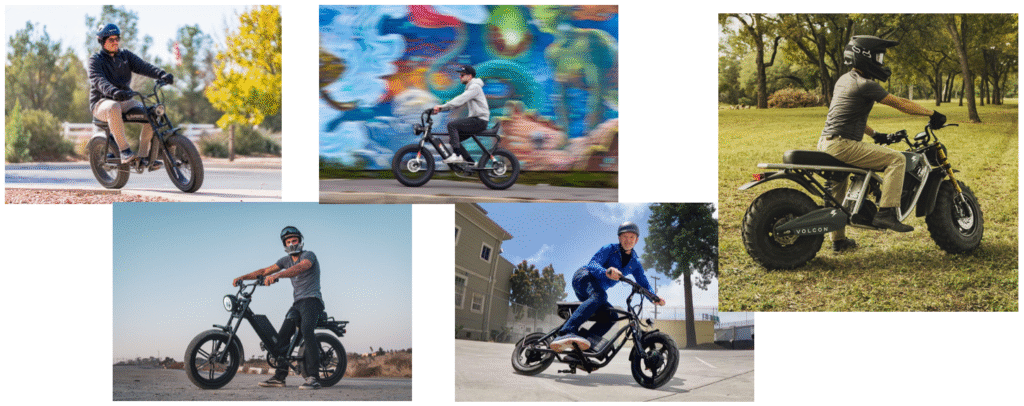
Some are scooters, some are one-wheels, some are electric bicycles, some are so powerful that they approach motorcycle territory. Many of the two-wheeled variety market themselves using the term “e-bike,” even when they far exceed the legal specifications allowed for electric bicycles.
According to the U.S. Department of Energy, 1.1 million e-bikes were sold in the United States in 2022, almost four times as many as in 2019. Some of that growth is attributable to the Covid pandemic, but not all of it. Some of it is attributable to lower prices for components and greater profit for the vendors.
If you’re looking to buy one of these, maybe for yourself, or maybe because your teenager is convinced their life will absolutely end unless they get one of these devices, how do you know which ones are safe and legal? Given that many are manufactured outside the US, and are a mere click away via Amazon, how are you to judge?
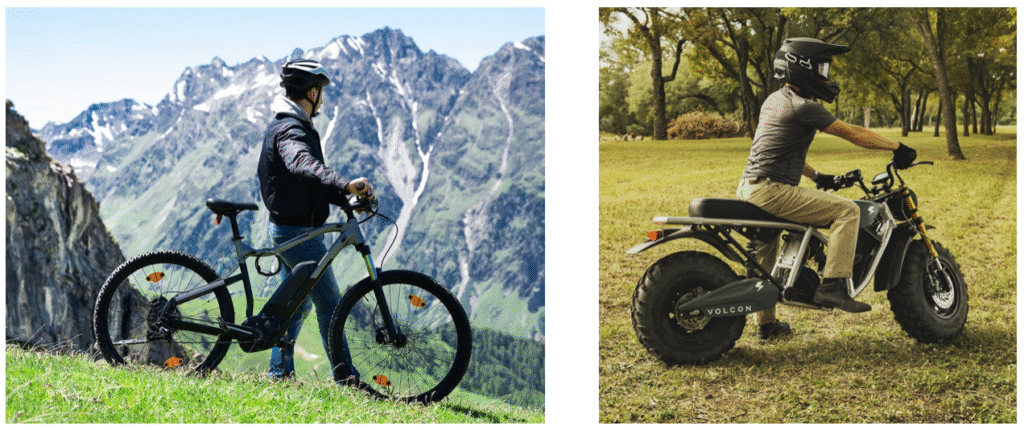
It is a legitimate quandary. Law enforcement agencies are seeking guidance in how to deal with this proliferation of personal electric vehicles (PEVs). Some states are responding to this proliferation by passing legislation, sometimes quite restrictive.
The backlash is understandable. Pedestrians have been seriously injured and even killed by collisions with PEVs, with two vivid recent examples both in Massachusetts. This makes people angry and emotional.
In some cases, PEVs are being ridden dangerously and irresponsibly by thrill-seeking riders. But even leaving that aside, E-Bikes have increased overall ridership, so many more cyclists (or small personal vehicle riders) are present on roads and on paths, possibly leading to crowding.
Powerful Anecdotes from Massachusetts
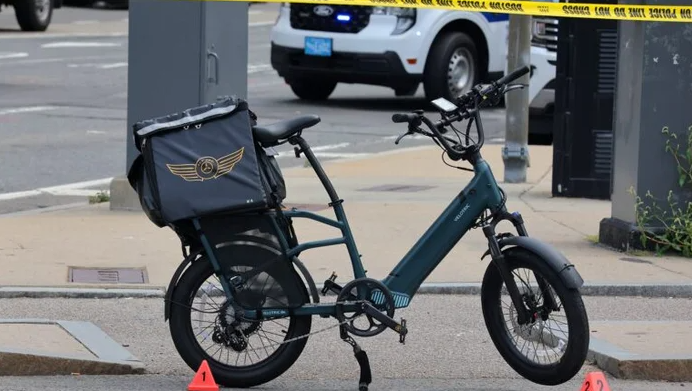
In August, Minh Dang of Braintree, 64, was in a pedestrian cross-walk when he was struck by a delivery e-bike in Copley Square.

Witnesses said he suffered severe head injuries. He was non-responsive after the crash, was taken to hospital, and he died a few weeks later. The delivery bike operator remained on the scene and cooperated with police. No charges were filed.
On September 10, Lynne Forester was walking on the Cape Cod Rail Trail, as a group of riders approached her from behind. One of them, on an e-bike, collided with Lynne, whose head struck the ground, and a handlebar went into Lynne’s left eye.
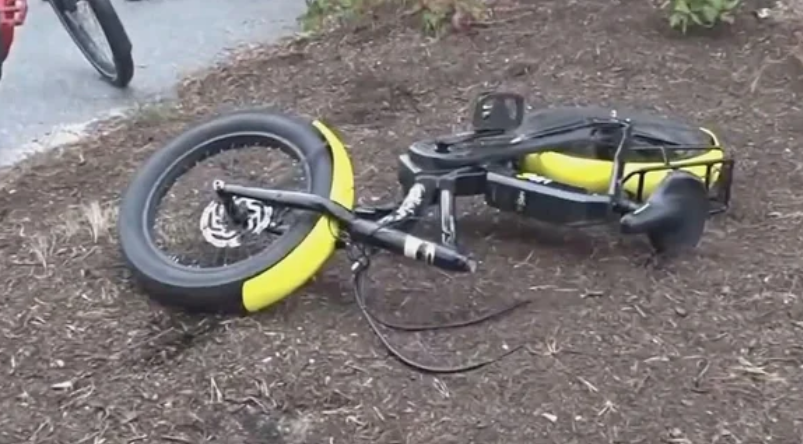
Responding Harwich Fire rescuers cut the handlebars from the bicycle and from Lynne’s face, leaving a small piece, before she was medevacked by helicopter to Mass General in Boston. She suffered facial and skill fractures and some bleeding inside her skull. She was hospitalized for 24 days. She is expected to remain permanently blind in her left eye. The muscles that open her left eye are not working at present.
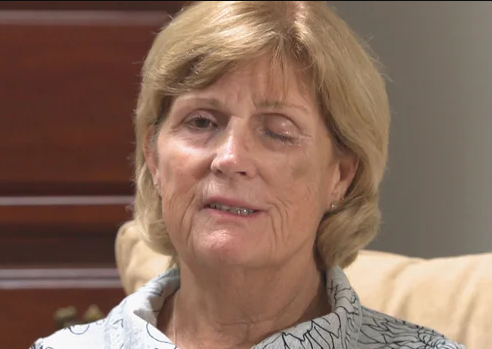
The cyclist told police that she never saw Lynne before the crash. Police say criminal charges will not be filed. Witnesses say speed was not a factor, and the e-bike was of a type allowed on the Cap Cod Rail Trail. The Mass Department of Recreation and Conservation operates the paved trail, which has a speed limit of 15 mph.
In both of these examples from Massachusetts, it appears neither cyclist was operating flagrantly. There may have been insufficient attention to their surroundings. It also appears that neither of the devices violated e-bike classifications or power limits. However, given the serious consequences of both incidents, emotions unsurprisingly get agitated.
I myself am an e-bike owner and rider. Mine is powered at 750 watts, nominally 1 horse power, has an optional throttle, and all power ceases once I reach a speed of 20 mph. This places my bike firmly in Class 2, defined below. I mostly ride with power completely turned off, until I encounter a steep hill, when I turn it on for a little help (usually in pedal-assist mode only, ignoring the throttle). Today, legally, I am not required to have a license, nor to register my bike as a motor vehicle, nor to insure it. I hope that those requirements do not change in the future. However, that could be coming. And arguably, for more powerful devices, such legislation is entirely appropriate.
State of E-Bike Legislation
First of all, E-Bikes have been defined in federal law since 2002, so for 23 years. They are regulated as human-powered bicycles under the Consumer Product Safety Act. They must comply with all bicycle safety standards. They are NOT motor vehicles and are not subject the NHTSA vehicle standards. (NHTSA = National Highway Traffic Safety Administration.) They are designed, manufactured, and tested like traditional bicycles.
Classes of E-Bikes
Early on, the organization People For Bikes recognized a need to clarify discussions of e-bikes by grouping them into classes, and so devised three classifications. These classifications are now recognized legally by 41 states, including New Hampshire.
All three classes are defined as pedaled vehicles with power not to exceed 750 watts (nominally 1 horsepower).
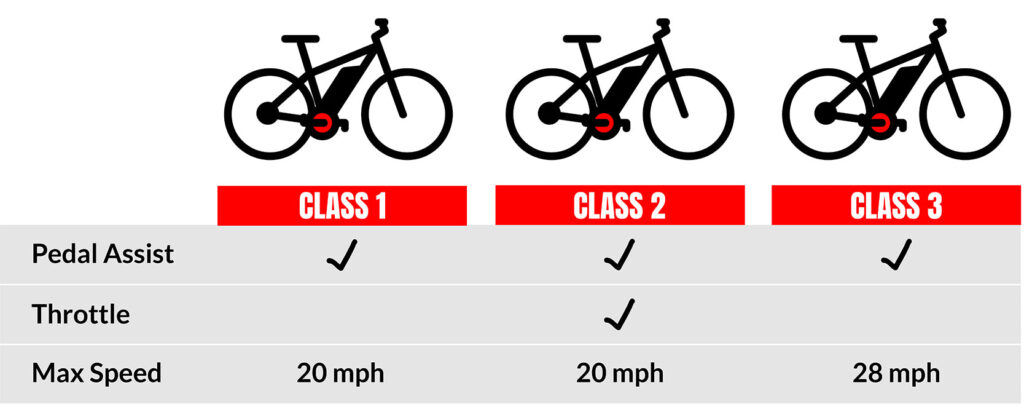
Class 1 is further defined as “pedal-assist,” meaning the motor supplies power only when the rider is turning the pedals, to provide assistance, no throttle is present, and powered assist stops once a speed of 20 mph is reached.
Class 2 is defined as similar to class 1, except a throttle is present and may be used to power the wheels in the absence of pedaling. Like class 1, power stops once 20 mph is reached.
Class 3 is also similar to class 1, with no throttle, but power assist is provided up to a maximum speed of 28 mph.
Any device that exceeds these limitations is known as “Out-of-Class.” This could be due to a power level greater than 750 watts, it could be throttle power continuing past a speed of 20 mph, it could be pedal-assistance continuing past a speed of 28 mph, or it could be anything other deviation from the specifications above.
State of E-Bike Legislation in NH
Present law took effect in August 2019, with requirements falling into nine areas as described below.
- E-bikes are divided into three classes as described above, and e-bike riders have the same rights and duties as bicycle riders.
- Neither license nor registration nor insurance are required for e-bikes falling into the three defined classes.
- Use on Paths: e-bikes of classes 1 & 2 are allowed on multi-use paths. Class 3 allowed only on paths within or adjacent to a roadway. This can be overruled by a town or jurisdiction.
- Use on natural-surface non-motorized trails: agencies managing trails may regulate this, can be overruled by a town or jurisdiction.
- In NH State Parks: class 1 & 2 e-bikes allowed on same trails as regular bikes. Speed recommended below 20 mph. More info here.
- U.S. Forest Service: Keep in mind that in New Hampshire, a significant amount of land is managed by the U.S. Forest Service. This includes the White Mountain National Forest, and iconic landscapes like Franconia Notch, Mount Moosilauke, Mount Chocorua, and the Presidential Range. In these areas, e-bikes are treated as motor vehicles, and only allowed on trails designated for motorized use, unless otherwise marked. More details here.
- Minimum age, only applies to class 3 e-bikes, of 16
- Helmet requirement, only applies to class 3 e-bikes, for riders and passengers under 18
- Speedometer required only for class 3 e-bikes
Changes and Enhancements to NH E-Bike Law
A modified bill, NH HB 1445, was filed in 2024 in an attempt to add further clarification, but was deemed “Inexpedient to Legislate.” More info.
In 2025, another bill was filed, NH HB 715-FN, this time to explicitly “define and regulate personal electric vehicles.” It also was deemed “Inexpedient to Legislate.” More info.
The Future
Recent events suggest further legislation is coming.
- Attempt to update E-Bike bill ITL’d in each of last two years
- Many other states recently passing similar legislation
- Recent high-visibility and serious e-bike related casualties in Massachusetts
Such future legislation could affect the legality of any e-bike you own. Especially if it’s high-powered, or in any way “Out-of-Class.” So be aware, you may be affected. I am hopeful that these laws will strike a balance between ensuring safety of all vulnerable road users and allowing continued responsible use of pedal-assist e-bikes. Luckily, I can remove my throttle if need be, and I would barely miss it, which would move me from class 2 to class 1, pedal-assist only. In the spirit of increased safety for all road users, I would happily comply.
Call for Input
We very much want to hear from you! Do you have any questions or concerns? What topics would you like us to cover? Send your feedback our way and we’ll get on it! We want to ensure this column meets your needs.
Stay safe, cool, and hydrated, and have fun out there!
Note: The author is a member of the board of the Bike Walk Alliance of New Hampshire, but the views expressed in this article are his own.