
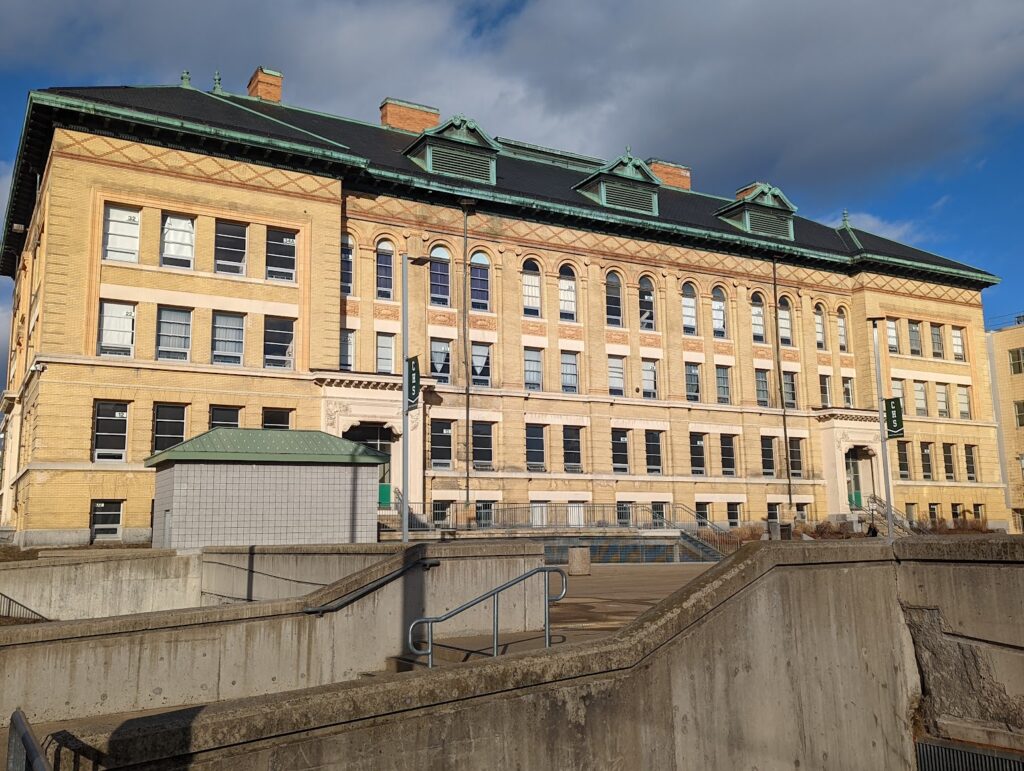
MANCHESTER, NH – For years, there have been rumors that the Manchester School District would somehow realign the city’s public high school students away from its long-standing configuration. In their first regular meeting of 2026, the Manchester Board of School Committee (BOSC) held another discussion looking at just such a realignment that recommended no immediate action.
Manchester School District Superintendent Jennifer Chmiel provided the BOSC with an examination of three options arising after the BOSC requested new recommendations for the city’s public high school configuration in 2025 upon the expectation of upcoming budget difficulties.
The topic of how many and what type of public high schools should be in the city have been a point of discussion in recent years, with recommendations evolving in response to public opinion, budgetary concerns and the desire to modernize the city’s educational infrastructure.
In 2022, former Manchester School District Superintendent John Goldhardt recommended the creation of one “super high school” comparable to Pinkerton in Derry, currently the state’s largest high school.
By 2023, the expected plan focused on two 2,000-student general studies high schools and a magnet high school focused on arts, with the three high schools potentially being placed at three of four locations in the city. Then in 2024, this approach was amended to create new Career/Technical Education (CTE) programs at each of the three high schools and close the district’s current CTE school, Manchester School of Technology,(MST) while also potentially building a new Manchester Central High School.
With those possibilities now unlikely, Chmiel presented three potential reconfigurations but declined to endorse any of them.
The first option would close Manchester West High School, with West students split between Central and Memorial. While this plan could have long-term benefits, the moving costs and need for additional school buses and bus drivers would be a significant up-front cost.
The second option looked at closing the Classical Building at Central, which theoretically would reduce maintenance costs by one-third. However, that estimate was not certain as the district would not be able to declare the building as surplus, meaning that it would still be responsible for some amount of maintenance even though it was no longer being used. Like with West, moving everything out of the Classical Building into different parts of the Central campus would also incur an expense.
The last option presented shifting MST into a CTE-only school. However, as MST also has non-CTE students, the change would remove Perkins Grant funding with the loss of those non-CTE students.
BOSC Vice Chair Jim O’Connell agreed with the assessment that actions should not be taken for the sake of expediency and asked newer members of the board to look through the significant amount of data accumulated through the facilities planning process, with Chmiel adding that that information is currently online. She added that additional presentations on the long-term facilities planning process would be coming in the near future.
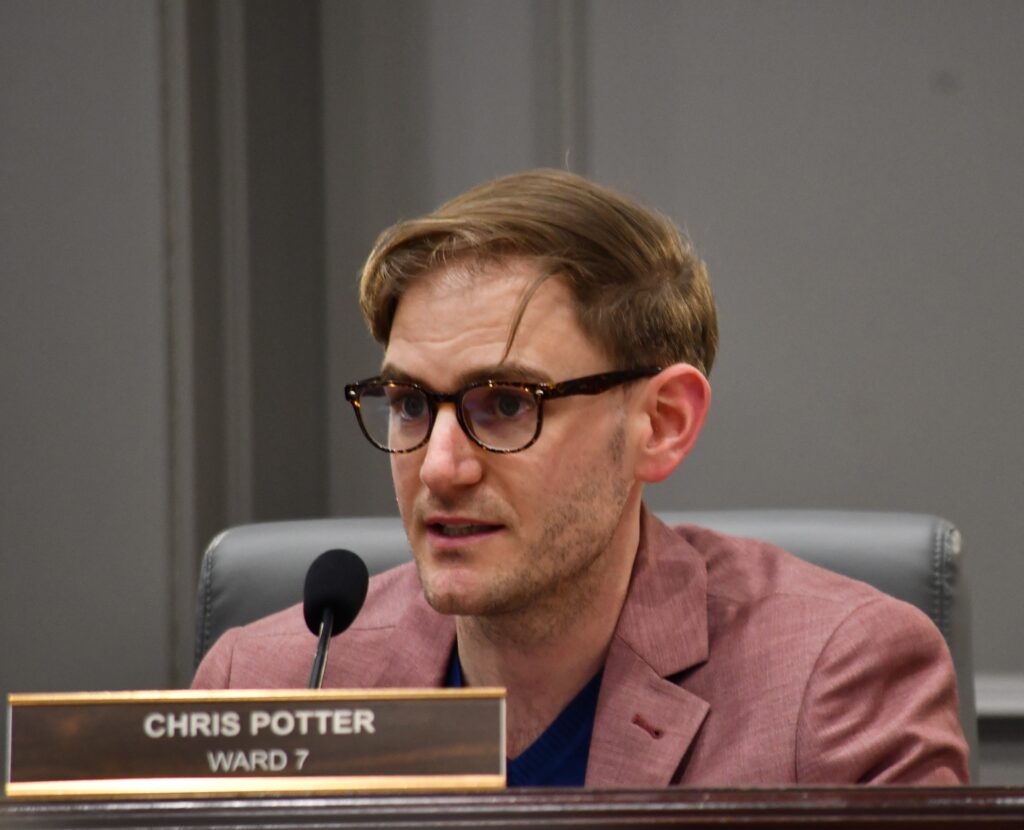
Ward 7 BOSC Member Chris Potter agreed, adding that the closure of West should be off the table given the significance of the school to the city’s West Side. He said refurbishing the current three high schools may be the best route using money from cost-saving measures, given the unlikelihood that money would become available in the near future for the broader initiatives of the initial facilities plan. However, he noted that the initial proposals within Phase 2 of the long-term facilities plan should be followed once they become feasible within the budget.
Ward 10 BOSC Member Gary Hamer agreed that remodeling or refurbishing would be a better approach than completely new schools and Ward 1 BOSC Member Julie Turner agreed with O’Connell, feeling that a quick move would be haphazard and detrimental to students.
The presentation on the recommendation was made for informational purposes only, with no action taken by the board.