
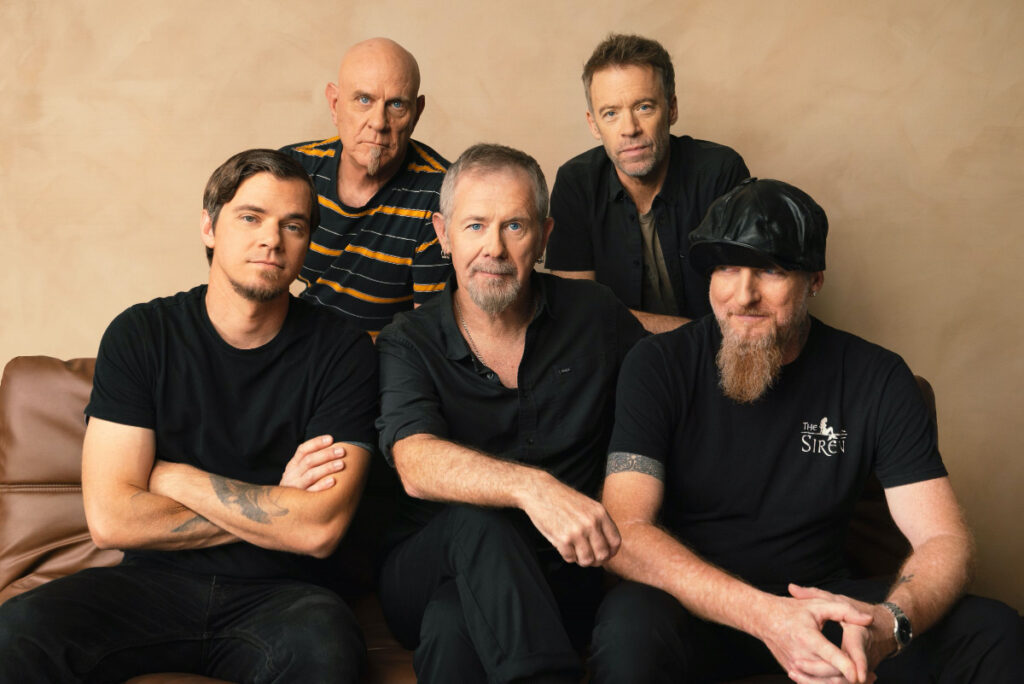
MANCHESTER, NH – St. Patrick’s Day is a little over a month away, and some people are already getting ready for the festive occasion. After Valentine’s Day runs its course, certain stores will have a section adorned with green shamrocks and caricatures of leprechauns. There’s also a bunch of bands who are getting ready for this particular time of year, including the Los Angeles celtic rock act The Young Dubliners. On February 13 at The Rex Theatre in Manchester, folks will have the opportunity to get into the St. Paddy’s spirit a little early when this band takes the stage. The show starts at 7:30pm with no opener, so expect to hear an extensive array of The Young Dubliners’ catalog.
I had a talk with lead singer and guitarist Keith Roberts ahead of the performance about having a new single out, working with crowdfunding platforms, and thoughts on coming to the “Queen City.”
Rob Duguay: Last year, The Young Dubliners released a new single titled “Stop Shaking Your Head,” so tell me about the making of it. What was the songwriting and recording process like for the single?
Keith Roberts: We’re in the middle of an album, and the album is crowdfunded, so we wanted to include all of the people who chipped in as executive producers. The idea was to keep giving them reports on the album’s progress, and then we realized that it was taking a while because of our touring schedule. That’s really been the hold up for us, we’re on the road so much, and when we get off the road, we take a break, and then after we go into the studio, we’re back on the road. The songs are there, it’s just been taking a while, so we decided that rather than making everybody just wait until the bitter end, we show the progress. Through the new way albums are released and how the internet has changed, we’ve realized that a lot of bands are doing that now, so we actually released a single before this one called “Drive,” and now we’re prepping a third one as we keep working on the record.
That’s really what we did, we just took a couple of tunes that we played live and we felt were ready to finish and we went into the studio. Instead of doing every song a piece at a time where you do all the guitars and all your drums, etc., we’ve been doing them a little bit differently where we’ve started a song like “Stop Shaking Your Head” and finished it so we can release it as a single, show everybody the progress and that we’re all moving along while keeping them all engaged in the process. That was really how that came about.
RD: Speaking of crowdfunding, this is the second record you’ve done in this fashion following the album “9” that came out in 2013, so being a musician who has been making music since the ‘80s, what are your thoughts on this aspect where you get your fans more involved in the making of an album? What are your thoughts on having this platform where you get people to donate money and having them get different rewards and other things out of it rather than depending on a record label or other outlets?
KR: It makes a huge difference, and we are a great example of a band that started before the interview, so we’ve literally lived through every single change. We’ve been signed to major labels and we’ve been signed to indie labels, but this was just the perfect time for us because number one, our schedule with the working. Big, big bands with huge budgets can take a year off and do an album, but bands like us, which is sort of like the middle range of so many in America that tour nonstop and keep the venues going, we just don’t have that option to lock ourselves away. When we’d get budgets from record companies, there would be a lot of pressure to hurry up and finish it, and then maybe you’d sacrifice quality due to having to get it done so fast. Then, as you know, the industry standard, as they always called it, was horrendous for bands where you would get a tiny percentage of your sales, and from that, they’d want you to pay back the advance they gave you to make the album.
Basically, you were paying for everything and it was more like a bank loan. This way, we’re not asking people to give us charity money, we’re saying, “If you love the band enough and you trust us, would you be willing to buy the album in advance? Are you willing to give us what you’d give us for an album anyway, but just in advance?” Then you could go up in levels where if you want to go a little higher, you can get a t-shirt or tickets to a gig, so the amount you’re giving us is always given back to you. Sometimes, it’s even more than what your pledge was, or at least as much as it was, so the idea is that when the album’s done, you don’t owe a record company a hundred grand. You’re doing it on your own, it’s already paid for, and it just feels good to do it that way.
Also, the fact that this is our 10th album, after a while, like anything in life, you learn how things work. We’ve started to realize that with the changing world, we literally couldn’t see an advantage to having a record label because we have our own publicity, we have our own social media, and we have an amazing fan base. We have our own producers and our own studios, so what exactly would a record label be doing that we’re not doing ourselves? To be honest with you, not having to listen to somebody’s opinion who you maybe just met and you don’t know if they know anything about Celtic Rock or not is nice. The only downside of everything I just said is that there isn’t an A&R man screaming at me, so when we come off a tour after doing three and a half weeks straight, the last thing we want to do is go into the studio. We need a break from each other, so we go back to our families and chill for a minute.
That’s why our albums tend to take longer to make because we don’t have that whipcracking A&R man telling us that we have to get it to him by January or it’s not going to be released next year or something like that. Once it’s ready, we can release it on our own, so it’s a completely different business and I’m just glad that as musicians, we don’t feel like a bunch of old dudes trying to understand the internet. We still think we’re in our 20s, so we hire young people to make sure all of our social media and stuff represents a young outlook and not a bunch of dudes who were around before the frickin’ internet was.
RD: It’s also cool that you’re able to have a deep connection with your fans through crowdfunding where they get to see how the process works, kind of like how the sausage is made, but with a record.
KR: Yeah, absolutely.
RD: You’re the sole original member of The Young Dubliners since the band started out in 1988, and this lineup currently has you on vocals and guitar, Chas Waltz on violin, keys and vocals, Justin Pecot on guitar, Dave Ingraham on drums, and Ethan Jones on bass, so when it comes to current lineup, what makes it stand out versus previous iterations?
KR: As you know, for a band to be around this long is a miracle as it is, but the fact that Chas and Dave have been in this band for over 29 years, so even though I’m the original, we really got signed in around ‘92 and ‘93. Eventually, that lineup was solid until our drummer left and Dave came in, but that was almost three decades ago, so I sort of feel like the three of us are the originals. Justin came in on guitar after Bob [Boulding] left after being with us for about 28 years, and these are tough things when they happen because you’ve been together for so long and you can’t even imagine replacing anybody. When you’re faced with that daunting task, you have to put your head down, and we’ve gone to the usual sources in L.A.when it came to putting the word out that we needed someone to join up. We had all of these guys applying for the job, which was great, and it really cheered us up to see the interest, but everybody was just shredding on their videos and doing stuff that didn’t really look like Young Dubliner guitar playing.
We were looking for someone to fill Bob’s shoes, which were massive, so Justin was a local guitar teacher here near where I’m at in San Luis Obispo. He had taught my kid guitar because I looked at it like you don’t want to teach your kid how to drive because you’d go nuts, and I knew I could help him with guitar, but I wanted somebody who really understood the instrument. I’m self-taught, and half the time I don’t even know what chord I’m playing and it just sounds good to me where Justin is a technically educated and gifted guitar player. The word was out that he might be interested, and he started sending videos to me with him playing our stuff perfectly, so we eventually cancelled all of the auditions in L.A. and we had the whole band get together to audition Justin. That was about seven years ago, and he’s been in the band ever since.
Then our bass player left, and that was Bren Holmes, who I had grown up with in Ireland. We came to America together, so what was another big, “Oh no! Here we go again.” Luckily for me, my original guitar tech from back in the early ‘90s, Ethan Jones, had been with me for 12 years and then he went on to pursue music himself while moving to Hawaii. He heard that Bren was leaving, and we had already been in the middle of auditions with bass players, and he said, “Listen, I’m coming up from Hawaii and I want to have a shot at it.” He just blew everybody away, so the amazing thing now is I look to my right and I see this incredible guitar player who loves the band, is a fan of the band, who mastered the stuff, and is now writing the new stuff with me. On my left, I see my guitar tech of thirty years ago who is also a good friend, and he was only guitar teching so we could stay together as friends.
I didn’t hire him as a guitar tech, he was actually working at my bar and I said, “Ethan, you gotta come with me, what do you want to do?” He said, “I can do guitar” and I said, “Let’s do that.” I get to see him on my left, and then behind me, I get the two guys I’ve been with for 30 years, so I love this version of the band and I’m very well aware that a lifetime fan probably sees them as different. When you’re in the band everyday, you don’t really notice that, but now when I listen to songs we’re doing now that we did with the first few records, they sound different. They also sound great to me, and that’s because of the sum of the parts, this configuration of musicians has its own original Young Dubs sound while still very much maintaining what we’ve always been, but you have to admit that it’s different. I’d tell people that it’s this version of the Young Dubliners, and it might be similar to other versions, but it does have its own merits and its own different creative angle.
In a way, it sort of keeps the band young by having had to go through these very tough changes to come out the other side and have the band that we have now that’s still touring like mad, making new music, I think it’s helped a lot. I don’t think we’d still be going if we stayed with the exact same lineup, we’d all been burnt out by now.
RD: I totally understand that, but it’s great that it’s worked out the way it has with the newer members. Being from Ireland, what originally brought you out to California before Young Dubliners started?
KR: It’ll make you laugh because of you doing what you do with journalism, but I had a degree from University College Dublin and I wanted to be a journalist. I thought I wanted to be a television journalist or something, so I moved out here and I took an internship at PBS. I was driving super shuttles to and from LAX, even though I had never driven in America before. In Ireland, we drive on opposite sides of the road, so you can imagine that people were taking their lives in their hands in my bus. I was kind of aiming for that, and then I ended up starting a little show at an Irish pub in L.A. where we started doing just Irish ballads, and I’ve always wanted to play, but I just never saw it as a career.
Eventually, through many, many coincidental flukes, I ended up owning a bar in Santa Monica called Fair City, and we became the Saturday night band. We started adding players and we eventually fleshed out from just a duo to a full band, and it ended up that the original guy that was with me, Paul O’Toole, quit the band in ‘99, but with me owning the bar and us playing every Saturday night, you had what became Flogging Molly due to Dave King being our opener.
RD: Oh, very cool.
KR: Yeah, the bar was sort of getting going, and again, my only ambition was to lead the band on Saturday nights so I could keep playing music while also having a job. Then we scored a record deal out of the blue, which was unusual because most of the bands we knew were looking for record deals, but we weren’t. We didn’t think anybody would want to sign us anyway, but next thing you know, we got a record deal with a little tiny label called Scotti Brothers Records. We got airplay, and it all happened pretty fast. We went from playing Saturday nights in Santa Monica to all of a sudden we’re doing gigs around the country while being flabbergasted that anybody knew who we were.
That was 30 something years ago, and the rest is history, I suppose.
RD: That’s an amazing story. You got this show coming up at The Rex, so what are your thoughts going into it?
KR: The tour this time of the year is built around St. Paddy’s Day. It’s the idea that Americans can be particularly open to Irish music in March, so over the years, it’s become like walking to Wal-Mart seeing Thanksgiving decorations. We’ve managed to make St. Paddy’s Day start in January and go until April, so that’s kind of the tour we’ve put together. It leans on the Irish a lot, but we’ll have all of the new singles and it’s a new show that we’re doing this year. We’ve changed things up a little bit mostly to accommodate the newer stuff, but also, what we discovered was, from our fans anyway, they seem as excited if we pull a song from fifteen years ago as they do for a new one.
It’s an unusual dynamic with music fans because you’ll have your average fan who goes to your gig, and they want to hear the songs they want to hear. They don’t give a damn about a new one they don’t know and they can’t sing along to, and then you have the guy who’d be particularly upset if it is the same show they saw last year, so they’ll want those different things. We’re very mindful of the fact that the show is for the audience, the ticket buyer. I never could understand bands who decide to change up everything and do all b-sides or whatever because they’re bored with playing their hits. That’s all well and good, but guess what? Someone who dropped 30 bucks or whatever really wanted to hear that song that he heard when he first found out about your band, so we’re very aware of that.
One of our records that gets a lot of attention in March is our Irish album “With All Due Respect – The Irish Sessions” that we released sort of as a tribute to all of the Irish music that influenced us while we were coming up. If not the biggest, it’s our second biggest album we’ve released, so we do a section of the show from that record because people love to hear that stuff in March. Then as the summer comes with festivals and that, we’ll maybe go a little lighter with the stuff of the Irish album and do more of our originals, but I think that’s what makes this tour as popular as it has been over the years. Everybody knows that we are going to become that fun, rowdy Irish band that they all heard about 30 years ago, and these are exciting shows that’ll hopefully cheer everybody up with what’s going on in their life. It’s going to be stuff that’ll put a smile on their face and send them back out there fightin’ fit.