

New Hampshire’s private-sector employment continued to rise during the summer months in 2025, but the seasonal increase was smaller than the average gain over the prior decade.
The State added 11,118 private-sector jobs from May to August 2025, rising from 607,047 to 618,165 jobs, according to New Hampshire Employment Security data from the Quarterly Census of Employment and Wages. Employment peaked in July at 620,646 jobs. The 1.8% summertime increase was below the 2.2% gain in 2024 and below the 2015 to 2024 average of about 3%, excluding the 2020 data due to disruptions due to the COVID-19 pandemic. These trends suggest that New Hampshire’s summer economy continued to expand in 2025, but with less seasonal hiring than in previous years.
Tourism and Seasonal Activity Continue to Shape Summer Employment
Summer tourism is an important part of New Hampshire’s economy. State tourism officials expect over 4.8 million people will visit New Hampshire during the summer months generating an estimated $2.6 billion in visitor spending. This spending helps support employment in industries tied to travel, hospitality, recreation, food service, lodging, and retail.
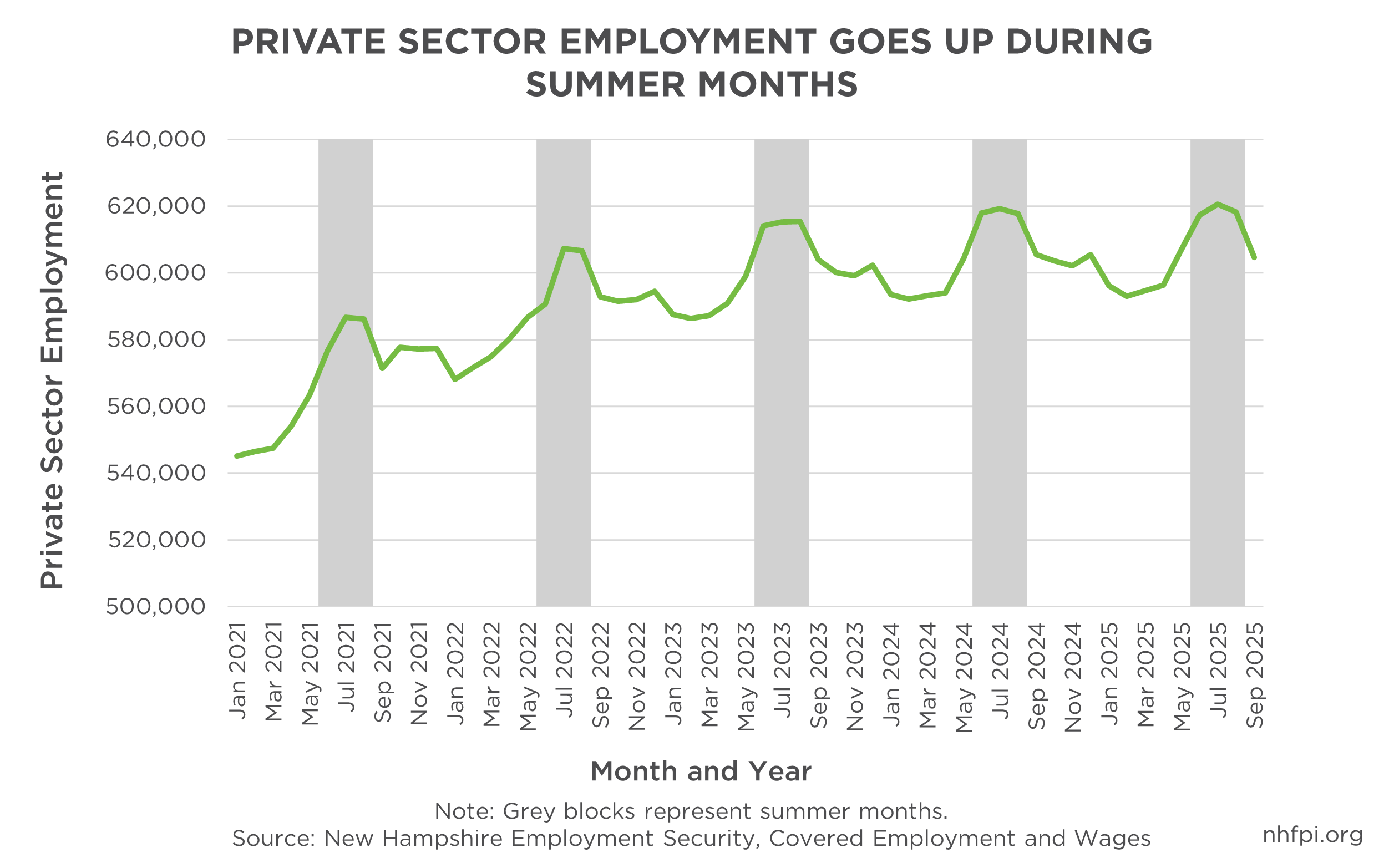
New Hampshire experiences seasonal hiring patterns, particularly during the summer months of June, July, and August. Industries including and related to tourism, recreation, hospitality, retail trade, and construction all see significant bumps in hiring. This seasonal pattern has disproportionate effects in areas where the local economy is closely tied to summer travel, restaurants, hotels, seasonal attractions, camps, and recreation businesses. Recent employment data offers insights into how seasonal hiring patterns may be changing across the Granite State.
Private-Sector Employment Rose, but Less Than the Historical Average
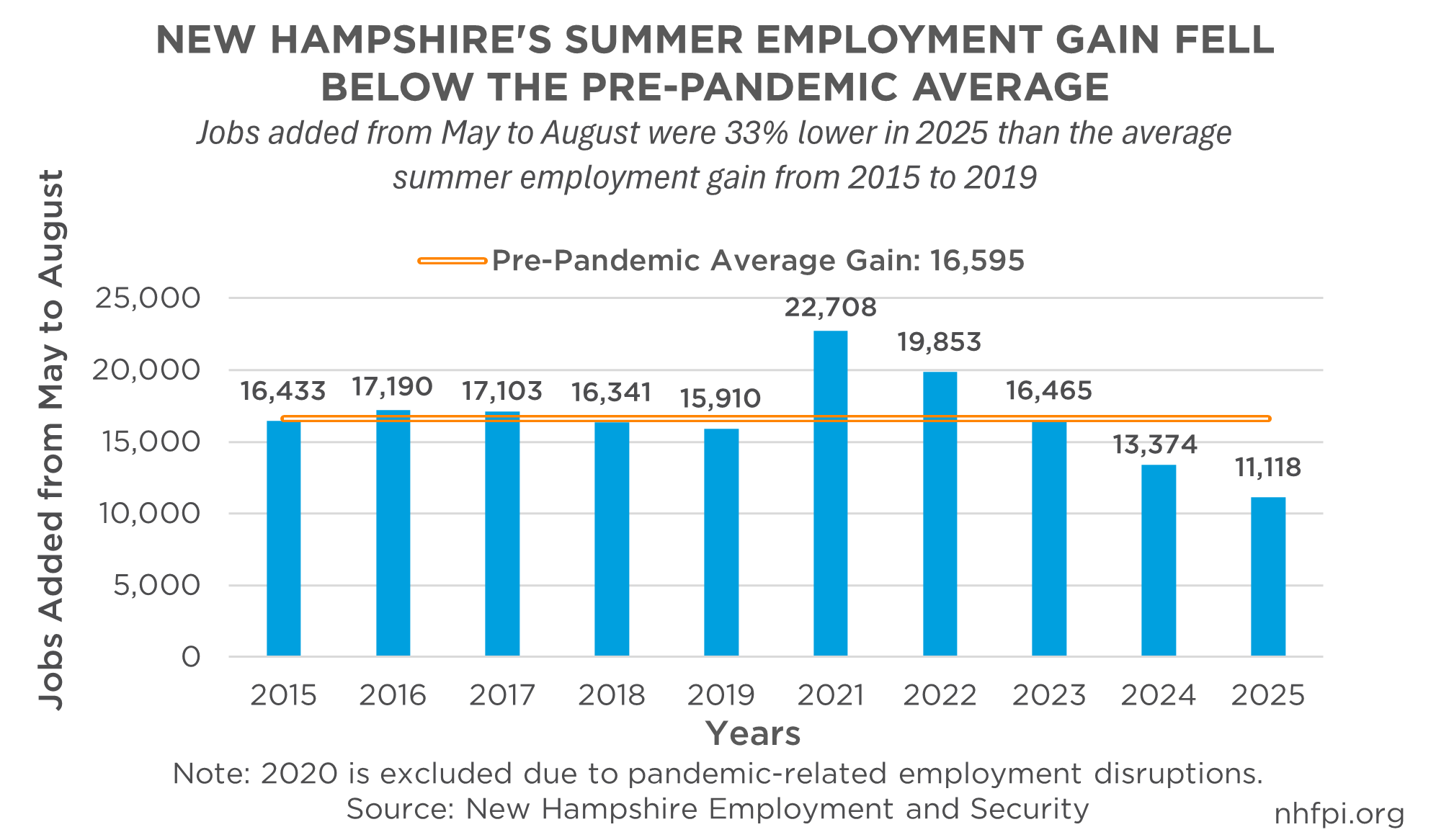
According to the New Hampshire Employment Security data based on participation in the State’s unemployment compensation system, private-sector industries grew during the summer of 2025. Total private-sector employment increased by 11,118 jobs from May to August 2025. That gain was smaller than the increase in 2024 and smaller than the previous decade of summer increases. From 2015 to 2024, excluding 2020 due to the pandemic, the average May-to-August employment gain was an estimated 17,264 jobs added. The 2025 gain was 6,146 jobs added.
Measured as a percentage change, private-sector employment increased 1.8 percentage points in summer 2025. That increase was 17 percent smaller than the 2024 percentage gain of 2.2 percentage points. It was also below the 2015 to 2024 average of about 3.0 percentage points, excluding data from 2020.
The smaller summer increase follows a broader moderation in the State’s labor market. After the fast-growing labor market rebound in 2021 and a shortage of workers relative to employment opportunities in 2022 and 2023, employment growth slowed in 2024 and 2025. The summer employment bump remained present, but the scale of the increase was less pronounced. After 2023, summertime employment increases have been smaller than the pre-pandemic average, and have decreased each year since 2021.
Hospitality and Recreation Produced the Largest Seasonal Gains
The largest summer employment increases in the State were closely tied to tourism and recreation. Accommodation and Food Services experienced the strongest seasonal growth, adding 6,906 jobs as restaurants, hotels, bars, and other hospitality businesses expanded staffing levels for summer tourism activity. That was an 11.4% increase in filled jobs during June, July, and August. However, this percentage increase was below the ten-year average (excluding 2020) of 13.4%.
Arts, Entertainment, and Recreation had the next largest increase in the number of filled positions, adding 2,934 jobs as seasonal attractions, outdoor recreation businesses, camps, and entertainment venues increased hiring during some of the busiest travel months of the year. This increase was almost 5% less than 2024’s increase, and about 37% less than the ten-year average. Arts, Entertainment, and Recreation has seen the biggest percentage gain in general of these four industries, increasing almost 50% from May 2015 to May 2025.
Construction saw the third-highest increase in summer employment in 2025, as the warmer months may have allowed for more building and maintenance activity. Construction has been consistent across summers in the last ten years. In 2025, Construction added 921 jobs, a 2.8% increase. Overall construction employment has gone up 33% from 2015 to 2025.
Retail Trade employment in New Hampshire peaked in 2006, and has changed unevenly during a long-term decline in the last 20 years. In May 2015, Retail Trade had 94,313 employees, and by May 2025, that figure dropped to 89,148, a 5% reduction. Employment in Retail Trade still increased in summer 2025, but that increase was relatively small, rising 876 jobs, only 1%, between May and August. That increase is 47% smaller than its ten-year average.
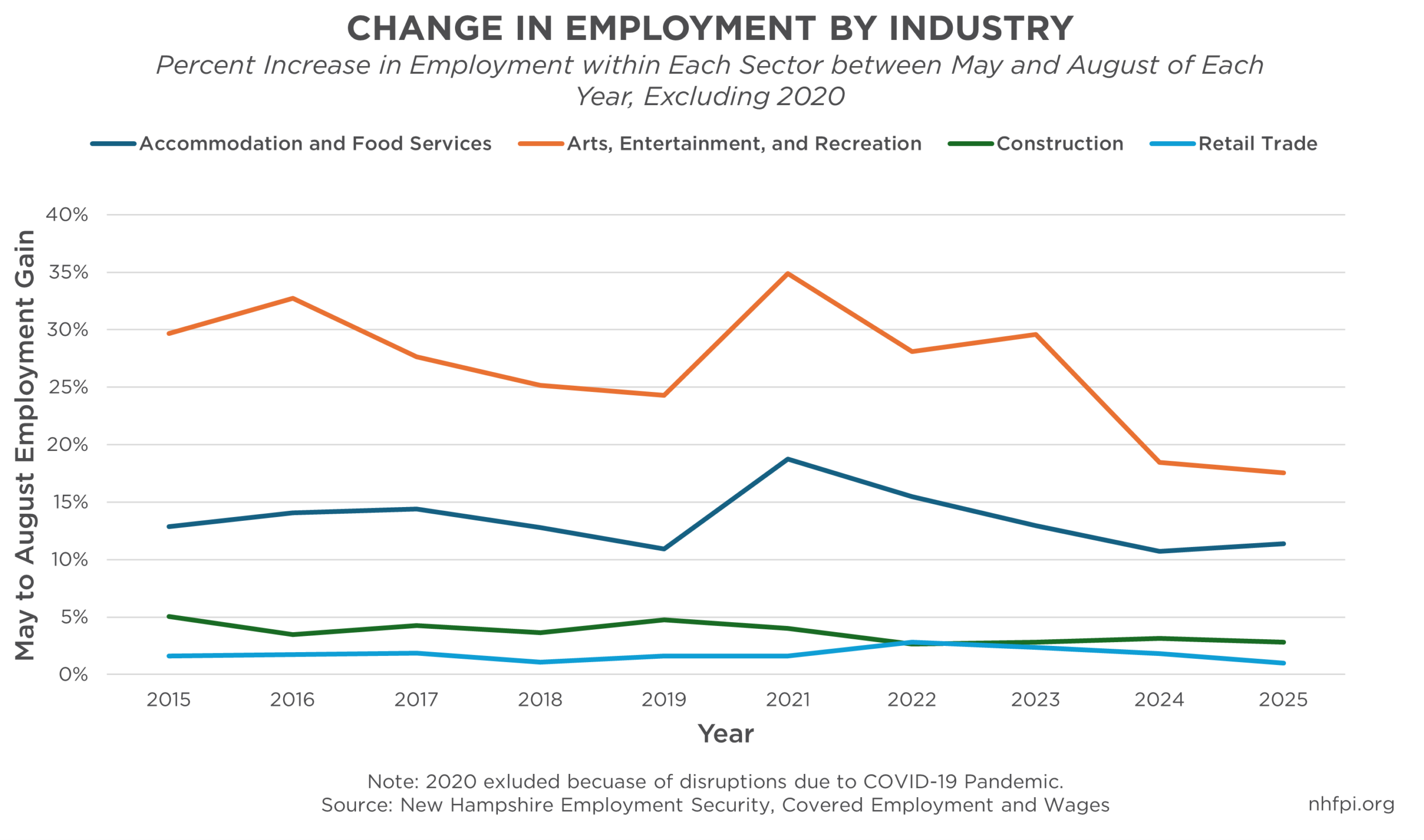
Each of these industries experienced smaller average summer employment bumps in 2025 compared to the historical average. The increase in the number of people employed in Retail Trade during the summer was half the 2015 to 2024 average. Retail Trade has also fallen from the third industry with the most added employment in summertime to fourth, with Construction replacing Retail Trade. Accommodation and Food Services still produced the largest seasonal hiring gains overall, but summer growth was weaker than the long-term pattern. Construction remained comparatively stable and closest to its historical seasonal trend.
Slower Summer Hiring May Reflect Labor Supply and Cost Constraints
Overall, the data show that New Hampshire’s summer labor market is heavily influenced by tourism-related industries and outdoor seasonal economic activity. The 2025 data suggest that these influences may be changing over time.
The 2025 data do not show whether weaker summer hiring was primarily caused by lower employer demand, limited labor supply, higher operating costs, or changes in visitor spending. The smaller increase may reflect several concurring factors.
New Hampshire’s labor force remains constrained, with relatively low unemployment, and high housing costs in many communities in the state, including those with economies more reliant on tourism. Seasonal businesses may face difficulty finding workers who can live near major visitor destinations. Employers that rely on temporary or visa-based seasonal labor may also face staffing limits if labor availability or federal processing timelines restrict hiring.
Consumer spending patterns may also have changed. Higher prices for housing, transportation, food, and other necessities can affect household budgets and discretionary travel spending. Visitor spending may remain high in dollar terms from year to year, but the change in the value of the dollar with inflation may mean consistent spending is the result of higher prices, rather than increased real economic activity. Businesses facing higher labor costs may also operate with less staff.
New Hampshire’s employment data shows that the state still has a summertime expansion in jobs, but that the gains have not been as large as in past years. Tourism-related industries remain important for added employment during the summer, but analysis from New Hampshire Employment Security estimated that overnighting Canadian visitors from Quebec to the United States were at least 25% lower between March and December 2025 than the same month in 2024, and day trips were at least 30% lower during the February to December period. Overall spending at hotels and motels in New Hampshire remained flat between 2024 and 2025, after growing annually during the years since the pandemic and between 2011 and 2018.
Whether the slower summer hiring growth observed in 2025 represents a temporary shift or is part of a longer-term trend remains unclear. However, as New Hampshire enters another summer tourism season in 2026, the data highlights how workforce availability may increasingly shape the ability of businesses and local economies to fully benefit from peak seasonal economic activity.
Ben Reynolds is a senior policy analyst at the New Hampshire Fiscal Policy Institute, a nonpartisan, independent research nonprofit that examines issues related to the state budget, the economy, health care, housing, and more.