
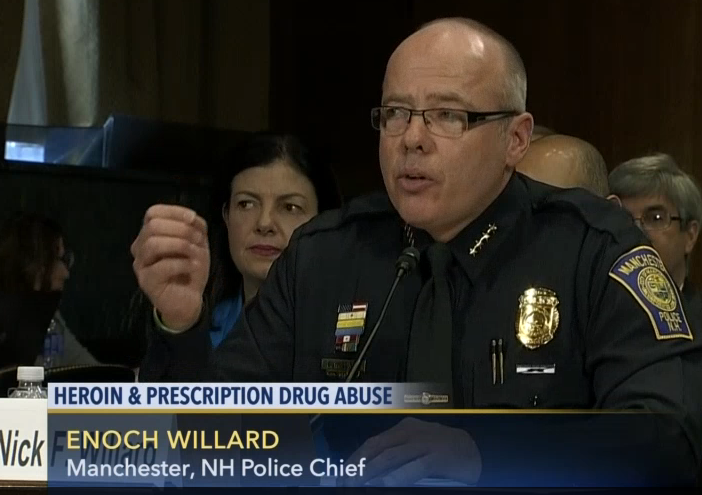
MANCHESTER, NH — Manchester Police Chief Nick Willard delivered a strong message to lawmakers in Washington, D.C. Wednesday.
He kept it short and sweet, but what he said, he said on behalf of the citizens of Manchester — and also on behalf of his officers, who are becoming battle weary from the relentlessness of this city’s drug scourge.
They are on the front lines of an escalating battle against heroin addiction, with no relief in sight.
Willard said the opioid crisis in Manchester is threatening the morale of his officers and eroding the quality of life for all [see his full prepared remarks below.]
Willard did go off script a little when addressing the committee, first by doing a little damage control by balancing the drug crisis against New Hampshire’s beauty and its citizens’ “vibrancy” (and encouraging tourism during the political primary season.)
“I don’t want to give the impression that New Hampshire is falling into the abyss,” Willard said.
But he also had strong words about what he’s been a witness to.
He criticized the actions of actor Sean Penn’s as reported in Rollingstone for “romanticizing” drug kingpin “El Chapo,” He called the U.S border at Mexico “a sieve.” He said his department intends to go after “dirty doctors” who perpetuate the cycle of addiction through over-prescribing pain meds.
Willard praised the efforts of Mayor Ted Gatsas, and the future of treatment for those suffering in Manchester through Hope for New Hampshire Recovery‘s 24-hour peer-support community recovery center. He said he believes it will set a new standard for addiction treatment and recovery, and allow his officers to bring addicts someplace where they can get help, rather than a jail cell.
Willard was invited to speak before a special Senate judiciary committee Jan. 27 by U.S. Sen. Kelly Ayotte, R-NH, to discuss passage of the Comprehensive Addiction and Recovery Act (CARA Act) S.524/H.R.953, a bill introduced by Ayotte.
⇒WATCH THE HEARING NOW ON C-SPAN
During her remarks, Ayotte called the heroin crisis “the most urgent public health crisis facing my state,” and “like nothing she’s ever seen.”
The key provisions of the bill include:
- Expand prevention and educational efforts — particularly aimed at teens, parents and other caretakers, and aging populations — to prevent the abuse of opioids and heroin and to promote treatment and recovery.
- Expand the availability of naloxone to law enforcement agencies and other first responders to help in the reversal of overdoses to save lives.
- Expand resources to identify and treat incarcerated individuals suffering from addiction disorders promptly by collaborating with criminal justice stakeholders and by providing evidence-based treatment.
- Expand disposal sites for unwanted prescription medications to keep them out of the hands of our children and adolescents.
- Launch an evidence-based opioid and heroin treatment and intervention program to expand best practices throughout the country.
- Launch a medication assisted treatment and intervention demonstration program.
- Strengthen prescription drug monitoring programs to help states monitor and track prescription drug diversion and to help at-risk individuals access services.
U.S. Sen. Jeanne Shaheen, D-NH, also spoke briefly, reminding the committee about the great investment our country made in response to recent ebola and swine flu threats, which by comparison, had little to no human toll.
The conversation throughout the several-hour hearing also touched on:
- The overall lack of meaningful treatment availability across the country for addicts, a phenomenon that would not be deemed acceptable in dealing with any other chronic illness.
- How to get “dirty doctors” who over-prescribe to regulate the worst offenders within the profession, including whether drug-monitoring should be made mandatory, given the general lack of voluntary participation.
- Training of medical students on the addictive nature of painkillers and proper management of substance abuse disorders.
Perhaps the most dramatic — and pointed — testimony came from Vermont Gov. Peter Shumlin, who has led the charge for treatment in his state, and famously devoted his entire State of the State address in 2014 to heroin.
Shumlin began with the need for money and physicians to meet the need for treatment centers and qualified medical help.
“As we build out treatment centers, the challenge is getting enough primary care doctors to deal with the illnesses we’re all facing. We don’t have an extra physician force to deal with the magnitude of treatment necessary to deal with this crisis,” Shumlin said.
He also made the case for allowing nurse practioners and physician assistants to be able to legally dispense “maintenance drugs” to help addicts in treatment. Shumlin said it made no sense that non-physician practitioners are allowed to dole out addictive opioid painkillers but not medications that would be considered treatment for addictions, Shumlin said.
And then, Shumlin asked the million-dollar question: “Why are we in this mess? Why are all 50 states on a bipartisan basis saying we need help? This is everybody saying they need help. I think we have to have a more honest discussion about what led us into this mess,” Shumlin said.
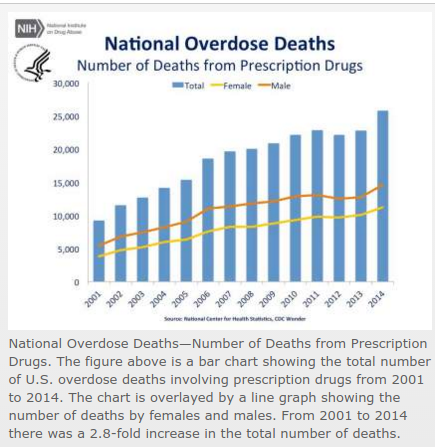
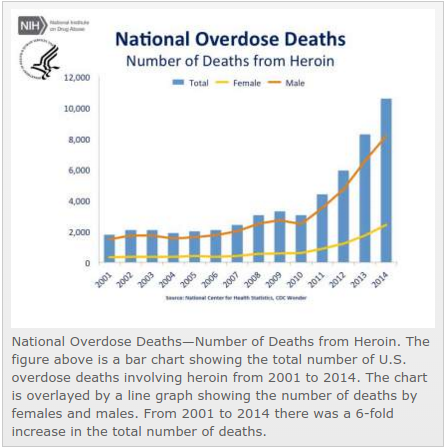
He said the argument that this scourge is coming to us from drug pushers south of the U.S border or elsewhere outside of the country falls flat; drug smuggling is nothing new. Meanwhile, four out of five heroin users report that they started with an oxy addiction.
“What changed was we changed our attitude in America and our practices in the late 1990s in how we deal with pain. Why aren’t we talking about that? I have a lot of hope about where we’re headed, but I’m discouraged that we have more people signing up for opiate addiction treatment in Vermont than two years ago, when we started,” Shumlin said.
He pointed a finger at Perdue Pharma, who pleaded guilty for misleading physicians into thinking that oxycodone was not addictive, and paid a $634.5 million fine nearly nine years ago. Yet, they continue to make more than $3 billion in annual revenue, to this day, primarily from oxy.
“In 2010 we prescribed enough oxy to keep every person in America high for a month. In 2012 we wrote 250 million prescriptions of oxycontin… that’s just about one prescription for every living American,” Shumlin said.
“I ask us to pause, take a deep breath, and ask this question: Are we willing to have an honest conversation about how we’re dealing with pain in America? Otherwise it will lead to more tragedy, and more loss of life. That is what has changed. We simply pass out painkillers like candy in America, and we’re unwilling to have that conversation.”
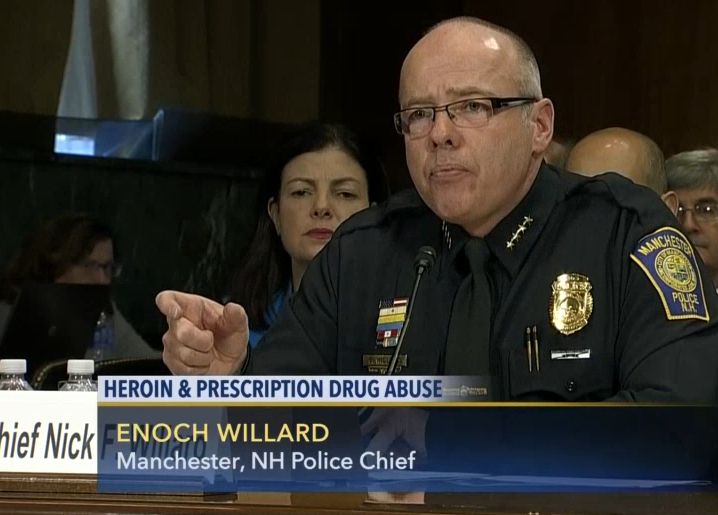
Below is the full testimony given by Willard before the U.S. Senate Committee on the Judiciary (or link here):
“Attacking America’s Epidemic of Heroin and Prescription Drug Abuse”
“Thank you for the invitation to appear before the committee today.
It is an honor to be able to share with you what my officers are dealing with on a daily basis with regard to the abuse of prescription opioids and heroin. In addition, the role of fentanyl in fatal overdoses is truly alarming.
I first want to thank Senators Whitehouse, Portman, Ayotte, and Klobuchar for their leadership on the Comprehensive Addiction and Recovery Act. What law enforcement needs is a comprehensive and sustained approach to help prevention efforts, improve treatment, support for individuals in recovery, and adequate resources for state and local law enforcement who are on the front lines of this public health and safety crisis every day. This bill represents a huge step in the right direction, and I hope the committee will pass this legislation.
In 2013, the City of Manchester had 14 fatal overdoses, 30 percent of which were heroin and 7 percent of which were heroin mixed with fentanyl; in 2014, we experienced 19 fatal overdoses, of which 22 percent were heroin and 22% were heroin mixed with fentanyl. 21 percent were strictly fentanyl; and in 2015 we suffered 69 fatal overdoses with a staggering 33 percent being straight fentanyl, 26 percent fentanyl mixed with cocaine and another 9 percent fentanyl mixed with heroin.
Our citizens are dying because of the synthetic fentanyl that is being produced in clandestine labs in Mexico by the Sinaloa cartel.
The poison the cartel is putting on the streets of America is an affront to our way of life. Not only is it taking lives, it’s deteriorating communities, devastating families, and leaving children without parents. Some of these children are finding their parents who fatally overdosed.
Fentanyl is so dangerous, that I have instituted strict handling procedure to protect our officers from being exposed to a potential overdose simply by absorbing it Senator Ayotte noted in her testimony the Stop Trafficking in Fentanyl Act, which would bring parity to the penalties for trafficking in heroin and the much more deadly fentanyl. I encourage the committee to pass this bill, which would enhance law enforcement’s efforts to remove fentanyl from our streets and more appropriately prosecute those who are trafficking it.
When I took over as Chief of Police in July 2015, I expressed that two of my top priorities were to deal with our city’s heroin and fentanyl problem and to support and boost morale among the ranks of the Manchester Police Department. These two priorities are effectively interrelated at this point— my officers are out there every day trying to save lives and make our community safe, and today far too often fentanyl and heroin are the direct or indirect cause of any one public safety or health issue in Manchester.
In 2013, officers responded to 166 overdose calls for service; in 2014, 406; and in 2015, they responded to 616. Each one of those numbers is a person. Each one of those numbers represents time in which the officer is tied up. Each one of those numbers taxes the resources of our public safety professionals, police, fire and EMS.
After previously testifying in front of Senator Ayotte and Senator Shaheen, we created the first OCDETF strike force to go after the high level producers of the poison that is taking American lives.
Locally, I’ve invited the DEA and NH State Police to partner with MPD and work collaboratively in Manchester to target the low-level drug dealers who directly affect the quality of life in the neighborhoods in which they are dealing drugs.
We’ve conducted six of these operations thus far making 62 arrests, seizing 604 grams of heroin and a large quantity of other illegal drugs. Just recently the Manchester Police Drug Unit seized over 500 grams of pure fentanyl. This past summer MPD seized over 27,000 grams of heroin and fentanyl in just one investigation, whereas in all of 2014 MPD seized 1,314 grams of heroin.
These numbers are truly staggering and beyond my capacity to truly understand how enormous of a problem we have. The addiction pool needs to shrink to lessen the demand, but the supply, most urgently, needs to be reduced with greater interdiction efforts. Drug abuse is undoubtedly taking a toll on our city. Every single day, my officers are dealing with overdose victims. They are dealing with drug traffickers. There’s also the intangible “quality of life” issue that drug abuse presents to us.
It is the mission of the Manchester Police Department to serve the greater good by protecting life, property and the liberties of Manchester’s residents and the community at large. Sadly, the quality of life in Manchester is suffering from the scourge of prescription opioid and heroin abuse. We must do more and we must do it now. At the same time, we must recognize this problem for what it is: a public safety and a public health issue. It certainly has been said before, but we won’t be able to arrest our way out of this problem. Treatment and support for recovery are critical to our work in law enforcement.
Last summer, the City of Manchester launched a comprehensive plan to help confront this epidemic. One part of that plan was to develop a continuum of care by mapping all community assets devoted to drug-addiction and allowing someone struggling with addiction to enter the system at any point along the continuum.
We are making great strides. A 24-hour continuum of care facility will be opening in the spring, which will allow 24-hour access to care for anyone seeking treatment, while affording my department a more compassionate alternative to arrest. I will continue to be aggressive in my fight to rid the city of Manchester of drugs, while supporting the recovery and treatment community; this is not just a law enforcement issue, it’s a community issue, and as a community we will prevail through tireless action.” — Manchester Chief Nick Willard
 You’re one click away! Sign up for our free eNewsletter and never miss another thing.