MANCHESTER, NH – During their April 2026 meeting, the Manchester Zoning Board of Adjustment (ZBA) denied a set of variance requests for a proposed housing complex at the end of Woodland Avenue, a street immediately to the west of the Hannaford Plaza on Hanover Street.
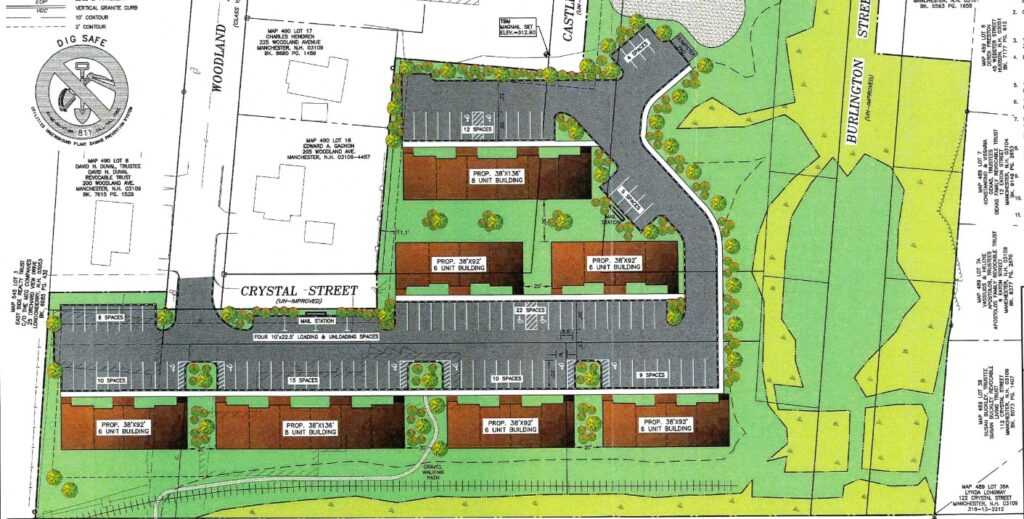
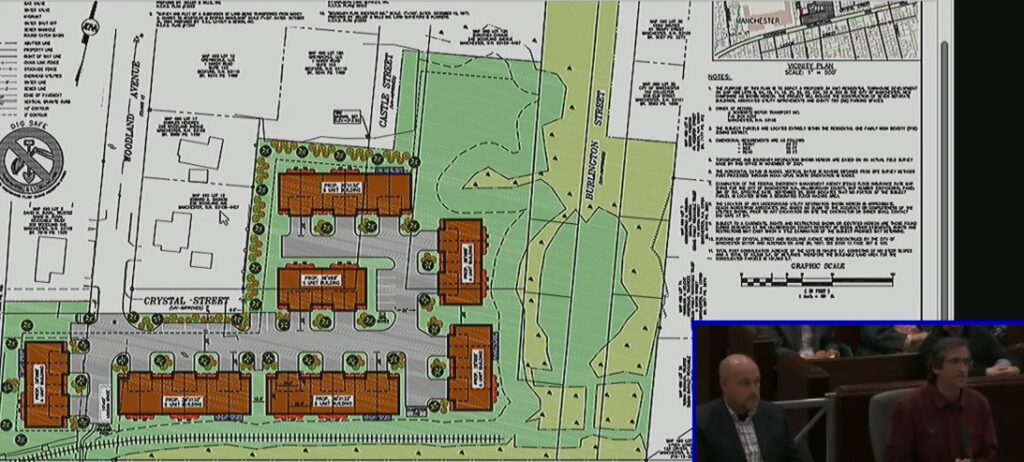
The proposal bought forward by Ryan Filion of Woodland Ave. LLC sought to place 34 dwelling units at the corner of Woodland Street and Crystal Street in what was once a small company called J. Schwartz Motor Transportation which now houses an abandoned warehouse and several remaining freight trailers. Among the 34 units, 18 of them would be split between three six-unit and four four-unit townhouse buildings. This proposal serves as a stripped-down version of a request for 46 units on the property that was tabled by the ZBA in February.
Engineer Matt Peterson of Keach-Nordstrom Associates introduced the revised proposal to the board, noting that the feedback given helped create this smaller and more neighborhood-like proposal after numerous redrafts. Peterson also noted that each unit would also have its own garage, significantly reducing the amount of parking spaces in the proposal. The new proposal also no longer had any buildings over three stories tall, eliminating the need for a variance there. However, variances were still needed from the city’s old zoning ordinance regarding single-family attached townhouse dwellings, minimum lot frontage and width (two counts), parking setbacks, parking screening, landscaping and fence height.
Attorney Chris Swiniarski of Devine Millimet, speaking on behalf of the applicant, built upon Peterson’s testimony, noting that the change from rental units to owner-occupied units along the design changes to create a less “transient” feel, also mentioning the severe shortage of housing in the city.
“This process really put us through our paces and really made us explore every possibility of what we could do here, and this is the result of that process,” said Swiniarski.
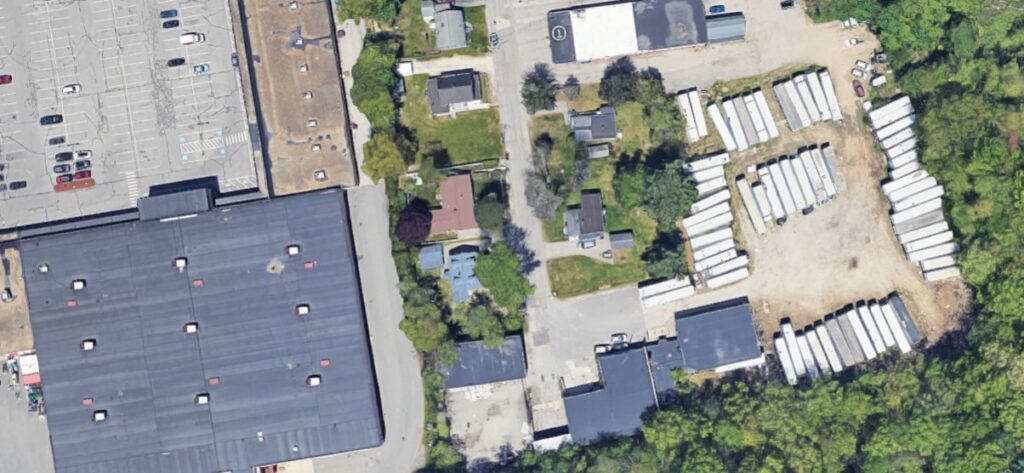
Although other homes on the street are single-family houses, it was noted by representatives of the applicant that duplicating that style of construction on the J. Schwartz property would not be financially viable.
While one audience member did speak in favor of the proposal, testimony was still heavily in opposition even if some neighbors appreciated the fact that the applicant’s attempts to modify their proposal.
Neighbors opposing the project expressed concerns with added traffic, the ability of fire trucks to make turns in the development and the density of the proposal overtaxing a local water system that is already struggling to keep up with demand as well as wetland areas near the property.
New Hampshire State Representative Kathy Paquette (R-Manchester) represents residents of the street in Concord and noted that nearby streets already face frequent flooding and the Manchester Department of Public Works already estimated that existing sewer infrastructure in the area is operating at 118 percent of capacity and any relief from the Christian Brook combined sewer/stormwater outflow project would not impact the area until 2037.
“At its core, this project takes land that is zoned for single-family homes and attempts to transform it into a dense, multi-unit townhouse development. That’s a significant shift in use and intensity, and it deserves careful consideration. This is not simply a matter of design. It’s a question of whether this site is appropriate for this level of development,” she said.
Members of the board generally felt that the proposal was an improvement over the version seen in February, there were also still concerns with the fact that the property is in the R1 zoning district, a type of district for single-family homes, even though the light industrial use formerly on the property had been grandfathered in since it was in place prior to the city’s first zoning ordinances in the 1920s.
“R1, it’s a low density (district), it’s not this. So, when I look at the spirit of the ordinance, this isn’t the spirit of the ordinance. The spirit of the ordinance wants to maintain the intensity in some capacity,” said Zoning Board Vice Chair Craig St. Pierre. “What we’re seeing here is more than a tripling of the use of this road.”
A motion to deny the variance request passed by a 3-2 margin. St. Pierre was joined by Kathryn Beleski and Matthew Carnevale. Chair Robert Breault and Nick Taylor opposed the motion to deny the variance.