
INK IN THE WILD
By John Angelo
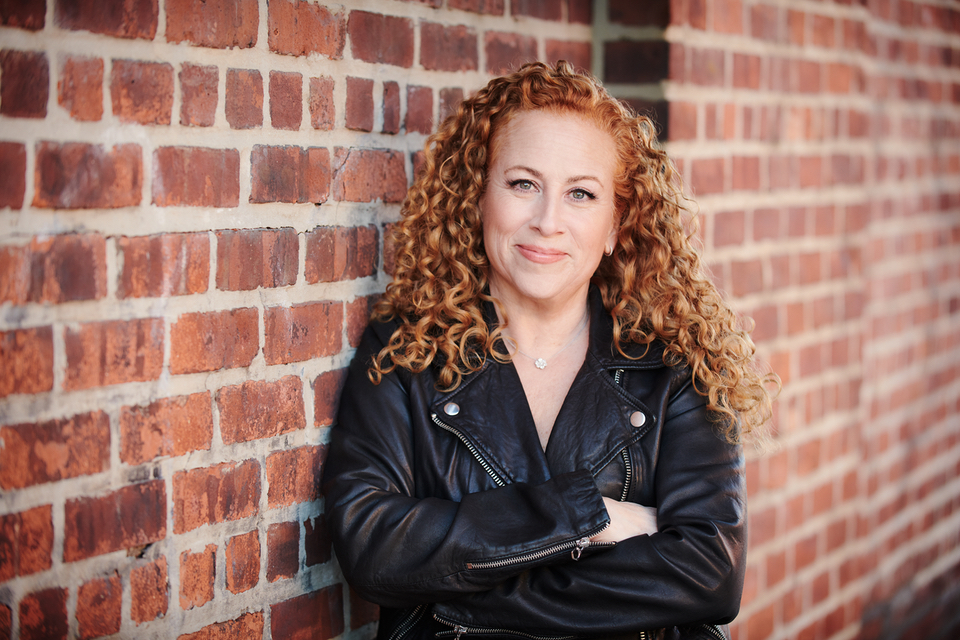

New Hampshire author Jodi Picoult is both talented and prolific. She’s penned short stories, 30 novels including two young adult books with daughter Samantha Van Leer, Mad Honey with Jennifer Finney Boylan, plays, musicals and five issues of DC Comics’ Wonder Woman. She recently wrote a stage adaptation for the musical The Book Thief which opened in London this past November. The highly popular 2005 young adult novel by Markus Zusak was made into a brilliant 2013 movie. There is jodipicoult.com and a Jodi Picoult Junkies Facebook page for those who can’t get enough.
Picoult’s books have sold over 40 million copies in 34 languages. This is the best of times for the author. Wonder Woman, indeed. She’s the recipient of the New England Booksellers Award for Fiction, New Hampshire’s Literary Award, and Cosmopolitan Magazine’s award for Fearless Fiction. And the honors beat goes on…Picoult was named in 2018 as one of Princeton’s 10 most influential living alumni. Partial company is Michelle Obama and Jeff Bezos.
New Hampshire Magazine described her writing in 2011: “As well as offering stylistic impact and emotional clarity, her books weave in controversial themes, often in such a prescient manner that they seem to lead the public debate.”
The keystone to Picoult’s writing is research. Her website describes her style as “meticulous.” She’s visited Arizona’s death row and execution chamber, spent a week on an Amish farm, studied the Gnostic gospels, trailed a sled-dog race in Alaska, and spent time with a wolf whisperer. She leans on lawyers, doctors, psychiatrists, pathologists, detectives and a DNA scientist as needed.
I’ve chosen to focus on the author’s 2007 14th book, Nineteen Minutes. The novel’s plot turns on a school shooting at Sterling High School in Grafton County, New Hampshire. For the book, Picoult spoke with survivors of school shootings and consulted with law enforcement who investigated 1999’s tragic Columbine shooting.
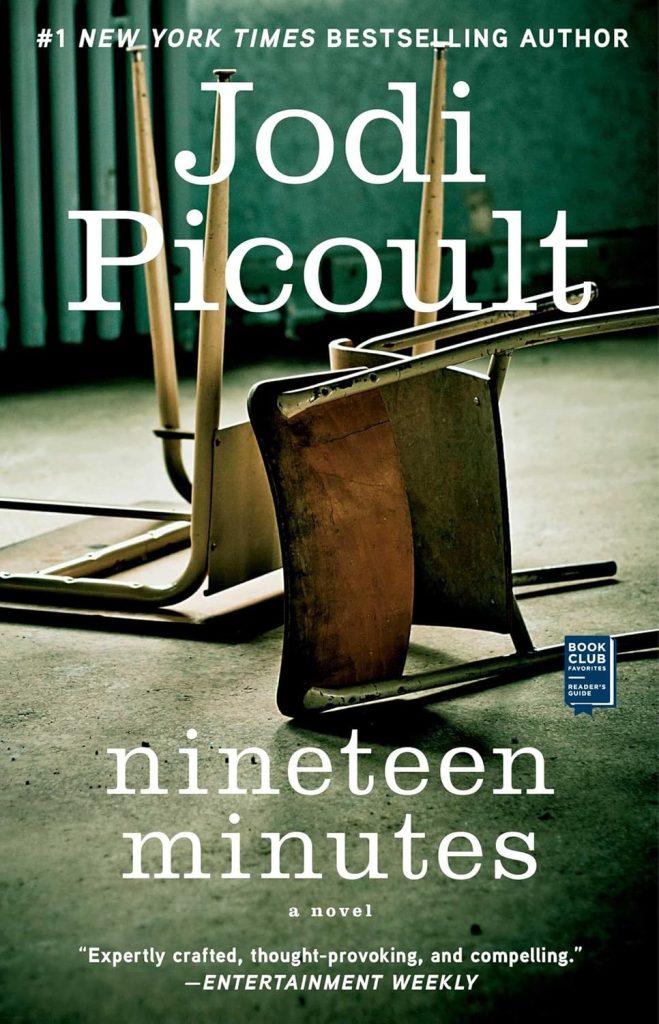
But research alone doesn’t make a novel a best seller. The author has a turn of phrase that perfectly captures a scene or situation. Nineteen Minutes’ Lacey Houghton, the shooter’s mother, is a midwife: “Newborns reminded her of tiny Buddhas, faces full of divinity.” Another example: “The magazines in Jordan’s dentist office had the shelf life of plutonium.”
The author and activist joined the board of VIDA: Women in Literary Arts, a decade ago. The organization seeks to remedy the gender discrepancy that strongly favors men in the publishing world. VIDA’s core mission is “to amplify historically marginalized voices.” From Maya Angelou’s I Know Why the Caged Bird Sings (race and statutory rape survival), to Margaret Atwood’s A Handmaid’s Tale (dystopian religion), to Boylan’s She’s Not There (gender-affirming surgery), voices are begging to be heard.
Picoult’s 2024 novel By Any Other Name takes on sexism. In 1581, Emilia Bassano, a mistress to British royalty and a lover of theater, decides to pay a man for his name so that she can see her work performed on stage. That man is known to history as William Shakespeare. 400 years later, Melinda Green, a descendant of Bassano, finds herself with the same dilemma. How much will she compromise?
Martin County, Florida, has banned 20 of Picoult’s books. To challenge a book in the county, a parent doesn’t need to read the book or even reveal what they find offensive. A challenge gets the book removed from a school library until it can be evaluated, in most cases by a school board. This could take until the twelfth of never. In 2021-22, there were 2,532 challenges in the state. In 2023-24, there were 4,295. One parent recently filed 92 challenges. According to Deborah Caldwell-Stone, the American Library Association president, about one-half of challenges result in bans. Books dealing with people of color (44 percent) or LGBTQ+ people (39 percent) are the most banned subjects. The extensive challenges and bans make it the worst of times for Picoult and her social justice themes.
“Books bridge divides between people,” Picoult has said. “Book bans create them.”
Challenges now come from organized political organizations. Moms for Liberty has 165 chapters in 33 states. There are two in New Hampshire, one each in Hillsborough and Rockingham counties. Moms for Liberty put a $500 “bounty” on New Hampshire teachers in 2021 found guilty of teaching “divisive concepts,” whatever that means. No Left Turn in Education was formed by parents objecting to K-12 “radical indoctrination” after the murder of George Floyd. There is a New Hampshire No Left Turn Facebook page with stated objections to Critical Race Theory and “Transgender Indoctrination” in schools.
“The process of review is very muddy,” Picoult says on her website. “Having the most banned book in the country is not a badge of honor. It is a cause for alarm.”
Above, a post from Jodi Picoult’s Instagram account after Gov. Kelly Ayotte vetoed a statewide book ban.
I was most of the way through Nineteen Minutes before I learned that it was the author’s first book to debut at number one on the New York Times best-seller list, is ranked her second best novel behind My Sister’s Keeper by Goodreads, and was the most banned book in school libraries in 2023-24 according to PEN America, a non-profit founded in 1922 to ensure free expression.
“Narrative erasure is a kind of psychic violence,” says Dr. Sayantani DasGupta, a pediatrician, children’s book author, and founding member of Authors Against Banned Books.
Nineteen Minutes, like most of Picoult’s works, tackles a tough moral issue. Her characters struggle with what they think they know and what they then learn from a powerful event. A diced timeline containing chapters “Seventeen Years Before” and “Five Months After” is not my favorite way to read a book but the bookends of the story have the shooting early on and the trial at the end. There are several substantial and fully surprising twists in the trial testimony.
I’ll end discussion of books being challenged and banned, a topic Picoult is a passionate activist against, with her words from a 2024 BBC interview: “They [the challengers] have no problem with that [violent content]. The problem is that on page 313, I use the word ‘erection.’ “
Peter Houghton, the 17-year-old student and the school shooter in Nineteen Minutes, is eventually found guilty of eight first-degree murder charges and two-second-degree charges.
The mitigating circumstances leading to the pair of second-degree convictions are that Peter had been bullied, tormented, by Matt Royston and Courtney Ignacio and their extended alpha posses since first grade. His prized Superman lunch box thrown out the window of the school bus on day one. Its replacement crushed a week later beneath the same bus. Glasses stomped on. Faceplants into his locker. Always the last kid picked in gym class “…as if he were the punchline to a joke,” Picoult tells us.
In the days before the shooting, Matt pulls Peter’s pants and boxers down to his ankles in the crowded cafeteria. Courtney hacks into Josie Cormier’s computer and finds an email that Peter had sent to Josie, an old school friend, really his only friend, who he was trying to reconnect with. The email ended with: “Anyway, by myself, I’m nothing special. But with you, I think I can be.”
Things change from middle school, however. Josie is now Matt’s girlfriend but she ultimately sees he’s no prize. Rough sex turns into assault. In an act of cyber-bullying, Courtney blasts Peter’s email to the entire school after she hacks Josie’s computer. Some in the small town think Peter Houghton is evil. Others think the bullying made him snap. An enduring and heartfelt outpouring of grief for the victims.Tears. Anger. Flowers. Church services. Eulogies. For Peter, a single pebble of uncertain sympathy. Keep it or throw it back into the lake?
The FBI has learned there are common denominators in school shootings. The perpetrator feels that he has no allies, no status. Bullying is processed less on the physical and more on the humiliation. The shooter often has access to firearms, violent movies and disturbing video games. His initial harmful thoughts are of self injury. The shooter offers a tell online, to a person, or in writing, a signal to be taken seriously.
According to Picoult, she’s had hundreds of contacts saying Nineteen Minutes was the reason they hadn’t brought a gun to school.