
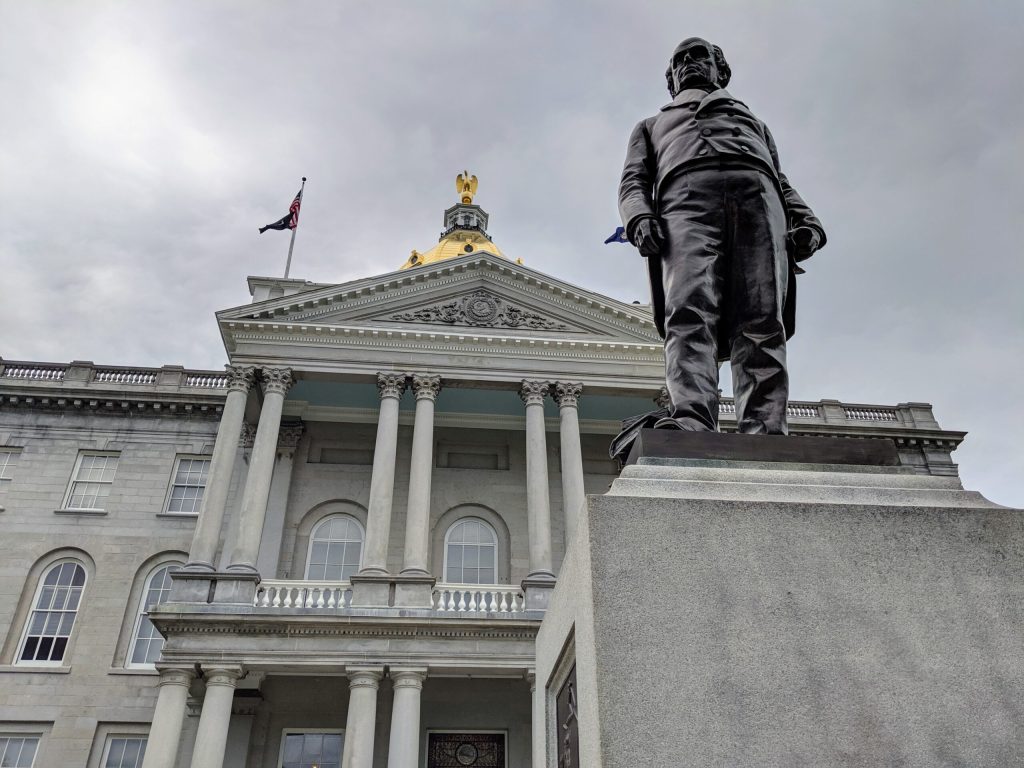
CONCORD, NH – Amid a spate of anti-trans legislation in the Statehouse this season was a bill that would have prevented transgender and gender nonconforming people in New Hampshire from freely participating in public life. It was vetoed by Gov. Ayotte Tuesday—a move being upheld by trans activists across the state.
“It’’s a big sigh of relief for all of us [in the trans community],” said Linds Jakows, founder of 603 Equality, an LGBTQ+ advocacy organization based in the Granite State. “I think it’s knowing that on the most basic level people are not going to be threatened.”
HB 148 would have drastically rolled back nondiscrimination protections for trans people in the state, reversing rights that were signed into law by Gov. Sununu in 2018. The bill was passed in the Senate in a 16-8 vote in May, and had been sitting on Gov. Ayotte’s desk since then.
Introduced by Wilton Republican Rep. Jim Kofalt, the bill, also known as the “bathroom bill,” would have paved the way for the separation of bathrooms, locker rooms and correctional facilities based on biological sex. Last year a similar bill was vetoed by Gov. Sununu, making HB 148 the second bill of its kind to be defeated in the legislature.
“I believe there are important and legitimate privacy and safety concerns raised by biological males using places such as female locker rooms and being placed in female correctional facilities,” Gov. Ayotte said in a press release Tuesday, explaining her decision. “At the same time, I see that House Bill 148 is overly broad and impractical to enforce, potentially creating an exclusionary environment for some of our citizens.”
Some Republican proponents, however, do not understand Gov. Ayotte’s reasoning behind the veto.
“I was disappointed. I think she was misguided on that,” said Rep. Alvin See, of Loudon, as previously reported in The Concord Monitor.
While Gov. Ayotte openly endorses several other anti-trans legislations—including the ban on trans girls from participating on girls’ teams in school sports—members of the trans community welcome her efforts in protecting Granite Staters against arbitrary discrimination.
“We are really thankful that she did the thing that’s going to keep people [the] safest, even if her reasoning wasn’t quite a ringing endorsement of trans rights,” Jakows said.
Fight for equal rights far from over
Even though anti-discrimination protections for trans people in the state remain safeguarded for now, the reality many live with is difficult, said Kamren Munz, Area Director of Residence Life at Southern New Hampshire University, who grew up in Manchester. They started receiving gender-affirming care in the form of testosterone-based hormone replacement therapy in 2020.
A former public school teacher in Nashua, Munz was forced to resign from their job for introducing the topic of preferred pronouns through a questionnaire in the classroom. They were targeted under the state’s divisive concepts law—that prevented teachers from freely discussing race and gender related issues inside classrooms—but felt like they were singled out because of their nonbinary gender identity.
“There was actually a lot of fear amongst the teaching staff and educator staff in general,” said Munz, who would introduce themselves as Mx. Munz—a gender neutral title—to their students. “…I was the only trans identifying educator in my school—I’m not sure about the district—but it definitely felt like a personal attack, especially by the parents or the families with students that you know were doing very well in the class.”
Munz said they are relieved the bathroom bill didn’t pass, especially because they have personal experiences in having hurdles accessing public restrooms all their life. In third-grade Munz was bullied by a few kids for entering the girls bathroom—an experience they said made them avoid using public bathrooms until freshman year of college, unless it was a dire emergency.
“I had always been looked at suspiciously whenever I used women’s restrooms, even before testosterone by just being a masculine presenting person,” they said. “In third grade, I was followed into the girls bathroom at school by two classmates, and they were giggling while I was in the school that there was a boy in the girls bathroom, and [said] they were going to tell a teacher.”
To Munz, the separation of bathrooms doesn’t make sense, and they believe it would only make those in favor of it more uncomfortable.
“[Under HB 148] more masculine trans individuals, or trans men would have been ‘forced’ to use the women’s restroom,” Munz said. “So, there was a part of me that thought, I will use the bathroom that [Republican lawmakers] want, and if anyone feels uncomfortable, that’s not on me.”
After facing mounting scrutiny from parents for discussing gender identity inside the classroom, Munz decided to end their decadelong career in teaching in July of 2022.
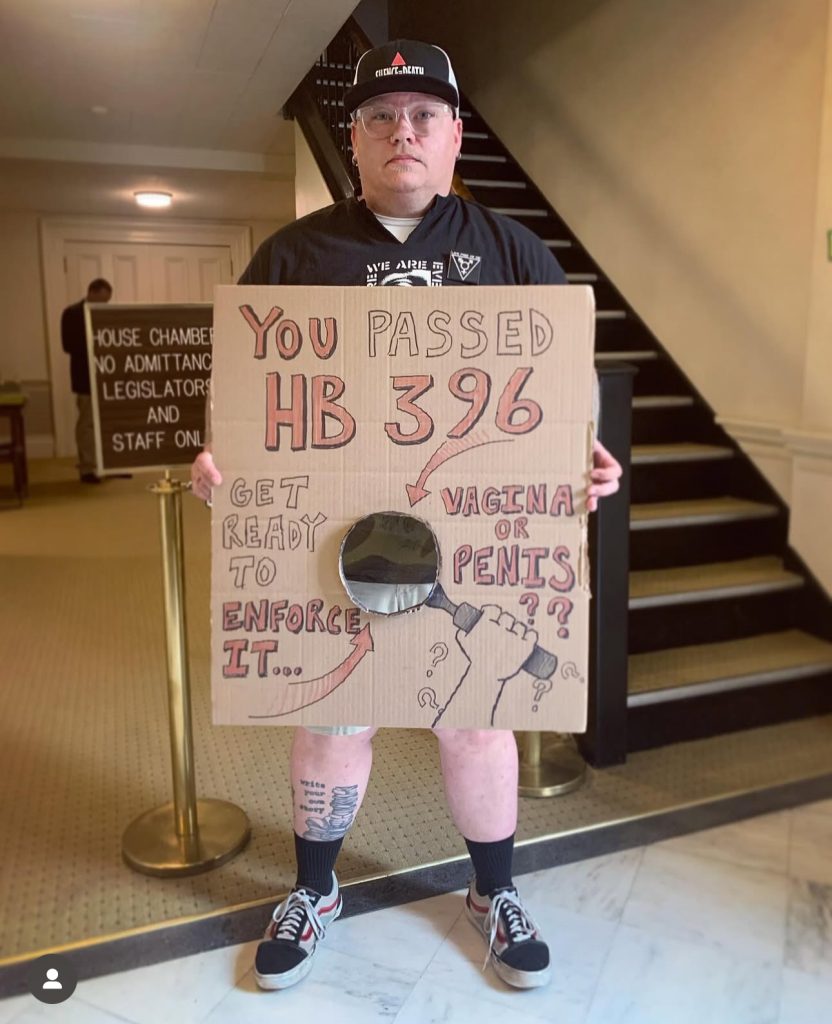
Munz, however, didn’t take that experience as dejection and in fact, involved themselves in activism and spreading awareness about LGBTQ+ rights through advocacy and creativity.
“I started going to Concord to do some activism work—holding signs, going to rallies, about two or three years ago,” they said. “I started attending public hearings on anti trans bills and testifying when I was able to take some time off from work.”
Munz said they were “happily surprised” by Ayotte’s decision, and gave themselves a day to celebrate before continuing the fight to protect other trans rights, especially access to gender-affirming care.
For Jakows too, the fight for equal protections doesn’t end with HB 148.
“We should celebrate a this reduction in harm, but it would still be absolutely devastating if [Ayotte] were to sign the two youth health care bans—HB 377, and HB 712,” Jakows said, highlighting the bills that would restrict access to hormone replacement therapy breast surgeries for trans adolescents in the state.”We cannot take our sights off of doing everything that we can to call for vetoes on those bills.”
Legislators will have another go at the bill later this year, if two-thirds majority in both the Senate and House vote in favor of overriding the veto.