
INK IN THE WILD
NH AUTHOR PROFILES
By John Angelo


I moved to Manchester in September, 1978, from the Connecticut flatlands. I was just in time to witness the dart-in-the-forehead angst of Red Sox Nation when Yankee Bucky Dent sent the Sox crashing in a flaming spiral, and then the publication by Viking Press of the novel The Dogs of March by Ernest Hebert.
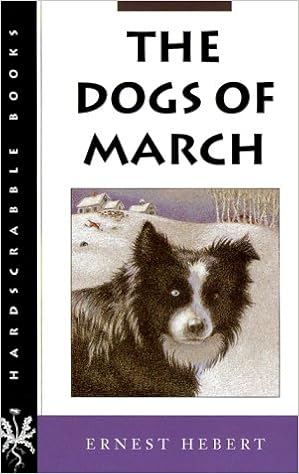
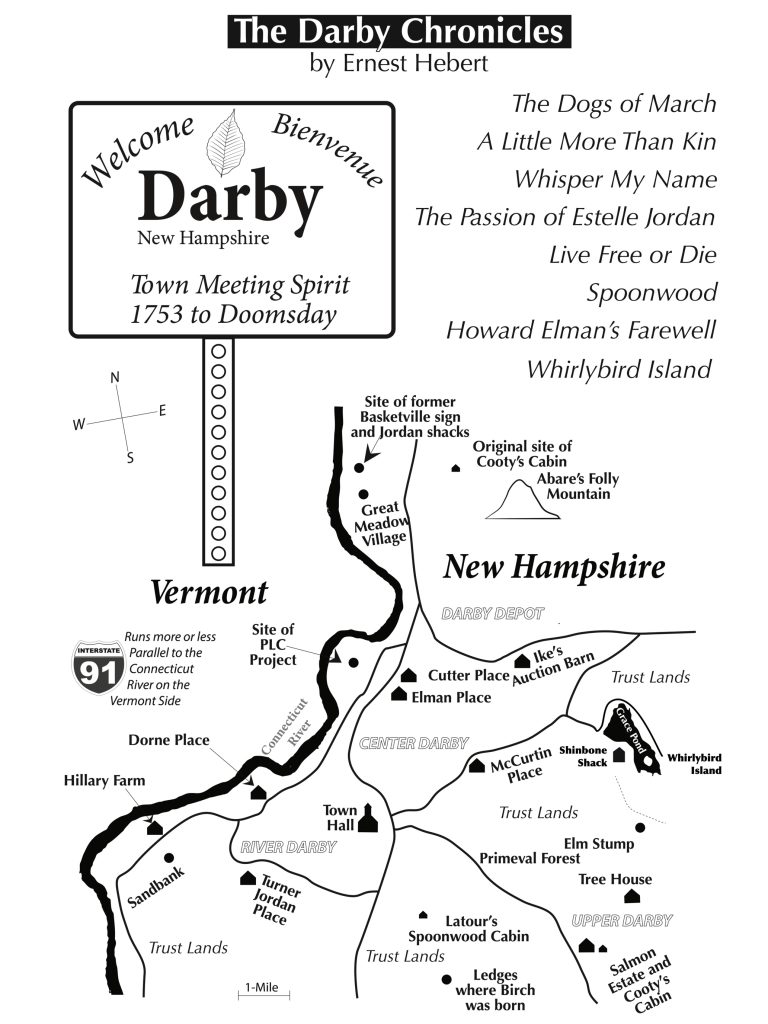
It was the first book in what would become the Darby Chronicles. The Dogs of March and Little More Than Kin, the second series book, pit Monadnock-area gritty beer-swilling locals against forces imbued with powers they don’t understand. In the former, Howard Elman, without work since the local factory closed, now has to deal with illness and no medical insurance. He also takes on new neighbor Zoe Cutter, who is intent on building a rural baubles, bangles and beads boutique, just like Fifth Avenue. She wants Elman’s property free of the fleet of dead parrot eyesores: rusted, still-leaking and moss-strewn junk cars. Her trump card is that she’s discovered the border between Elman’s property and hers isn’t accurate. She owns more. He owns less. Little More Than Kin pits Ollie Jordan’s constantly-stoked paranoia against his nemesis, the Welfare Department. He’s afraid the state will take away his mentally-retarded son Willow, prone to ascending New Hampshire’s Basketville billboard and tossing his clothes to the ground. Ollie and Willow have taken to a sanctuary tarp deep in the woods in what Jordan dubs Niagara Falls Park.
Darby has drawn favorable comparison to William Faulkner’s fictitious Yoknapatawpha County in Mississippi. It’s unclear if Faulkner ever saw a “Frost Heaves” sign or if Howard Elman ever picked off escaped family dogs running deer to their deaths on a crusty March Magnolia ridgeline.

Q: When did you decide The Dogs of March was only the first book in the Darby Chronicles?
A: (Hebert) I had it in the back of my mind to write a series well before I even wrote a novel. The year was 1969. I was in graduate school at Stanford studying to be a poet when I switched to fiction because I wanted to tell stories. One of my heroes was E. M. Forster, author at the time of five novels. I thought, if like Forster, I could publish five interconnected novels, I’d have a career that would satisfy me.
…I write because I believe my words are a conduit to a better self and to a connection with the Divine. It’s as if God, if there is one, is gifting me something close to wisdom and, dare I say it, a sense of fun. God fun.
Why a series? When I finished The Dogs of March, the work didn’t feel like a novel. It felt like one segment of many stories yet to be told.
Darby is a composite of small towns in the Monadnock region that I covered when I was a reporter for The Keene Sentinel.
Q: I recall The Dogs of March being reviewed in the New York Times Book Review. What was your reaction?
A: New York Times blurb: ‘By turns funny, poignant, appalling, (antihero Howard Elman lodges in the memory).’
Actually, the New York Times Book Review was anti-climactic. The most exciting review came before that in a glowing piece by Anatole Broyard in the daily New York Times. Rita Scott, my agent, called me and read it over the phone.
My reaction? Well, of course I was pleased. But, really, the biggest high in my lifetime occurred a year earlier, May of 1978, when at the beginning of the month, I learned that Viking Press had accepted The Dogs of March for publication. A few days later, May 9, my wife Medora gave birth to our first child, a daughter, Lael…What has stuck with me over the years is that the thrill of the birth far exceeded the thrill of publication.
Q: You were the first Dartmouth English professor who taught fiction writing to receive tenure. What did that mean to you?
A: College teaching was never a career for me. It was a job, but a job I took seriously and that I grew to revere. I discovered that I loved working with young people; also I grew to love Dartmouth. Little things like the wood paneling in Sanborn House, colleagues who knew more than I that I could learn from. [ Former student David Benioff was co-creator of HBO’s blockbuster series Game of Thrones].
Q: You’ve said, ‘I don’t begin with a story. I begin with a character.’ You describe Howard Elman, the protagonist in The Dogs of March, as being ‘tough and tender.’ Can you give examples of these characteristics in Elman?
A: The ‘tough and tender’ description comes from an inspiration that led me to Howard Elman’s character. One of my many jobs as a young man was pumping gas for Top Gas in Keene. One day a guy with hard eyes and a tough guy demeanor arrived in a pickup truck to gas up. He had a ‘Don’t Tread on Me’ look. But as he drove away, I noticed that he made eye contact with his young son in the passenger seat. I could see his face melt with love for the boy.
If I’ve portrayed Howard Elman correctly, a reader will conclude that Howard may be a horse’s ass but that he has a fearless streak and he’s willing to fight for what he believes. That’s the ‘tough’ part of him.
Howard feels tenderness toward his wife and children, but has a hard time showing it. Howard grows in tenderness through the Darby novels by the way he treats his slightly coo-coo friend and former Army buddy, the hermit Cooty Patterson.
Q: You said in an interview on Somersworth’s SomeCities TV segment The Creators several years ago: ‘It’s been my mission as a novelist to write about working people without idealizing or demeaning them. I’m especially interested in the interior lives of working people…’ How did you come by your interest in New Hampshire’s rural underclass?
A: My Dad, Elphege Hebert, was a weaver in a textile mill, 55 hours a week in a hot, dangerous and ugly environment. My Mom was a nurse. From age 16 to age 31, I worked in my Dad’s shop, pumped gas, wired telephone bays, planted flowers and mowed lawns for a landscape company, drove taxi, worked in the laundry room in a hospital and worked as an orderly in a psychiatric hospital in New Orleans. I was pushing 32 when I landed my first middle class job, news reporter.
So many of the working people I encountered in my jobs were smart and lively. I never felt working people were portrayed accurately or fairly in the fiction I read. Examples in classic American novels: In The Great Gatsby, the only working man in the novel is a dope who ends up shooting the wrong guy. In Deliverance, the rural working men are demonized as murderous bumpkins. Steinbeck overly romanticizes his working people, and Hemingway ignores them.
I made it my business to put working people or left out people front and center. I went out of my way to give them an inner life that the reader is privy to.
Q: In your second Darby novel, Little More Than Kin, you give us Ollie Jordan with beginner’s mind, trying to make sense of a TV show he calls Says-Me-Street while nursing a platoon of beers at a Keene watering hole. He can’t understand the affections of the characters considering the green one lives in a garbage can and the big yellow one is stuck in a two-small car. Ollie’s internal dialogue runs the gamut. Why don’t they help each other? Don’t they have any common sense? I’m getting mad. Willow has no common sense. The Welfare Department is a bunch of crooks. I deserve anudder beer.
A longer internal dialogue has him describing a Catholic Mass with what he internally describes as a metal beer mug and a white cookie.
What are a few keys to writing effective inner dialogue? (Note: There isn’t room here to lay out Hebert’s insightful eight keys to writing a novel, but Step Five is relevant):
A: You should seek a balance between the thoughts and motivations of the protagonist as revealed in the interior monologue with the actions he or she performs in the world of things and time. That’s the ideal, but actually revelations of the interior life of the protagonist can vary widely. Maybe most of the story takes place in the head of the main character or even a minor character who is relating the story, in which case the interior world is the story. Maybe the protagonist is not particularly meditative and there is very little interior monologue. How to balance interior with exterior is a judgement call by the writer
Q: Is there anything else you’d like to add?
A: If you happen to run into any literary agents, give them my pitch for my new manuscript, The Methuselah Protocol…I have had a bit of luck. The only person who has read The Methuselah Protocol is an indie filmmaker, Sophie Rousmaniere. Sophie has roots in Keene and New York City. Sophie encouraged me to write a screenplay of the book, and it’s attracted a lot of attention. Sophie as producer rounded up an experienced cinematographer/director and actors. Recently, they shot a twelve-minute trailer that I wrote, which we hope to use to raise money for the film.
The starting point for this novel was work I did in 2021 as a hired tester for a Google AI product.
John Angelo can be reached at timelywriter@hotmail.com.