
Three Tales of Misplaced Royalty, Existential Pancakes, and the Queen of the Sunrise Café
O P I N I O N
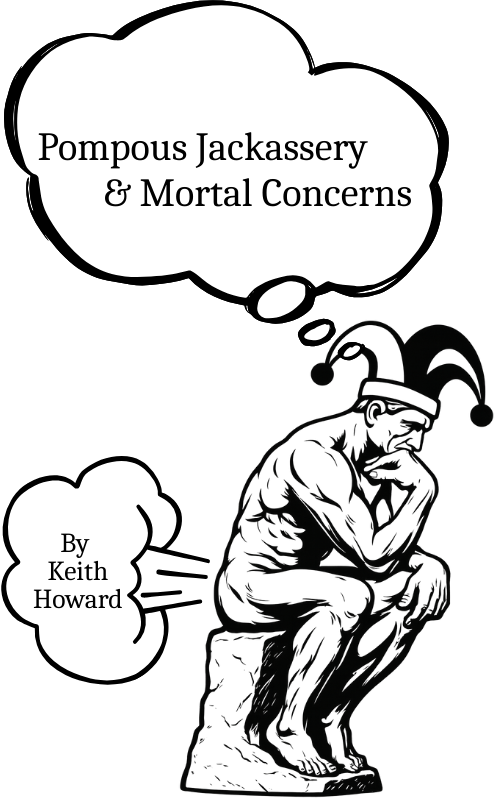
By Keith Howard
Tale #2: Existential Pancakes at Denny’s
Brad and the Bohemian Delusion
If Jonathan imagined himself misplaced at Thanksgiving dinner, Brad imagined himself misplaced in all of history.
And then there was Brad. His family was wealthy if not downright rich, and he only lived in our town for a year while his parents were having their “compound” completed on an island off the New Hampshire Coast.
Like Jonathan, who’d been denied the wealth and breeding that was his birthright, and Sheila the Revolutionary/Princess/Waitress, Brad believed he had a secret, real, family, that might someday return for him. Brad was born to be an artist—by blood, if not by circumstance. Sure, his parents had taken him to Disneyland, even Disney World once, and a few obligatory educational trips to D.C.
But to Brad, those vacations were evidence of his tragic mix-up at birth. He’d tell anyone who’d listen that his real parents were Parisian expats, bohemians of the highest order, possibly conceptual artists who spent their days sipping espresso in smoky cafes, creating exhibits to proclaim loudly the pointlessness of speech.
“Look,” Brad would say, tilting his head with the seriousness of a misunderstood genius. “Vision is genetic. It’s in my bones. I mean, just…look at me.”
I once asked, “So, what exactly did your ‘parents’ do?”
Brad paused, his eyes narrowing as though I’d asked him to recite the mysteries of the universe. “Something avant-garde,” he finally said, voice lowered as if he was letting me in on a secret. “Maybe a dead fish exhibit. You know, you walk in, smell mortality, twist the paradigm till it snaps like a sparrow’s neck.”
Brad had been to lots of expensive places, yet he was convinced that his real life awaited him somewhere in Paris’s Marais district. He imagined his mother, a failed novelist in a turtleneck, and his father, a glass-blower or painter, discussing the futility of existence while waving baguettes for emphasis.
“They’re not like…corporate,” he’d say, as if the word itself left a bitter taste. “They are qualitatively different from the people I live with now.”
“You mean, your parents? I asked.
“Allegedly.”
One night, he convinced me to meet him at Denny’s to “discuss the finer points of existential cinema.” Brad had just seen a French film—Le Charme du Vide (The Charm of the Void), as he called it—which he’d found on some obscure streaming service.
“It’s about this guy who just…sits on a beach. For three hours. Nothing happens, and that’s the point,” he explained, his eyes glittering with excitement. “That’s art, man. It’s like…a rejection of narrative. Pure existentialism.”
As he spoke, he tore his pancake into meticulous pieces, treating each bite like a holy ritual. I tried to keep up, but halfway through, I couldn’t help but laugh. Here we were, sitting in a Denny’s in rural New Hampshire, him pontificating on the charm of cinematic voids while the smell of bacon and maple syrup lingered in the air.
“Brad,” I said, stifling a smile, “you don’t even speak French.”
He gave me a wounded look.
“Language is a cage, man,” he replied, shaking his head. “It’s not about the words. It’s about the feeling.”
Brad’s locker was his makeshift altar to all things bohemian. He’d pasted cut-outs from The New Yorker, pages from On the Road, and blurry photocopies of Van Gogh paintings across the door. I once found him leaning against it, gazing at a particularly grainy photo of Sartre.
“Someday, people will see,” he muttered, his voice heavy with the weight of unfulfilled promise.
“What exactly will they see, Brad?” I asked.
He sighed, looking at me like I was hopelessly out of touch.
“That I am destined for more than this,” he said, gesturing vaguely toward the high school hallway, as if its fluorescent lights and lockers were symbols of an unjust fate.
“I’m…misplaced.”
Brad’s artistic aspirations didn’t stop with cinema. He once dragged me to a poetry reading held in the back of a pizza joint. When the poet finished his last line, Brad leaned in and whispered, “This place just doesn’t get it, you know? Real poetry has to be…devastating. Raw. This is like, processed cheese.”
When I asked if he’d written anything himself, he scoffed.
“It’s not about writing. It’s about the vibe. I mean, bourgeois,” he said, drawing out the French word with a dramatic flourish. “Look at this place.”
I did—or at least I looked at him. A kid in a beret, his eyes squinting in mock sophistication. Brad had fully committed to his tragic artist fantasy, borrowing phrases, gestures, and airs from a world he’d never known. In his mind, he’d been meant for a garret, surrounded by books and paint, not the linoleum floors and vinyl booths of New Hampshire. Even when the island retreat was complete, he would still be . . . here.
But in some ways, Brad’s dedication to his imaginary lineage kept him going. He’d talk about his real parents as though they might find him any day now, bringing a plane ticket and a pack of Gauloises.
“They couldn’t be…ordinary people,” he’d say with quiet conviction, “Not with someone like me as their son.”
And he’d lean back, nodding to himself, as if the question had been answered.
For Brad, his real parents were Parisian bohemians waiting to reclaim him with Gauloises and a one-way ticket. Until then, he’d keep sighing in English over maple syrup.
Jonathan had his lake house. Brad had his French cafés. But if you really want to meet the monarch of the wrong-crib kingdom, pour yourself a cup of burnt diner coffee. Because Sheila—the revolutionary princess of the Sunrise Café—was next-level royalty.
Publisher’s Note: This is a new series of columns by Keith Howard – you know him from his Tiny White Box series, and as former Executive Director of The Liberty House and Hope for NH Recovery. You can read the first tale in this trilogy here. His new memoir, Unclaimed, But Loud: The Memoir of a Shy and Retiring Boy Who Was Neither, is available for purchase on Amazon.