
Three Tales of Misplaced Royalty, Existential Pancakes, and the Queen of the Sunrise Café
O P I N I O N
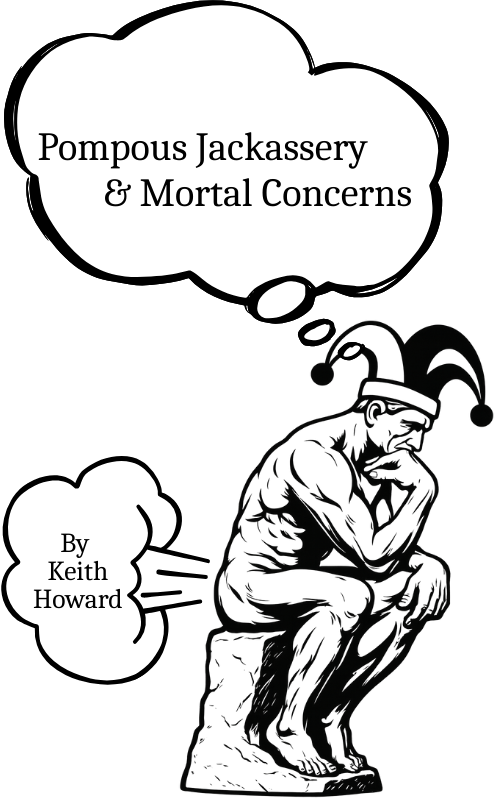
By Keith Howard
Tale #1: Prince of Potatoes
Jonathan and the Opera of the Wrong Crib
Every kid worth his peanut butter and jelly sandwiches has concocted some version of the “wrong crib” story. In these tales, hospitals are bustling disaster zones—fluorescent lights buzzing overhead, antiseptic stinging the nostrils, bassinets squeaking as nurses wheel them down hallways slick with the smell of bleach. Babies get swapped like playing cards, or worse, spirited away by shadowy forces in squeaky-soled shoes.
The takeaway?
The kid has been exiled, thrust into the care of impostors who wouldn’t know brilliance if it knocked on their door with a ball-peen hammer and left grease stains on their welcome mat. Out there, somewhere, is their true family—the ones who would see their genius in an instant, who’d cradle them in silk blankets instead of department-store polyester, who’d cheer their every quirk instead of sighing into casseroles.
I managed to pull this off in reverse. It’s what makes me special and extraordinary. The memoir itself will explain and demonstrate this, I hope. I’ll get to that by and by, but first I’d like to share a few stories about the mythic nature of the switched-at-birth tale.
Jonathan had a theory—a grand one, the kind you could write an opera about, complete with velvet curtains and a chandelier rattling from the high notes. Somewhere in the chaos of hospital births—the steam rising from sterilizers, the sharp snap of latex gloves—Jonathan was convinced he’d been swapped with another baby.
His “so-called” family, with their scratchy plaid couch that smelled faintly of dog hair and meatloaf, wasn’t his family. No, his real parents were jet-setting aristocrats who knew the difference between champagne and sparkling wine, who summered in Vienna or Lake Como where the air itself tasted of butter and salt.
“My real family,” he would declare, drawing out the words with the gusto of a Broadway tenor, “wouldn’t just know which fork to use; they’d have forks for courses you’ve never even heard of.”
Meanwhile, back in New Hampshire, Jonathan’s dinner table was a battlefield of plastic forks clinking against Corelle plates, steam rising from potatoes in every conceivable form: scalloped, mashed, fried, baked, reheated. The smell of boiled starch seemed baked into the wallpaper. But Jonathan carried himself like a prince in exile, surveying his mashed-potato kingdom with a sigh so long and slow it softened the butter into little golden puddles.
“This place could use a butler,” he muttered once, pushing peas across his plate with a plastic fork as though he were arranging pawns on a chessboard, the squeak of peas against porcelain more insult than nourishment.
Jonathan’s fantasy grew more elaborate as we got older. By the time we were ten, his “real” parents lived in a sprawling lake house with wraparound porches that smelled of cedar, green shutters that clicked in the breeze, and a private dock stretching out into water the color of glass. His father was the kind of man who wore cufflinks at breakfast, the faint metallic clink audible as he buttered toast. His mother—draped in linen soft as moth wings and pearls that clicked when she bent to kiss him—spent her days teaching him how to quote poetry and navigate wine lists that smelled faintly of cork and leather.
“At their house, Thanksgiving is a proper banquet,” Jonathan confided, his eyes flickering like candlelight on silverware. “No canned cranberry sauce. It’s… prepared.”
I didn’t ask him to define “prepared,” but the way he said it made it sound like some secret rite—berries crushed under marble pestles, orange zest perfuming the air, a recipe whispered in Latin and passed down from gods.
The thing is, I never pointed out the obvious: Jonathan’s “real family” was as real as the lake house he’d never seen. But it didn’t matter. For Jonathan, the fantasy wasn’t just about escaping casseroles and plastic forks—it was a doorway out of the humid kitchen with its buzzing fluorescent light, out of a town where boredom stuck to your skin like July sweat. His myth smelled of lemon polish and tasted like perfectly chilled wine.
And who was I to burst his bubble? In a town where nothing changed—where the streets smelled of woodsmoke in winter and hot tar in summer, where casseroles were practically currency—everyone needed something to dream about. Jonathan’s wrong-crib fantasy was wistful—part Lake Como, part mashed potatoes. But not everyone settled for wistful. Some went full beret and baguette.
Publisher’s Note: This is a new series of columns by Keith Howard – you know him from his Tiny White Box series, and as former Executive Director of The Liberty House and Hope for NH Recovery. You can read his introductory column here. His new memoir, Unclaimed, But Loud: The Memoir of a Shy and Retiring Boy Who Was Neither, is available for purchase on Amazon.