The tariff situation is a lot like that old saying about the weather in Maine. Don’t like it? Wait a minute.
The latest with the tariffs is that a federal appeals court has upheld the earlier ruling of the Court of International Trade that most of Trump’s global tariffs are not legal, and he exceeded his authority in using emergency powers to impose them. That said, the courts are allowing the tariffs to remain while Trump’s administration appeals to the Supreme Court.
It’s hard to say if any of this wild ride has an effect on what’s happening at the grocery store.
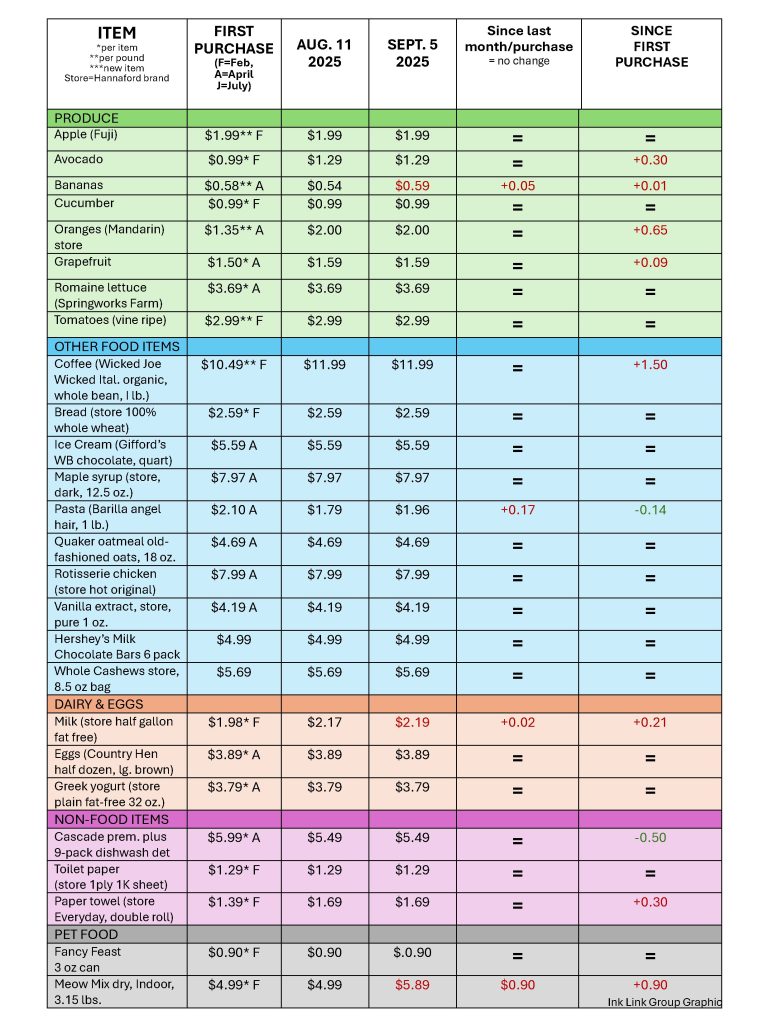
The biggest trend I noticed with my snapshot shopping trip this week is that, for the second month in a row, there were no price decreases. Early in our grocery snapshot adventure, there were always a few decreases that helped counter the increases. That didn’t happen in August or September.
The grocery list is down to two items that have a lower price than when I first started keeping track. One, a pound of pasta, has been slowly increasing, shrinking the savings since February.
Meanwhile, the anticipated banana price increase is upon us. Also increasing in price was pasta, milk and dry cat food. We’re still waiting for the much-dreaded Hershey’s chocolate price spike.
Let’s take a look at my September grocery snapshot.
What’s up?
Bananas. The long-awaited banana price increase has finally happened. They’re up from the 54 cents a pound they’ve been all summer to 59 cents a pound, one cent a pound more than they were in February, when they were added to the grocery snapshot list. The average price of bananas in the U.S. is 65 cents a pound.
Americans buy 6.4 billion pounds of bananas a year, so that’s about 27 pounds a person. They are the top-selling fresh fruit in America. And why not? They’re inexpensive, incredibly nutritious while being low in fat, calories and sodium, and they come in their own natural, biodegradable packaging. You can thank two enterprising businessmen – Andrew Preston and Minor Cooper Keith, who formed the Boston Fruit Co. in the late 1890s, and began exporting to the U.S. what was then an exotic fruit.
The Banana Association of North America warned in April that tariffs are going to drive prices up – a tropical climate is needed to grow bananas, so we import 90% of the bananas sold in the U.S. Most are from South American countries. In the past, since bananas aren’t a product we can produce enough of to meet demand in the U.S., they’ve been exempt from tariffs (this has historically been true of a lot of agricultural products). But the most recent tariffs don’t exclude bananas or other agricultural products. While one purported goal of the tariffs is to support U.S. production, farms in Hawaii and Florida, the two places in the U.S. that produce bananas, just can’t meet that 6.4 billion pounds a year demand. So, the price of bananas will definitely go up as the tariffs, as well as climate change, take their toll.
Dry cat food. Yes, I freaked out a couple of months ago when a 3.15 pound bag of dry cat food rose from $4.99 to $5.89. I was relieved when it went back down to $4.99 last month. Now it’s up to $5.89 again. What’s going on? A little digging answers the question. Grocers raise and lower prices for a lot of reasons. Some of it has to do with external issues like tariffs, climate change, supply chain, seasonal production, etc. But some of it is also an internal store strategy. A grocer may lower or raise prices because of inventory, loss leaders (putting a super-low price on something to attract shoppers), competitor pricing, a promotion by the item’s producer, or even the psychological makeup of buyers (yikes!). I can’t say which one is responsible for the crazy roller-coaster dry cant food pricing fluctuations, but the cats and I are going to hang on and ride it.
The good news is that we keep hearing the price of canned goods will increase because of tariffs on aluminum, specifically the 35% across-the-board tariff on goods from Canada, but Milo and Penny’s preferred wet food is holding steady at 90 cents a can.
Pasta. My one-pound box of angel hair pasta was $1.96, still down from the $2.10 it was when I added it to the list in April, and definitely down from the $2.19 it was in May, but after a plunge to $1.79 in June, it’s inching up again. Pasta prices are expected to go up because of the tariffs, even when the pasta is made in the U.S. Ingredients like durum wheat and semolina are imported, and are affected by tariffs as well as supply-chain disruptions and climate change.
Milk. Up another couple of cents. For a look at how milk prices, which are set by the government, are determined and why they go up and down, read last month’s column.
What’s down?
For the second month in a row, there hasn’t been a price decline for any product on my list.
What to watch
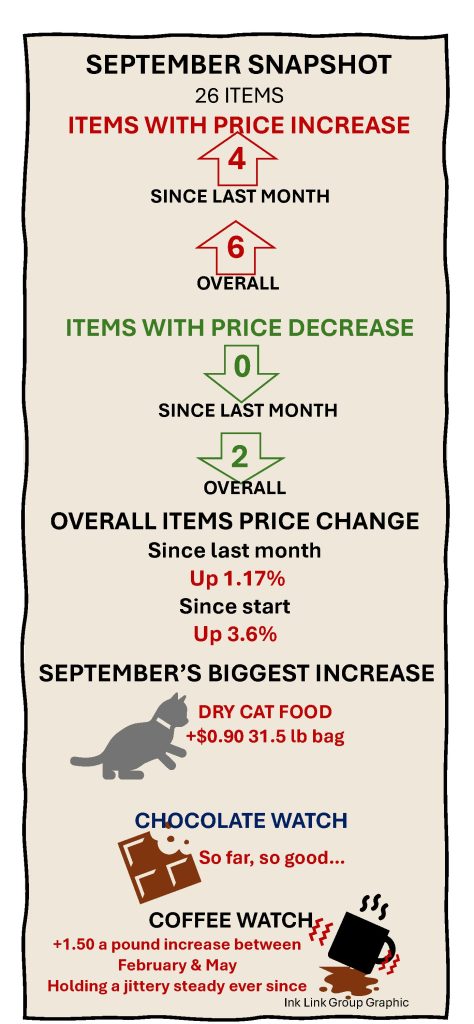
Chocolate. Hershey’s announced in July that sometime this fall it will increase the price of chocolate products by double-digits. When exactly this will happen hasn’t been announced. My six-pack of Hershey milk chocolate bars was still $4.99 at the grocery store this week. Fingers crossed that it lasts a while. Hershey’s has said that the price of Halloween candy won’t go up this year – that’s likely because it’s already been produced and on the market and probably started showing up on your store’s shelves earlier this summer.
Hershey’s said the increase is because of the steep hike in the price of cocoa, which has more than doubled over the past two years because of climate change and disease in West Africa, where much of our cocoa comes from. The company said that tariffs have nothing to do with the price increase, but the major importers of cocoa beans to the U.S. are Côte d’Ivoire, Ghana, Ecuador, and the Dominican Republic. All of those countries are subject to tariffs.
The reasons Hershey’s is raising its prices aren’t exclusive to Hershey’s. You can likely expect most of the chocolate you buy, or anything with a chocolate ingredient, to get more expensive in the near or far future. Hershey’s is only the third-biggest importer of cocoa in the U.S. The biggest is Barry Callebaut U.S.A. LLC, which you may not have heard of. It produces chocolate and cocoa products for both consumer and industrial markets. The second-biggest importer of cocoa beans to the U.S. is Cargill Cocoa & Chocolate, which also supplies chocolate and chocolate products to a variety of consumer and industry customers.
Coffee, nuts, tomatoes… If tariffs are going to have an effect, products that we just can’t produce enough of here are going to be affected. My coffee of choice has gone up $1.50 a pound since February, and will likely become more expensive. Prices of products from South America, Africa and Canada, will also likely be on the rise. Weather, climate change, supply chain issues and more will also have an impact.
The Disclaimer
The purpose of this monthly column is to keep an eye on how some grocery items on my regular list change month-to-month.
This is just a snapshot of a variety things I regularly buy, not a scientific analysis. Aside from tariffs, a lot goes into price fluctuations, including seasons, weather, store preference and store decisions. I’ve included items likely to be affected by tariffs as well as some that may not be. There are likely different prices and fluctuations at other stores of what I buy, but this is a reflection of my shopping list, not a comparison-shopping exercise or a definitive picture of what certain items cost everywhere.
This is not meant to be a brand endorsement or an advertisement for Hannaford. These are just the things I buy, and that’s just where I shop.