
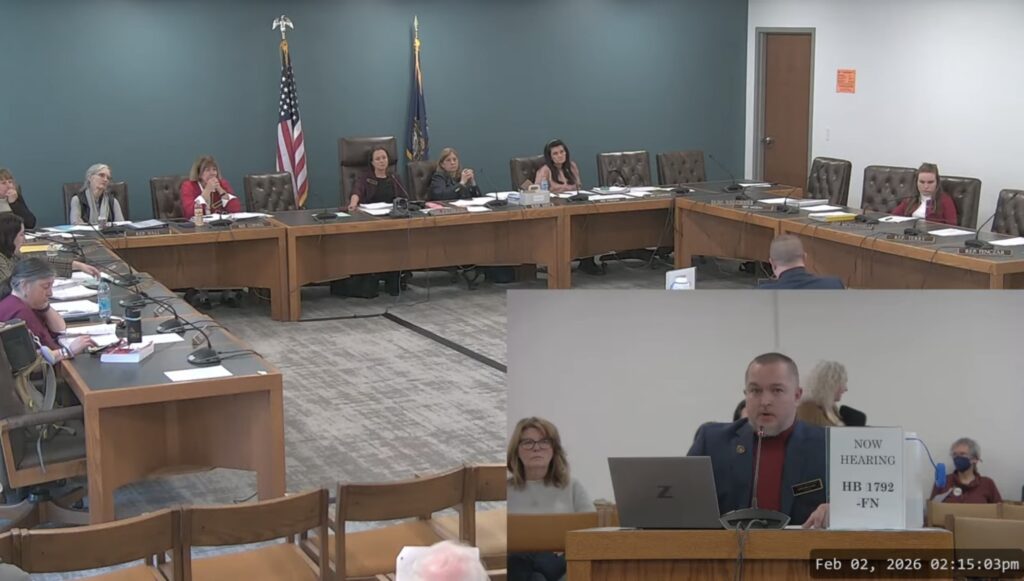
CONCORD, NH – The House Education Policy and Administration committee held a hearing on HB 1792, also called the “CHARLIE Act” – Countering Hate and Revolutionary Leftist Indoctrination in Education, named for Charlie Kirk – on Monday, Feb. 2.
The bill prohibits “the teaching of certain pedagogies in public schools, including but not limited to critical race theory, LBGTQ+ ideologies, identity based ideologies, and Marxist analyses,” and creates a “private right of action for parents and students who are aggrieved by a school violating these provisions.”
The bill states that these pedagogies, among others, “often promote purposeful division by framing society through lenses of inherent oppression, liberation narratives of overthrowing systems and hierarchies, systemic inequity based on identity groups, or anti-constitutional narratives.”
“This bill is tied to Charlie Kirk in two distinct but very important ways,” the bill’s prime sponsor Rep. Mike Belcher, R-Carroll District 4, said. “First, this bill contains the sort of thing that Charlie was frequently driving towards in his activism and his attempt to bring everything that he was into the public and civic realms. Second, this bill seeks to curb the indoctrination into hatreds and divisions of critical theory that fueled Charlie Kirk’s assassin and fuels left wing violence nationwide.”
Belcher said that the “current American Education paradigm” is comparable to The Red Guards during the Chinese Cultural Revolution.
“Of course, the modern forms of indoctrination and division take up the most public relations and human resources terminology hiding a long history of atrocity in words such as equity, diversity, inclusion and belonging,” he said.
While most spoke in opposition to the bill, some spoke in favor, including Representative Sam Farrington, R-Strafford, who said he didn’t feel the bill “goes far enough,” that it should also extend to higher education.
He gave an example of critical theory playing out in one of his classes, in which he said students are taught that it is not enough to be against racism, but one must take an active role in fighting it.
“Which seems good unless the professor’s saying that the white people are always the racists, and that goes to the very heart of this bill which is critical theory that there is always one oppressor class and one oppressed class and that those are the situations 100 percent of the time, which is unequivocally not true,” he said.
Retired teachers Nancy Brennan and Mary Wilke spoke in opposition to the bill, with Brennan describing the bill itself as “indoctrination of the worst kind.”
“The bill talks about prohibiting indoctrination and yet to teach without acknowledging various lenses through which we view the world is itself indoctrination. Accepting Charlie’s words as absolute truth is indoctrination,” she said.
“I don’t know what I would do if someone were being made fun of because they were, for instance, gay,” Wilke said when asked if she would feel confident answering questions from students on some of the topics mentioned in the bill. “Am I allowed to say it’s fine to be gay? Or am I not allowed to say that?”
Some felt the bill was vague, including Rachel Potter, policy associate at ACLU NH, who described HB 1792 as a “classroom censorship bill” that is “unconstitutionally vague.”
Senior Assistant Attorney General Sean Locke from the NH Department of Justice also had concerns with the bill.
He cited RSA 354-A:27 and 28 and RSA 193:38, which prohibit discrimination in public education.
He said under the law, schools cannot refuse to open their doors on the basis of race, religion, national origin, disability, sex, sexual orientation, and gender, or “foster environments that are hostile to students based on those characteristics, which effectively deny the student that public education.”
Locke said the bill “jeopardizes schools’ ability to address these hostile environments” and “can undermine a school’s ability and obligation to foster a welcoming inclusive education environment.”
While the bill allows for bullying prevention education, he said that doesn’t appear to extend to addressing misconduct.
“There isn’t a safe harbor here for a school or educator that’s attempting to ensure that their students are learning in an environment that’s free from hate, which is what the legislation was working to combat,” Locke said.