
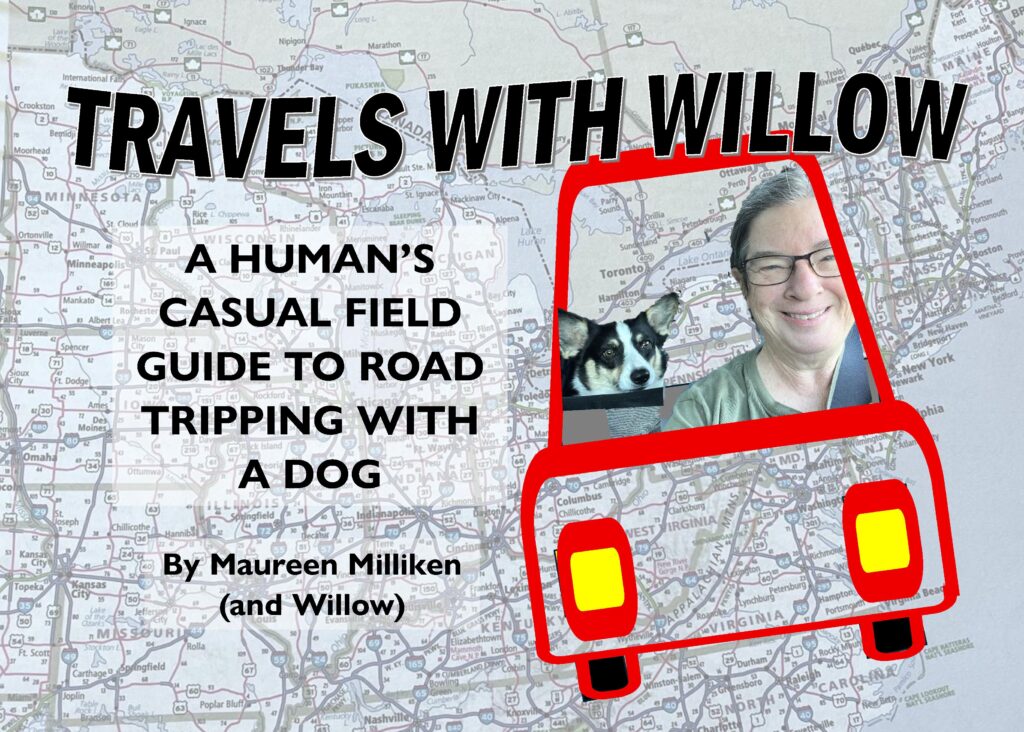
When I acquired a dog last fall after more than a decade of no-dog life, one of the realities that came back to me fast was that with a dog – at least a corgi – the journey isn’t part of the point, it’s the entire point.
I’m not one of those wax-philosophical types who think all of life’s mysteries can be explained by digging deep into my dog’s psyche, but the journey thing has practical applications. If you try to hurry the dog through the journey instead of letting her do her thing, neither you or the dog will be very happy.
This has become even more of a practical application as I plan a cross-country drive to visit a sister in Portland, Oregon. It’s not that I was going to get into the car in my central Maine driveway, aim it for the West Coast, put the pedal to the metal, get on the interstate and not stop until I got there. But taking the scenic route takes on a whole new meaning when you’re traveling long distances with a dog. The dog sets the pace, determines where you’re going to stay, and even how and when you will eat.
Our trip to Oregon begins June 29, so we’ve been practicing trips in the car. Willow’s a good girl, but car trips were a challenge when I first got her. She’s also a smart girl, and with positive reinforcement, her own dedicated space in the car and some boundaries, she now is a great car companion.
Still, we’d never been on a trip longer than a couple of hours and never stayed anywhere overnight. So, last week we took a little shakedown overnight cruise to Vermont to see how a long drive and an overnight stay would go.
What we’ve learned and continue to learn isn’t meant to be a complete how-to on traveling with a dog. Think of it as a shared experience that travelers – with a dog or without – may get some use out of, or just enjoy.
The Plan
Last September, shortly before I adopted Willow, I stayed at a short-term rental in Alberg, Vermont. The host has two dogs and we got to talking about my upcoming dog acquisition. She invited me to come back with Willow in the spring. [The host doesn’t advertise her short-term rental as pet-friendly, so, I’m not reviewing the accommodation today. I will for most future accommodations].
Alburg is on the chain of islands at the north end of Lake Champlain. The fastest way to get there from where I live in Belgrade, Maine, is through Canada, entering at the border crossing at Coburn Gore. I wasn’t looking for the fastest way, though. I live about 10 miles south of Route 2, and Alberg is on Route 2. I thought it would be fun to take Route 2 across Maine, New Hampshire and Vermont. Yes, I know there are other, faster ways. Getting there fast, though, isn’t the point.
By the way, for all the AI cultists out there, I didn’t keep track of mileage the way I had planned, and when I typed into Google AI “How many miles is it from Belgrade, Maine, to Alberg, Vermont, if I just take Route 2?” I was told that it is “impossible” to take Route 2 because “it’s not contiguous.” OK, AI.
I did some calculations on my own and the trip out was 272 miles. I took a slightly shorter route back home – Route 78 east out of Alburg to Route 105 to 108, down to Route 2, and then Route 2 the rest of the way home. It was beautiful. If you’re looking for a column on the fastest way to get somewhere, by the way, this is not going to be it.
The dog drive factor
One aspect of my upcoming cross-country trip is that I plan to visit state capitals in (mostly) states I haven’t been to before. I’m a state capital nerd. Don’t question it, just accept it. So, our Vermont trip itinerary included a stop in Montpelier. That would also be around the point in the trip that Willow would need to get out and stretch her legs.
I’d packed treats, her food for the next few days, several bottles of water. Willow sleeps in a portable soft crate, which folds up nicely. Open, it takes up too much room in the car, so she doesn’t travel in it. But we brought it for her to sleep in.
We use a “hammock” enclosure in the back seat. These are designed to keep the dog contained to one area of the car and also to keep them from falling between the seat and the floor. This works well for the purpose. It attaches to the head rests of both the back and front seats, and has high sides on the door ends that are mesh, for air circulation. I keep the one next to the door down so she can hop in and out.
This is not something that will keep the dog restrained if there’s an accident, though it does provide room to put an additional buckle-in seat. We don’t use one.
Willow also has a travel water dish with a weighted bottom, so it stays in one spot in her enclosure. She also has a chew toy in case she gets bored.
When traveling with a dog, stops are important. Not only so they can relieve themselves, but so they can get some exercise. Stops are important for people, too. The benefit of traveling with a dog is that I actually stop instead of just thinking I should.
Route 2 is incredibly scenic through Maine, New Hampshire and Vermont. Definitely worth the trip. Another benefit to traveling off the interstate is that there are many places to stop that would be great for walking a dog. One of the best options if you’re traveling through northern Vermont is the Lamoille Valley Rail Trail. It stretches diagonally 95 miles from St. Johnsbury northeast to Swanton. There is parking and trailheads at frequent intervals.
But if you just want to get out for a quick walk, keep an open mind. Walking around a town or a park is just fine for your dog. Always make sure that there are no restrictions on dogs, pick up the poop and throw it away properly.
We stopped in Montpelier to check out the capitol building and were delighted to see it had a nice big lawn with shade trees bordered by sidewalks. It’s right in downtown Montpelier, so we took a walk around downtown. Willow was delighted that several businesses had water dishes out for dogs.
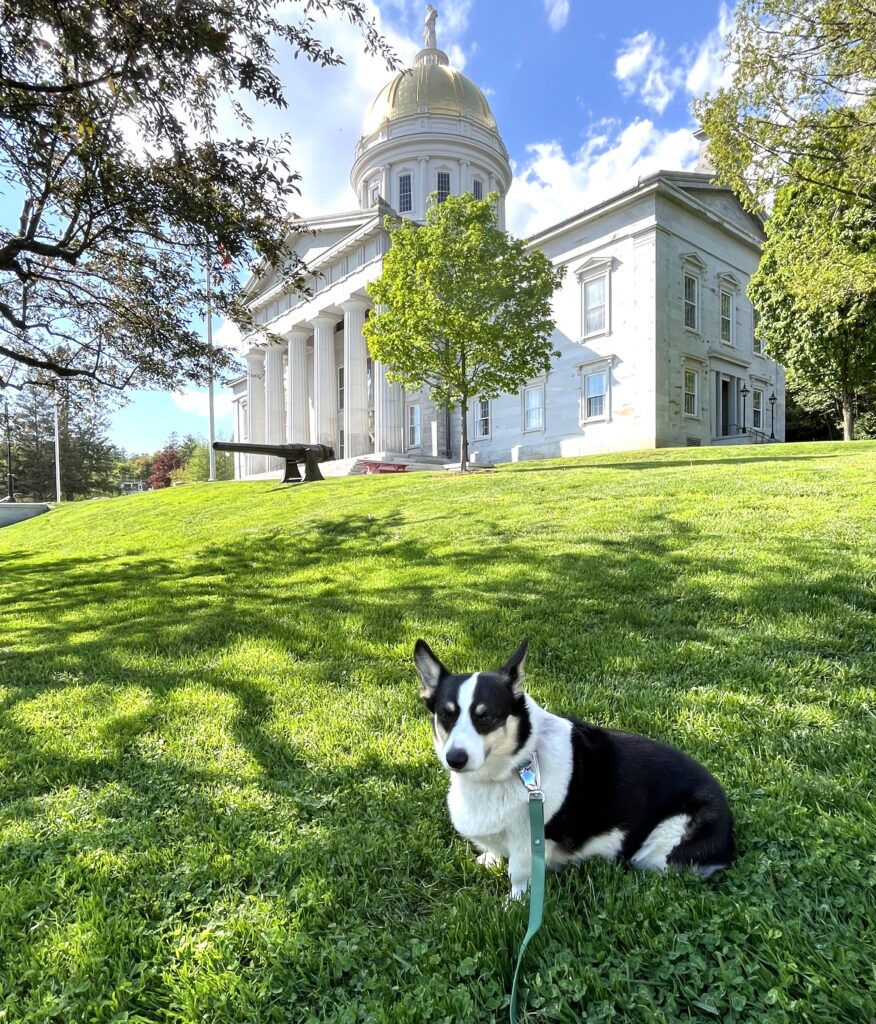
We ended our walk, which was about a half hour total, by circling the capitol building lawn.
I’d planned for everything except the unseasonably hot day, full sun and temperatures in the mid-80s. If it were just me, that’d mean a couple of bottles of water and a stop at an air-conditioned restaurant for lunch.
Traveling with a dog, though, meal stops also take planning, especially if it’s really hot or really cold out, so you can’t leave the dog in the car.
I guess I’d been thinking so much about how to plan a trip around Willow, I hadn’t realized human eating may be an issue. Normally, I’d be happy with a stop at a hot-dog stand or open-air walk-up hamburger stand. It’s part of the fun of traveling. But I have a medical issue that requires I stick to a low-fat, low-fiber diet. It didn’t occur to me until I got hungry that the likelihood of finding something I could eat at a roadside hamburger or hotdog stand was about nil.
I ended up stopping at a grocery store close to where we were staying and not eating on the road. But a lesson there – planning goes beyond making sure the dog is all set. How human concerns fit in with the dog’s matter, too.
Aside from roadside stands, there are many places to eat on Route 2. If you’re driving up from southern New Hampshire, Lancaster, while you’re still in the state, has a variety of places to eat and is a nice town to walk around with the dog. St. Johnsbury, across the border, in Vermont, also is walkable and full of places to eat. If you plan to stay on Route 2 and dip south, Montpelier is also a good place to stop for food and walking around.
Willow tolerated the drive very well. It ended up taking more than seven hours to get to Alburg, including the stop in Montpelier.
The only negative as far as the drive went was hitting the Williston-Burlington area at rush hour. Route 2 expands to a multi-lane road lined with malls (good for any travelers who need to get some shopping or eating done). It also goes by the University of Vermont, so can be very busy if school’s in session. She’d been snoozing after her Montpelier adventure, but the slow traffic and stops woke her up and then it was “Are were there yet? Are we there yet? Are we there yet?” until we got there.
The dog stay factor
Willow is crate-trained, but I really dislike metal cage crates. I don’t like the way they look and I don’t like dealing with them. That’s just personal preference, not a judgment of anyone who likes them just fine.
When I first got Willow, I got a collapsible soft-sided crate. It looks good, it folds up easily and travels well, not taking up too much room in the car. When I have to occasionally board her, I even bring it to the boarding kennel for her to sleep in.
I brought the crate on the trip, and definitely plan to bring it on the cross-country trip.
While there are many short-term rentals and a growing number of hotels and motels that accept dogs, the more contained your dog is, the better for everyone.
On our Vermont trip, I didn’t leave Willow unattended in our space. Many dog-friendly accommodations allow “well-behaved” dogs to stay in a room unattended. Others don’t. It’s something to keep in mind when traveling with a dog and can have an impact on things like dinner plans or visits and side trips to places that don’t allow dogs.
If I do have to leave her unattended, and am staying somewhere that allows it, I plan to crate her. Crating a dog not only helps the dog, because they can be in a comfort spot while at a strange place, but helps you, too. If she’s crated, it’s less likely something will happen that the hotel will then charge your credit card for.
One thing I didn’t account for on our Vermont trip that I plan to in the future is that Willow, a short-haired corgi, still sheds. Our accommodation had a nice low bed, and Willow hopped right on it, leaving white hairs all over the navy blue comforter. Fortunately, the host had a lint roller I borrowed with lots of apologies, so I could clean it up. I plan to add one to Willow’s bag, as well as a sheet or blanket to put on furniture. {See pro tips below for more].
If you’re planning a trip with a dog, never forget that you’ll be traveling with a dog. It’s kind of like that high-school exercise where they make kids carry an egg around for a week to give them the idea of what it’s like to care for a baby. Having a three-year-old corgi is similar in some ways to having a three-year-old child. Any plan you make has to account for them.
A major aspect of any dog road trip plan is whether you can, or plan to, leave your dog alone at the hotel, motel, short-term rental, or wherever. You should know your dog well enough to know how she’ll behave, but don’t just assume that because she’s good at home, she’ll be good in a strange place. If there’s a chance she’ll bark nonstop, chew up furniture, relieve herself on the floor or the bed, or some other behavior that won’t go over well, make sure that won’t happen.
Dogs will be dogs, but it’s up to the humans in their lives to make sure a trip goes smoothly. Making sure all goes well during your stays can mean crating the dog when you’re out or simply not leaving her alone.
It also means making sure you have her food, treats, one or two toys, poop bags, food and water dishes, and anything else you need to make her comfortable.
When you look for dog-friendly accommodations (I’m using the app Bring Fido to book the cross-country trip), most of the best information on what to expect can be gleaned from the reviews. But also be sure to check out the hotel’s pet policy and know if there will be a fee (most have them), if it’ll be collected when you check in, and what the rules are for dogs. Many reviews cite “issues” that the reviewer could’ve avoided just by reading the hotel’s pet policy.
I’ll have more on choosing accommodations and how to do it next time. The biggest thing to keep in mind, though, is that the best stays include activities that are both dog and human-friendly.
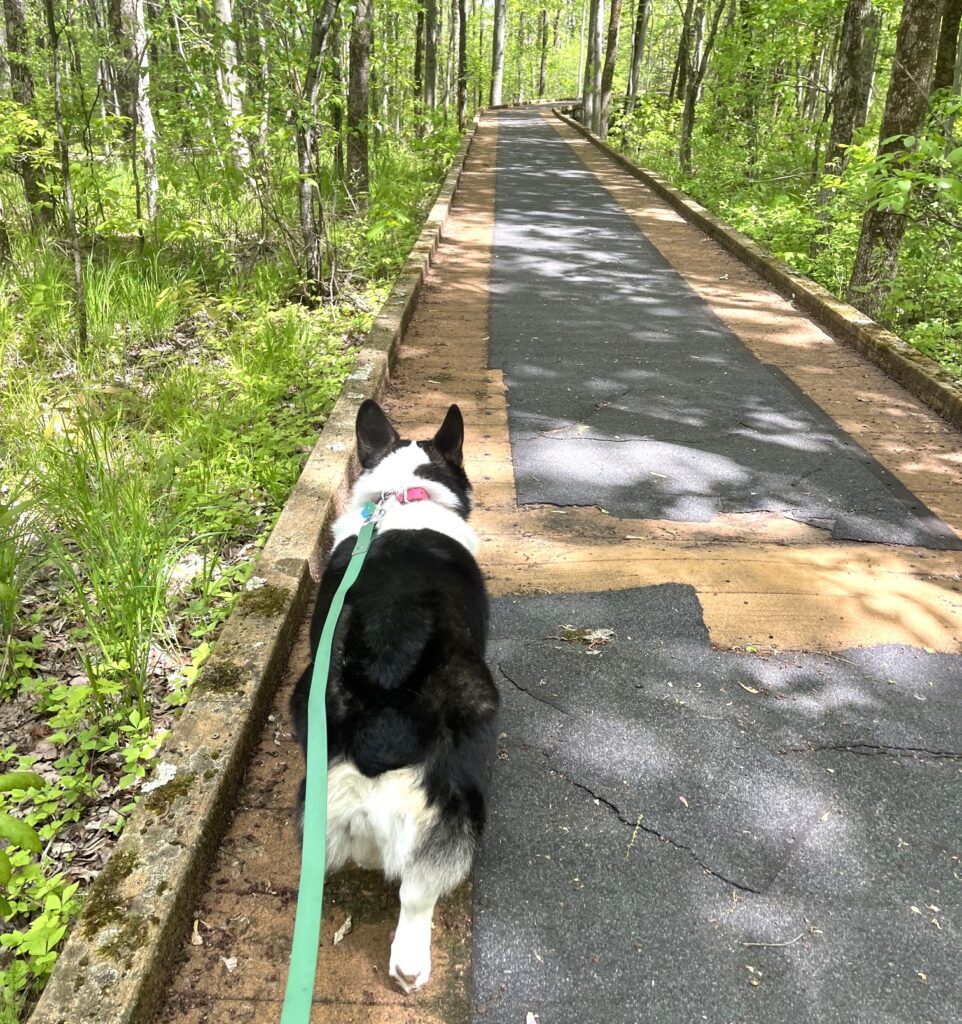
On our Vermont trip, we were lucky enough to be near the Missisquoi Wildlife Refuge in Swanton, Vermont, which has some very nice trails. The one we explored was the Discovery Trail, which is about a mile long, part gravel, part boardwalk, through very nice woods and bogs. There was a lot for Willow to sniff and watch.
Willow also loves a nice swim in a lake. We were close to several state parks with Lake Champlain beaches, but dogs aren’t allowed on the beach at Vermont’s state parks, so we opted out. There was a little private beach that the property we were staying had access to, and she was welcome there, so she did get a swim in.
The dog highlight
Driving through St. Johnsbury on our first day, I passed a sign for something called The Dog Chapel. Whoa, I thought. I’ll have to look that up and maybe we can visit on our way back.
I’d never heard of it, but apparently it’s famous. Artist Stephen Huneck created it two decades ago as a place where dogs and their humans can celebrate their spiritual connection.
Our visit on the way back was definitely the highlight of our trip. As we approached the road in, on Dog Mountain, just east of St. Johnsbury, Willow seemed to know exactly where we were going. She got up behind me, watching out the window, barking little yips of joy. Seriously. She could not wait to get out of the car when I pulled in.
Dog Mountain has no admission fee, and it’s open year-round.
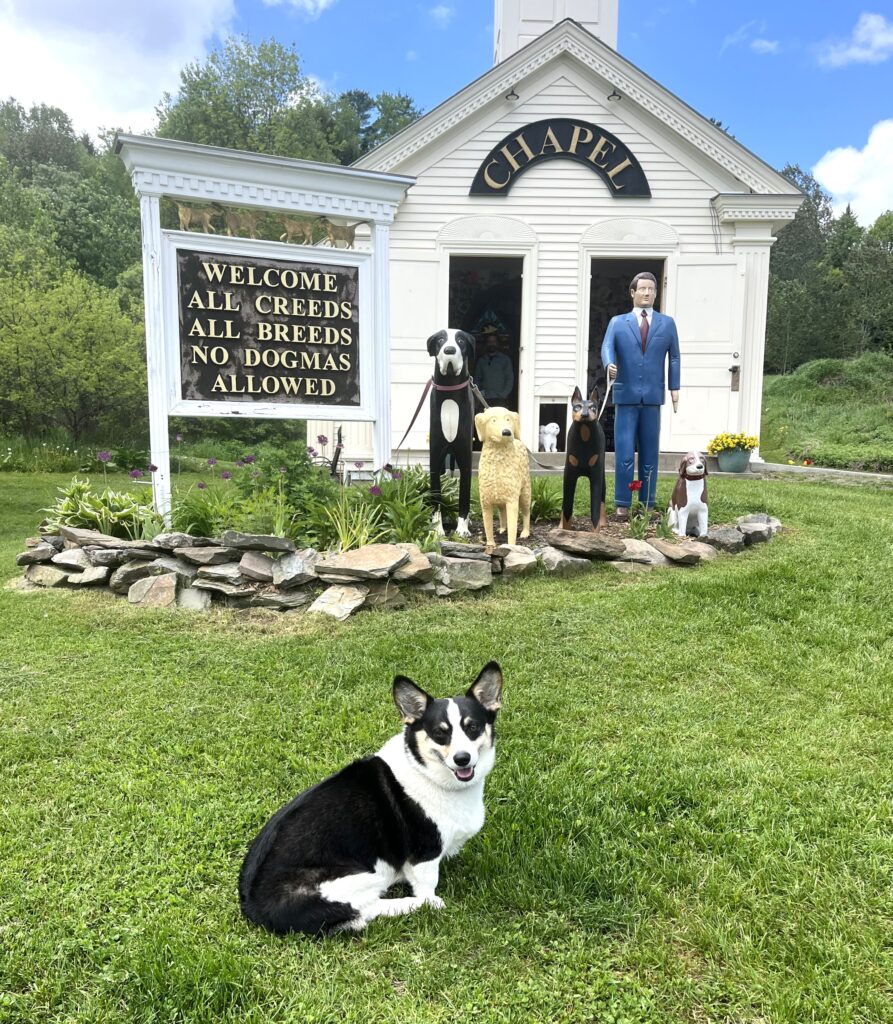
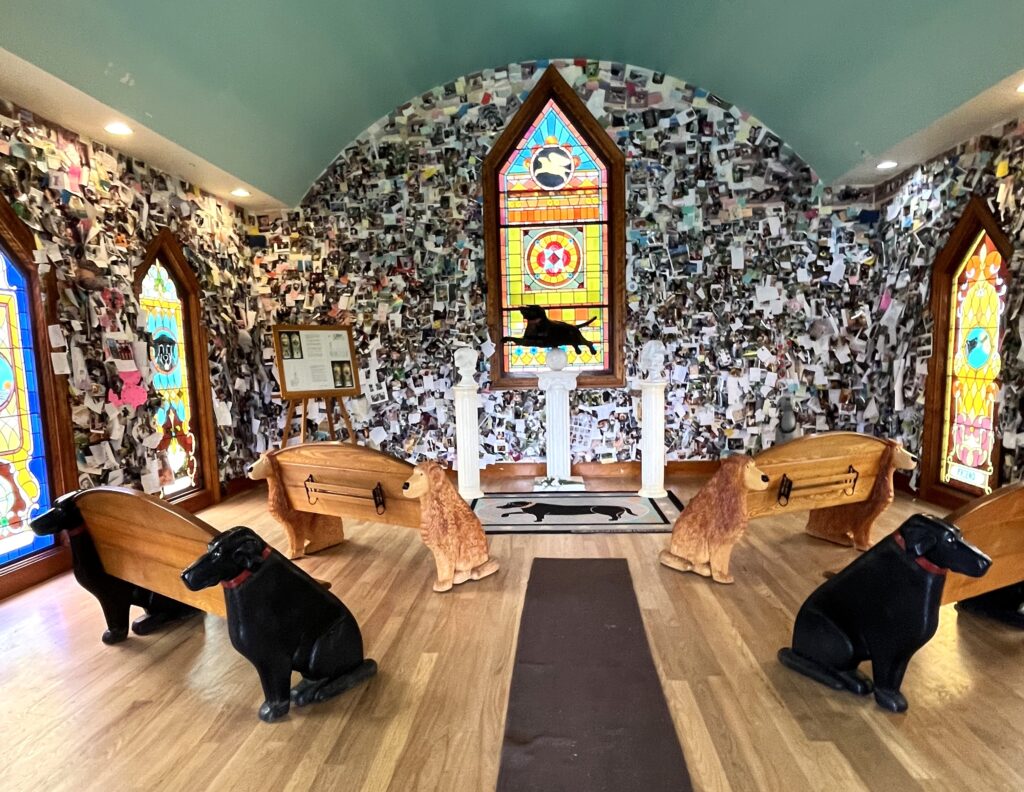
Dogs are allowed off-leash, except in the chapel and the (very nice) gift shop, where a leash is required.
The chapel itself is a calm and serene space, with stained glass and beautifully carved benches depicting dogs and even a cat. But the focus is the walls, which are covered with thousands of tributes people have left for their dogs who have passed.
Willow, still very much in this world, was more interested in the grounds. There are hiking trails, a pond with a fountain and a large basket of tennis balls, a fenced-in space for playing and an obstacle course. It’s all spread over 150 beautiful acres. It’s clean and well-maintained and every person and dog we encountered was friendly and happy to be there.
Willow and I took an easy hike on one of the trails, bracketed by swims in the pond (for her, no humans allowed). I visited the gift shop, which is also a gallery of Huneck’s very dog-focused art work.
We spent more than an hour there, and it was worth every second. It’s a place I wouldn’t have visited if I hadn’t had a dog with me, but even if you are in no-dog phase, it’s worth the stop. For more information, check out the website. It’s about a two and a half hour drive from the Manchester/Nashua areas.
Dog trip pro tips
Willow and I had a good time, and no issues, on our first overnight trip together. I did have some learning moments to share. These include:
- Bring a blanket or sheet to put over a bed covering or chair, as well as a lint roller. Even good dogs may shed or get muddy prints on a chair or bed covering.
- Bring an extra leash and keep it in the car, in case you misplace the main leash. This almost happened to me, but I remembered the leash was hanging on a hook at our short-term rental right as I started up the car to leave. If you find yourself without a leash and need one, it can be a problem.
- Have an extra supply of poop bags in the car, so they’re there if you go on a spontaneous walk, or forget the ones you meant to bring.
- Check out trails or parks online before you go to determine if there are any rules about dogs.
Traveling with a dog is easy and fun – most of the time. Common sense and thinking things out from the dog’s point of view should be the default. In a few weeks, I’ll talk about choosing dog-friendly hotels and motels.
Remember, don’t get uptight if a dog is your copilot. Take a tip from her and slow down and enjoy the journey.
You can reach Willow through her human, mmilliken@inklink.news.