
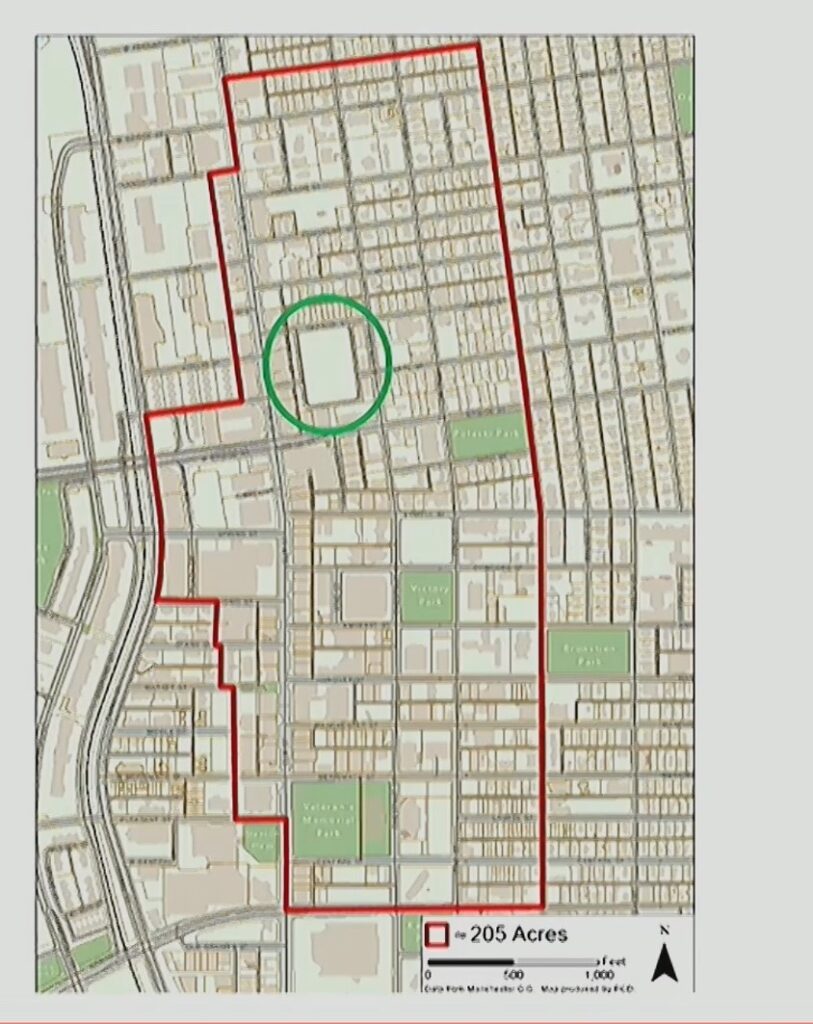
MANCHESTER, N.H. – Prior to the regularly scheduled Feb. 3, 2026 Board of Mayor and Aldermen (BMA), a special hearing was held to allow public comment on a proposed tax increment financing (TIF) district in Manchester’s downtown area.
The TIF district would repay a $23.6 million bond approved by the BMA for the construction of an affordable housing complex and public parking garage to be placed on the current site of the municipally owned Pearl Street parking lot, known as the Pearl.
Initially conceived in 2021, the Pearl project was part of what had been a broader effort to bring affordable housing downtown, and was eventually pared down and delayed for financial reasons. The currently proposed version of the Pearl would hold 136 dwelling units and a garage with 450 parking spaces. Among the dwelling units would be 10 market-rate townhouses and 126 apartments for families earning at or below 60 percent of average median income ($51,600 for a single person, $73,680 for a family of four according to Manchester Planning and Community Development Director Jeff Belanger). The garage would be owned by the city and 10 surface parking spaces in addition to those in the garage would be available. Construction is expected to start soon on both the garage and housing development with conclusion of construction for both projects expected in 2027.
Under New Hampshire law, TIF districts allocate taxes from higher property values in an area near a new public improvement to repay for the construction of that public improvement. Although the concept of a TIF district varies across the United States, in New Hampshire the districts must be within a specific area and for a limited time, with municipalities limited in how much space inside its borders can be designated at TIF districts. In the Pearl proposal, the TIF district is limited to 25 years or how long it takes to pay off the bond, whichever comes first.
RKG Associates consultant Eric Halverson stated that the analysis for the TIF came from the tax revenue coming from comparable building projects nearby in order to estimate what would be needed to repay the bond. He noted that over the next 25 years, additional funds would be allocated to cover interest on the bond and the city could potentially realize revenue put back into its general fund budget within the next few years.
This will be the first ever TIF district in Manchester, although nearby towns have used the concept since was introduced into New Hampshire in 1979.
Following questions from Ward 7 Alderman Ross Terrio, Belanger noted that requests for 79-E property tax relief within TIF districts can be denied by right given the reduction of revenue allocated toward project repayment that would occur due to the 79-E tax relief. However, last year the BMA announced a pause on 79-E requests in any case to create more standardization on responses to future requests.
Only one member of the public, Hanover Street resident Avery Cyr, spoke during the public hearing. He spoke in favor of the proposal.
A vote for the TIF is expected to occur during the BMA March 3 meeting, following the state-required 15 day waiting period. The BMA must appoint a TIF advisory board and could appoint a district administrator. Annual reports on the TIF district would be required as well.