
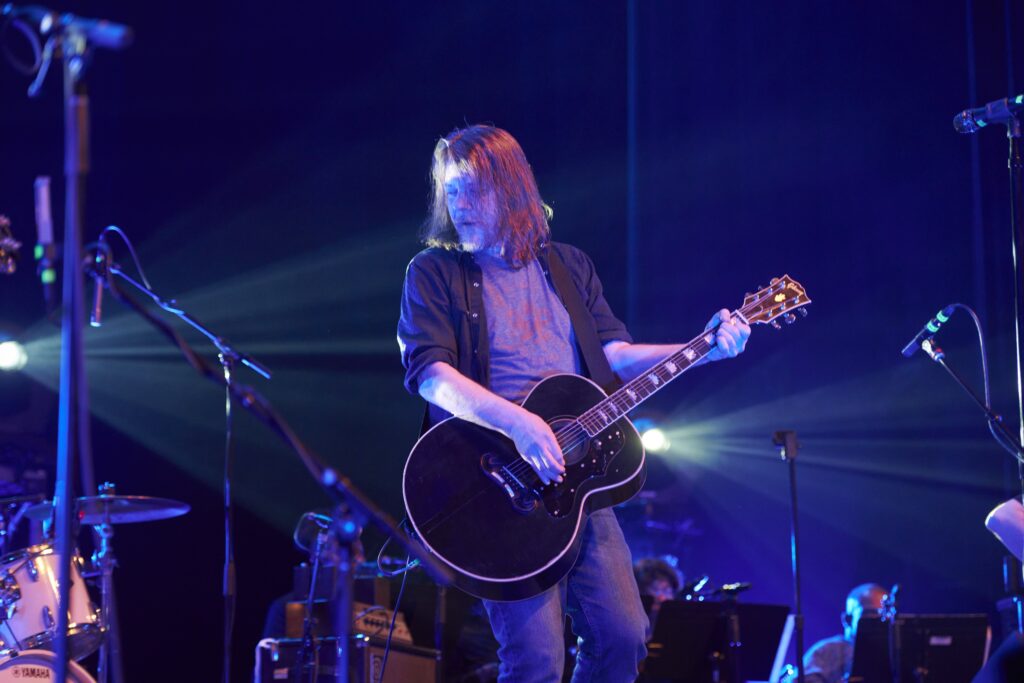
You can’t talk about rock music in the ‘90s without mentioning Soul Asylum. Led by lead vocalist, guitarist, saxophonist and pianist Dave Pirner, the Minneapolis band’s release of their sixth studio album “Grave Dancers Union” in 1992 put them on the map with hits like “Somebody To Shove,” “Black Gold,” and “Runaway Train.” In fact, those tunes can still be heard on the radio today along with “Misery” and “Just Like Anyone.” On April 21 and 23, they’re going to be rolling on through New Hampshire with the first show happening at The Music Hall in Portsmouth and the second taking place at Tupelo Music Hall in Derry. Both stops are part of an acoustic tour Soul Asylum is doing, so fans will get an opportunity to hear some songs in a different vein.
Pirner and I had a talk ahead of the performances about an upcoming album that’s due out soon, his love for the city of New Orleans, and how people shouldn’t get bored when he’s doing his thing on stage.
Rob Duguay: Earlier this year, Soul Asylum released a live record titled “MPLS Unplugged,” which you guys did back in 2023 to celebrate the 30th anniversary of your performance on “MTV Unplugged” at the State Theatre in Minneapolis. When it came to organizing the whole thing, the idea behind it, and going through with the whole thing, what was the experience like? From listening to the version of “Misery” off of it that’s already out, there seems to be more of an orchestral vibe.
Dave Pirner: When we were able to get Ivan Neville, that’s when I knew it was going to be something substantial. We’d just done a gig with a string quartet and I’ve always been kind of partial to strings, so any chance I get like that, I’ll probably jump on it. I thought it was cool to give all the songs I’ve written since the MTV thing sort of that kind of treatment, so presenting them in a different way is a challenge while getting involved with some different musicians. The last time we did it, it was with musicians from New York, but this time, it was most people from Minneapolis. There was a lot of looking back while figuring out how we pulled this off the first time and seeing how much better we are at all this s*** now.
The mystery wasn’t part of the thing and the first time we did it, it was really the first time we had played all acoustically as a band, much less with a string section and this, that, and the other thing. It was just an opportunity to expand, try something different and a little out of our comfort zone, but also enhanced in a different sort of way as kind of a different interpretation. That’s a big part of it for me, when I found out that “Somebody To Shove” worked acoustically with strings and it sounded great, I thought, “Wow, this is a punk rock song and the only way it can be performed is with electric guitars and stuff.” When you find out that it works in a different way, it’s cool. We’re also doing one song from our “Slowly But Shirley” album that’s the last song you would expect to work acoustically, and I did it recently in Minneapolis with strings and I just laughed when it was over because it was so different.
It didn’t sound like something a normal person would think of doing, but it worked in a really different kind of a way.
RD: Ivan Neville was also part of the original “MTV Unplugged” session too, right?
DP: Yeah.
RD: People know Ivan due to his connection with The Neville Brothers through being the son of Aaron Neville, and he’s considered to be New Orleans funk royalty. You come from a background of punk rock, so when it comes to collaborating with Ivan, what stands out for you? Does it open certain creative doors that you either didn’t recognize was possible in yourself or you’ve always wanted to pursue but never got the chance?
DP: We had him on a track on the new record, which seemed from the beginning like it was going to happen because Steve Jordan was producing it, and it’s also kind of how I met Ivan. It was through him touring with Keith Richards and I always had a thing for New Orleans, it’s how I ended up living there for 24 years, but at that point, I was realizing the dream. When I first went to New Orleans, I met Art Neville and he gave me his phone number. I was there not necessarily looking for mentorship, but more for an exploration of American music in a way that I wasn’t going to get anywhere else. I was drawn there by The Meters and we would always take a day off in New Orleans when we were on tour, which would always kind of be the surrealist day of the tour.
I fell in love with the second line beat, I fell in love with the city, and I ended up living there for that long. Now, whenever I get a chance to play with Ivan, I do and I know quite a few people in New Orleans. I think the musicianship is different from Minneapolis in all the right ways, it’s kind of like every kid has got an electric guitar in Minneapolis and every kid has got a brass instrument in New Orleans. I was a trumpet player when I was a kid, so there’s a lot of that going on too where in Minneapolis, I couldn’t find access to listening to trumpet players that were great whereas in New Orleans, they’re everywhere. All that stuff informs whatever it is I’m trying to soak up from there and it’s kind of in me now somehow.
I went down there looking for a drummer, and I ended up with a kid, and I still love the city. I still got a place there.
RD: That’s awesome. As part of this current acoustic tour Soul Asylum has going on, you guys have a couple shows going on in New Hampshire, so for these performances, are there any similarities in terms of structures or arrangements to “MPLS Unplugged,” or is a lot more focused on the guitars and less on the other string instruments?
DP: I don’t know how they billed it or whatever, but I think they’re saying that it’s “Soul Asylum Acoustic,” even though it’s been me and Ryan [Smith]. Now, Jeremy [Tappero], our bass player, has joined us, so it’s just the three of us. It’s not bombastic, it’s frankly quieter because there’s no drums, so when Jeremy decided that he wanted to come along, I was like, “Well, not it seems like we might as well have a drummer.” I find that people like it and they hear a lot of lyrics that they don’t normally hear when the full band is playing, and we really started this off kind of as just a few dates. Then people wanted it, I guess, so it turned into more shows.
I prefer playing electric, but this keeps me on my toes and there’s things that make it a little more nerve-wracking. You’re kind of naked up there where you don’t have the support of the drums and the wall of electric guitars that shape it into something else. I can take my hands off my guitar when we’re playing electric and no one would really notice, but you can’t do that when there’s only a couple acoustic guitars playing. The mistakes really stick out.
RD: Yeah, there’s a lot more vulnerability when you’re playing acoustic. What are your thoughts on coming to perform in New Hampshire and the New England region as a whole? Do you get a different vibe here with the audiences?
DP: It’s interesting. The other night, my sound guy told me that the show was good and I asked him what he liked about it. I couldn’t tell if he was reacting to the crowd’s reaction or the way we sounded. With different crowds, sometimes you get what you’d call a “fishbowl effect” where people are just staring at you and it can be dangerous to try to get a dialogue going. I have a very hard time focusing on the crowd and I find that with most drummers I’ve worked with, they have a much better barometer on the crowd than I do.
When I’m looking at a crowd, I’ll pick the most bored looking person and look at them while thinking, “Why are you bored? What are you doing here? I don’t understand, “ so I’m not really good at assessing a crowd. We just played a gig in Minneapolis where the crowd sang along to an entire song and I was kind of overwhelmed by it, it really made me emotional. There’s a little bit in “Misery” where there’s a singalong and that’s where you get a certain feel for a crowd. When you’re coming into it, you’re thinking about whether they’re going to sing or not. (laughs)
RD: That interaction can be a special thing when it happens. When “MPLS Unplugged” comes out, for fans who weren’t at the actual show that happened a few years ago, when they get this live record and give it a listen, what are you the most excited for them to check out? Is it the acoustic reimaginings of more recent material?
DP: For me, it’s the songs they haven’t heard before particularly in this context. It’s the stuff that I hadn’t written the last time we did this. We went back and forth a lot, actually. There was a lot of talk, not necessarily in post-production, but the details of the project got to the point where one of my daily assignments was to listen to all the space between the songs. I was just sitting there listening to them because we had fit all of the songs on the record, and I did some talking, which was on there for a while.
Then I realized that we really were hemming and hawing over details on this thing and the mixing didn’t sound right to me at all. We used a guy that we used to make some of our records and it was just wrong. It turned out that Jeremy ended up mixing it and he did a great job, which is exciting for me. It is in the sequence that we played during the show and there’s only one song that got taken off because my manager didn’t like the time signature. I don’t really know why, but I think it’s a special thing and I hope people like it.