
INK IN THE WILD
By John Angelo


John Irving’s breakthrough novel The World According to Garp (1978) won the National Book Award and was short-listed for the Pulitzer Prize. Showing his versatility, he also received an Oscar for Best Adapted Screenplay for Cider House Rules (2000) and a Lambda Literary Award, given to writers addressing LGBTQ+ issues, in 2013 for In One Person. A Prayer for Owen Meany (1989) is the best-selling of his 16 novels.
John and Janet Irving moved to Toronto permanently in 2015, though he retains dual citizenship. The settings for both Garp are decidedly the New Hampshire of his Exeter townie youth and early adult years: Phillips Exeter Academy, Gravesend and the fictitious Dog’s Head Harbor, obviously Rye. Irving’s self-designated themes of “lunacy and sorrow” and his novels being ending-driven, point to the last paragraph of Moby Dick, one of his favorite books. When lone survivor Ishmael, bobbing in the waves atop Queequeg’s coffin, spots his rescue ship, he sees the Rachel as “only finding another orphan.” Irving has the line tattooed on an arm.
Irving is no fan of 20th century fiction, though comparisons to his beloved 19th century Dickens, Hawthorne and Hardy leave a gaping hole. Their writing was largely humorless. Irving makes one 20th century writing exception and it’s a key one. He studied under black humorist Kurt Vonnegut at the Iowa Writers Workshop.
The list of comparisons between Irving’s life and his fiction is a long one and is best detailed in a separate article. Two bear mentioning here, however.
As a young father, Irving received a draft deferment during the American War in Vietnam. Irving replied “Vietnam” when asked by Time what Garp was about. Owen Meany and narrator John Wheelwright, Meany’s best friend, debate the Vietnam War from many angles. Meany uses a Meany Granite Company circular saw to sever his friend’s trigger finger. The climactic event in A Prayer for Owen Meany, however, is because Meany is a soldier and Wheelwright’s presence and help are essential to Meany’s heroic act.
T.S. Garp never knew his father. Owen Meany’s Wheelwright can only guess which local man is his father. The setting for Cider House Rules is an orphanage in rural Maine. Irving knew next to nothing about his biological father John Wallace Blunt until his mother Frances gave him Blunt’s wartime letters in 1981. Irving took the surname of his stepfather Colin Irving, a man the writer deeply loved.
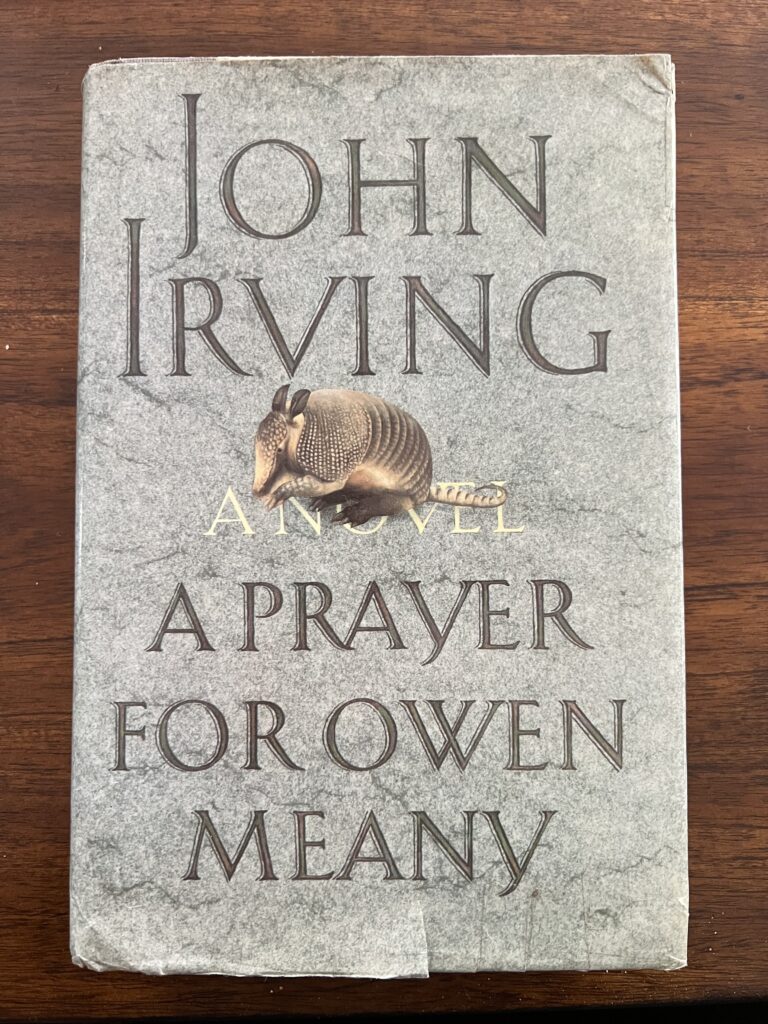
A Prayer for Owen Meany (1989) is one of the most powerfully spiritual books I’ve ever read. The continuous foreshadowing in the plot points directly to the ending of Owen Meany and Irving writes the endings to his novels first. Meany sacrifices his life in the book’s final pages to save others, a group of Vietnamese orphans, and the way he and Wheelwright save them is there in plain sight throughout. Wheelwright and the reader need only to have believed in Owen, “…one of God’s miracles.”
Meany’s dialogue is in caps throughout the book and shouting is key to his July, 1968 heroism. A statue of Mary Magdalene in front of a Gravesend church has no arms. Owen reaches out for comfort while laying down his life before realizing he has no arms. His five-foot frame is light as a feather, made so by the hand of God. He and Wheelwright practice a maneuver again and again and again on a basketball court. Wheelwright passes the ball to Owen and lifts him before Owen releases the ball through the hoop. This has to be done in four seconds, the precise time needed for the book’s climactic event.
To say much more would compromise the reader’s awe. A Prayer for Owen Meany is among the handful of books I’ve read that makes me believe the author might be a conduit to a Higher Power. Was Irving thus inspired? I won’t count it out.
Among Wheelwright’s final narration are the words, “We did not realize that there were forces beyond our play…O God-please give him back! I shall keep asking You.”
The mystic Krishnamurti, when asked how he found peace, said, “I don’t mind what happens.”
This is the best I can say in reaction to The World According to Garp. The reader doesn’t celebrate the novel. He endures it, much like driving on the Cross Bronx Expressway while whistling 96 Tears by Question Mark & The Mysterians. The lunacy, in this case, is over the top. Garp’s biological father is a severely brain-damaged WWII Army Air Force ball-turret gunner known for two things post-trauma: He can only utter one word, fittingly “Garp,” and he has a constant erection. Garp’s mother Nurse Jenny Fields takes advantage of the latter to conceive the title character. Who needs lust?
After living at, working at and attending the Steering School, obviously Phillips Exeter Academy, mother and son decide to become writers during a year in Vienna. I found myself thinking of Krishnamurti’s advice while reading the 75 unnecessary pages of Garp’s novel within a novel. “Lay on, Macduff.”
Nurse Jenny Fields puts T.S. (Technical Sergeant, his unknown father’s rank) Garp to shame with her autobiography A Sexual Suspect, the first line of which is, ” In this dirty-minded world, you are either somebody’s wife or somebody’s whore-or fast on your way to becoming one or the other.”
Fields strikes a chord with women seeking empowerment but also becomes an icon to a sect of self-mutilating misguided feminists. They purposely inflict on themselves the deep physical wounds Ellen James, an 11-year old sexual assault survivor, is left with. The nurse’s Dog’s Head Harbor mansion by the sea becomes a safe space for all wounded women. Among them is 6’ 4” trans woman Roberta Muldoon, a former tight end for the Philadelphia Eagles. She is Garp’s best friend and helps him navigate the worlds between the writer and the self-mutilating feminists and between Garp and his English professor wife, Helen.
Garp is clear in his disdain for the self-mutilating feminists, known as Ellen Jamesians. When the real Ellen James shows up in his life, seeking advice on how to become a writer, he does what his late mother would have done. He invites her to live with the Garps.
Irving writes, “Ellen James shut her eyes as if she had fainted for joy.”
“I hate the Ellen Jamesians,” she writes. “I would never do this to myself.”
But what Ellen James has given to Garp, the Ellen Jamesians will soon take away. Lunacy and sorrow in servings too large for this reader to digest.
Helen’s affair and a dopey Garp driving habit result in a family tragedy that claims the life of their young son Walt. The three surviving family members need the healing powers of the mansion by the sea.
The book ends with 30 repetitive pages of “whatever happened to?” virtually every character in the novel. The book’s last line is, “In the world according to Garp, we are all terminal cases.”
“Bring out your dead!”- Monty Python and the Holy Grail
You can reach John Angelo at timelywriter@hotmail.com.