
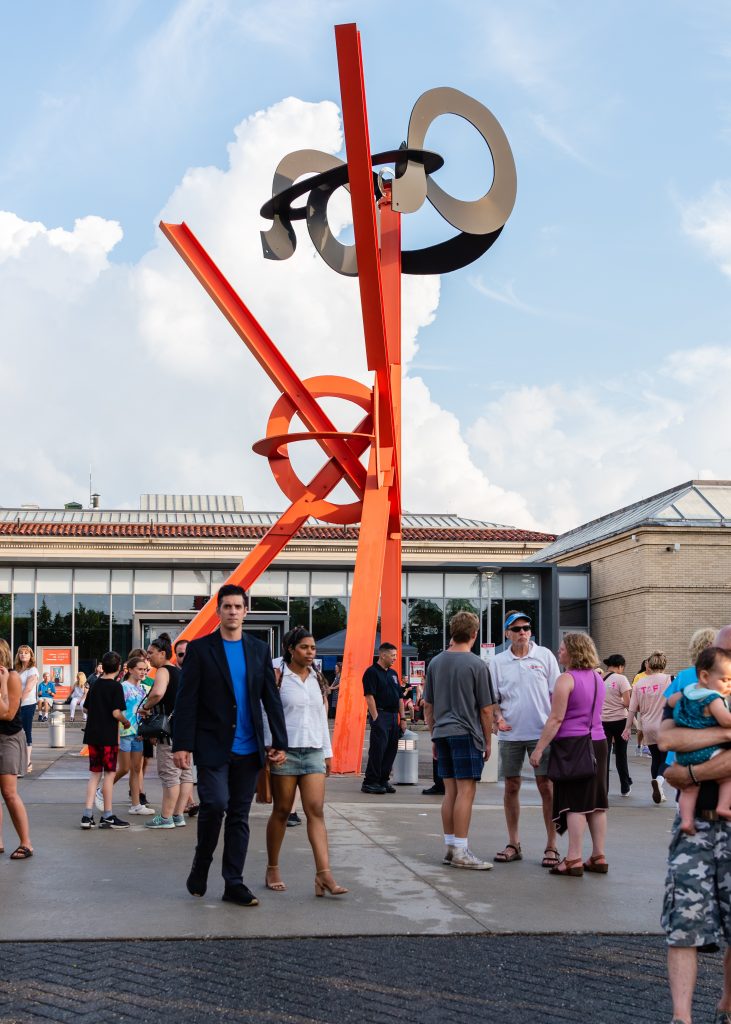

When you pull into the parking lot of the Currier Museum of Art, you see it: a monumental red sculpture reaching into the sky.
It’s Origins by contemporary artist Mark di Suvero. Here are the details. It’s 36 feet tall, constructed with industrial I-beams that contrast with the horizontal structure of the museum. There’s a black painted curlicue of steel high up in the center of the sculpture that moves, ever so slightly, in the breeze.
This sculpture, however, is so much more than its materials and scale. For many of us, it’s the landmark that lets us know we’ve arrived at the Currier.
There’s something achingly beautiful about landmarks. They connect to something deep within us we use to place ourselves in the larger world. Maybe, for you, it’s the sight of the Millyard, glimpsed from 93, lit up at night. Maybe it’s that first “Moose Crossing” sign on your way north. Maybe it’s classic Manchester, like the Red Arrow. Whatever the landmark, they are anchors in our personal geography – how we know we are home, or very nearly there.
And yet this Currier landmark is always changing, even as it stands still. There’s the orange hue to the shade of red di Suvero preferred, which looks different in every type of light. There’s the movement of the steel curlicue, fast or slow, depending on the wind. Whether you stand up close or far away, on one side or another, you see a slightly different sculpture every time.
There’s also the factor of time. As an outdoor sculpture, the New Hampshire elements are part of its story. Since di Suvero created Origins between 2001 and 2004, it has weathered seasons of heat and cold, snow and rain. It stayed put, with grace and integrity, as the leaves fell, year after year. In its texture and color, there is something almost human about its resilience, but also its evolution.
Now, this summer, it is time for restoration. Origins goes back to its origins. Conservators are at work this month to return the sculpture’s paint color to its original brilliance. Great art requires tending, care, and love. You might see the process unfolding on your next visit, or simply the restored work, shining brightly.
When you get out of your car, and hold a hand up against the sun, look up at this inspiring sculpture. Admire the change, but also the familiarity. Say hi to the work of art that is also a landmark, as it welcomes you to your hometown art museum.
For more of the story of Origins by Mark di Suvero, visit the Currier’s free digital guide on Bloomberg Connects, where you’ll find an audio tour of museum highlights.
Follow along with the conservation of Origins on the Currier’s Instagram at @CurrierMuseum.

Ali Goldstein is a writer who first fell in love with art museums on a French class field trip to see a Degas exhibition at the Detroit Institute of Arts. Today, she is the Director of Marketing and Communications at the Currier Museum of Art, where she helps others take their first step into the arts. She can be reached at agoldstein@currier.org.