

MANCHESTER, N.H. – A proposal to transform the historic Chandler House into a “social club” took a step forward on Thursday night after it received several variances from the Manchester Zoning Board of Adjustment.
Built in 1878, the building was purchased in 1915 by the Roman Catholic Diocese of Manchester and housed numerous bishops and nuns before falling into disrepair. A grassroots effort arose to save the Chandler House, leading to its eventual sale to the Currier Art Museum.
Located directly across Beech Street from the Chandler House, the Currier Art Museum originally planned to use the Chandler House for office space and an artist in residence program until it was determined that such an approach would not be financially viable, leading to another sale. That’s when Ben Pfinsgraff stepped in.
After a stint as a minor league pitcher in the Philadelphia Phillies organization, Pfinsgraff eventually entered the world of finance in Manhattan before becoming one of the co-founders of the Common House: a “third-place” style blending the atmosphere of coffee shops, co-working spaces, restaurants, bars, hotels and fitness centers to create a unique membership-based experience designed to create a sense of community.
Currently there are four locations of the Common House located in cities across the south, all in repurposed historical buildings.
The largest concern from the board came from a lack of onsite parking, something Pfinsgraff and engineer Brian Pratt said could be resolved through valet parking service, with the Currier Art Museum lending parking spots with Deka also lending parking spaces one block south at the corner of Beech and Pearl as well as near its facilities in the Millyard.
The concept received support from several members of the public along with some members of the board such as Craig St. Pierre, who recused himself on this matter given that he lives next door, and alternate member June Trisciani.
“I’m a huge fan of this,” said Trisciani. “It gives Manchester just one more cool factor to be where we need to be and build our city.”

St. Pierre said that the nearby Liberty House, Ash Street Inn and several nursing homes establish that such a use is not uncommon in the area and several Deka employees such as Caleb Kase stated that if the Common House were allowed to open, it would provide a draw for young professionals in the city.
“There are too many people that avoid Manchester or find other places to go or drive all the way to Boston when there are plenty of things to do here in Manchester,” said Kase. “We all want a place that is beautiful and great to live in. Manchester is a wonderful place and it needs a little help to bring itself back. (This proposed use of) Chandler House is a great opportunity to do that.”
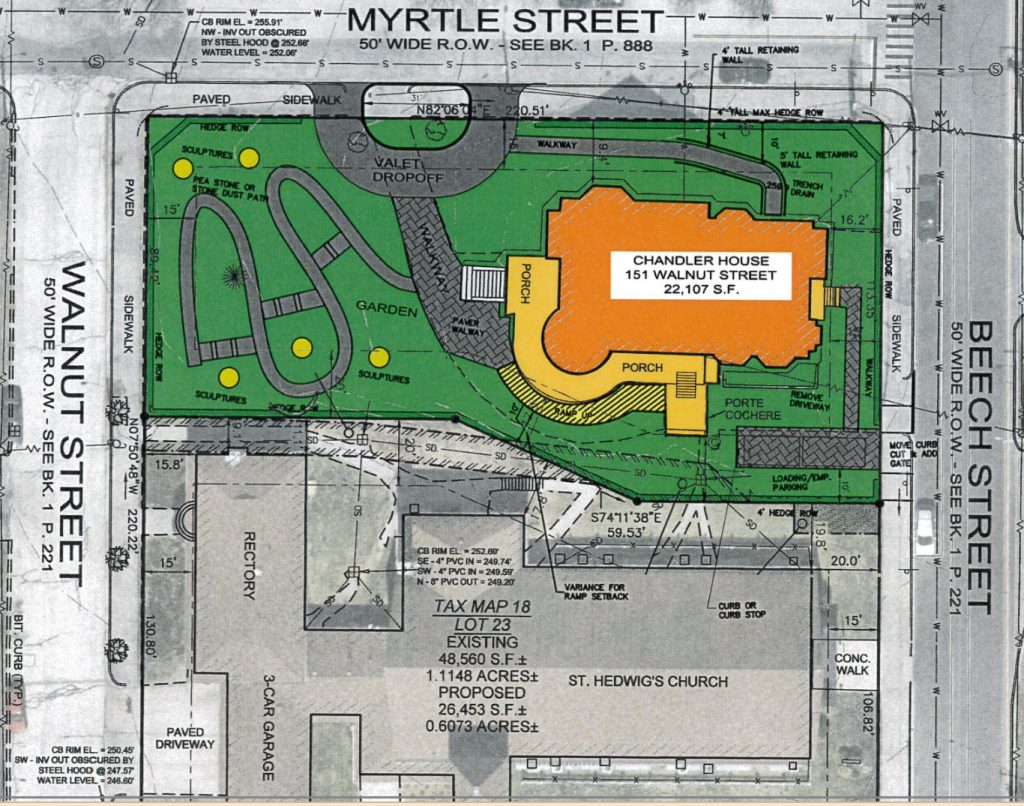
Only two people spoke in opposition to the proposal. One was a woman that did not give her name who said that the proposal would only benefit the operators of the Common House and have a negative impact in terms of traffic, parking and noise to St. Hedwig Parish, which shares a block with the Chandler House.
The other speaker in opposition was attorney Christopher Boldt, representing the Roman Catholic Diocese of Manchester. Boldt stated that the proposed use would not provide substantial justice, one of the criteria for granting a variance where the benefit of the proposed use outweighs the harm to neighbors, specifically St. Hedwig Parish in this case. Boldt also said deed restrictions in the sale of the property which he believed the Common House proposal violated. Knowledge of the restrictions serves as what Boldt argued was a “self-imposed hardship”, stating that voluntary acceptance of a limitation to a property’s use does not meet the hardship criteria for granting a variance where a lack of alternative uses for a property other than the use proposed in the variance request would impact the property owner’s ability to fully utilize the property.
Trisciani argued that the deed restrictions were a matter between private entities and thus beyond the scope of the zoning board’s decision-making process and that resolving the deed restriction was a matter for the parties involved in the dispute rather than the zoning board.
Following Boldt’s comments, supporters of the Common House proposal also challenged the standing of the diocese, stating that St. Hedwig is a property rather than a “neighbor” and thus any potential negative impact would not be comparable to someone that lives on an adjacent property.
Zoning Board chair Robert Breault and alternate member Matthew Carnevale felt that it would be prudent to table the matter to obtain opinion on Boldt’s assertions from the city’s legal counsel prior to making a decision with Trisciani reiterating her earlier statement.
The requests for variances from city ordinance relating to Membership Fraternal and Social Organizations and Clubs, Hotels and Motels and Extended Stay Facilities, Indoor Health, Fitness Center, Pool, Gym or Membership Recreation Center, Side Yard Setbacks, Fences and Walls and Parking Maneuvering were granted on a 3-1-1 vote. Breault voted in opposition and Carnevale abstained, with supporting votes coming from Trisciani, Greg Powers and Kathryn Beleski.