
MANCHESTER, N.H. – The Manchester Board of Mayor and Aldermen received a presentation on Oct. 15 detailing recommendations from an employee compensation study seeking to make the city more competitive in attracting and retaining quality staff members.
There was initially a recommendation to conclude the study out of fear that it would invariably harm local taxpayers, but that decision was later reversed after the necessity of the study was understood by the board.
The purpose of the study sought to address the complexity and ineffectiveness of the city’s employee compensation policies that had arisen since the development of its last overhaul in the late 1990s by the Yarger-Decker company. Since that time, the Yarger-Decker scale has evolved into numerous variations among the city’s 13 separate collective bargaining units, leading to pay scales that are not competitive to comparable municipalities and even different departments within the city itself.
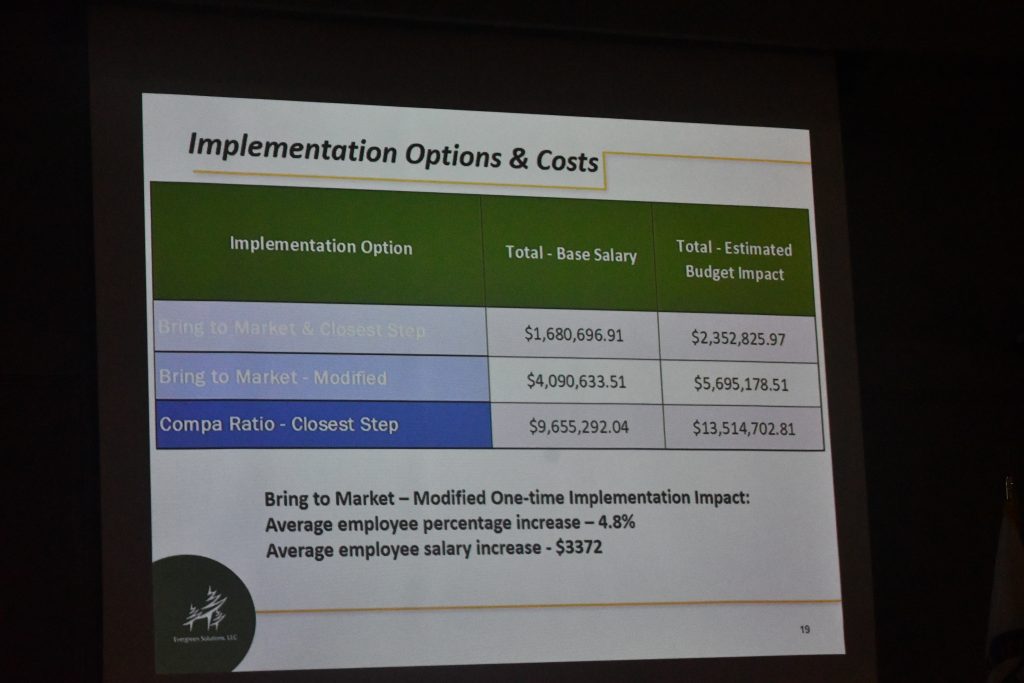
Rob Williamson of Evergreen Solutions joined City of Manchester Human Resources Director Lisa Drabik for the presentation, which boiled down to three potential options.
The first option adjusts employee salary steps that are below comparable municipalities and brings them within that range while adjusting employees with comparable salaries into new steps that reflect their pay range.
The second, called the Compa ratio, simply brings employees into median compensation ranges found in comparable municipalities.
The third option, which was recommended by Williamson, would modify step ranges and bring employees that are below the recommended minimum wage for that position compared to other municipalities into a new step with the recommended wage with a 3% raise. In this plan, employees are already within the recommended range would put into a new step that reflects their salary and if that move is not a 3% raise, they’d be moved up to a higher paying step.
Within all of these options, which the Aldermen are not required to adopt, the presentation also recommended replacing several “longevity steps” that are outside of the regular step scale and replace them with bonuses instead. There was also a recommendation that these bonuses be based on an annual merit-based performance review designed by the aldermen.
Several aldermen voiced concerns about this merit-based approach, with Board Chairman Joseph Levasseur stating that in 2003 the BMA secretly removed merit-based raises due to jealousy among employees within departments who felt they got arbitrarily lower raises than their peers.
There were also concerns over keeping a uniform 13-step plan given the belief that some jobs don’t need 13 separate steps and there are different benefit needs for different bargaining units.
“We have a mess now; if we implement this, we’ll have a mess in three years. I think it needs to be separate by bargaining unit,” said Ward 5 Alderman Anthony Sapienza.

Williamson said that the issue wasn’t the amount of steps, but rather making realistic steps, as the city has not hired anyone at Step 1 for any position for several years. He also noted that for entry-level workers, Manchester pays 22% less than its peers and 9% less than its peers for mid-career workers.
Drabik added that different numbers of steps were investigated, but it was determined that fewer steps could exasperate current salary inequity problems.
The merit-based step increase recommendation is also within the purview of the BMA, and the board could decide to stay with the current system where employees automatically get step raises on the anniversary of their hiring until they run out of steps. Either way, Williamson continued to emphasize that without realistic salary range proposals, the city would be unable to obtain skilled employees for positions. He used the position of commercial assessor as an example, stating that most comparable employers offer a minimum of $82,000 a year while the city of Manchester’s low-end salary proposal for the position is $68,000 a year.
Williamson praised the response rate from city employees while gathering data for the study, noting that 84.64% of all employees and 98.11% of all supervisors filled out a survey, a figure he said was unprecedented for an organization this size.
Armed with the information from the presentation, the topic of municipal employee compensation review goes to the BMA Committee on Human Resources.