
CONCORD, NH – A question from an audience member summed it up: Given prices, low inventory and the fact the average age of a first-time homebuyer is 40, what hope is there for younger people who want to buy a home in New Hampshire?
The question didn’t just capture the theme at the March 18 annual Homeownership Conference, but one that’s resonated in the state for the past several years and is only getting more insistent.
Wednesday’s conference, hosted by New Hampshire Housing, offered some glimmers of hope, but also highlighted the harsh reality of the housing crisis in the state: A median sales price well above half a million dollars, inventory at near-historic lows and a property tax rate that can equal as much as a quarter of a monthly housing payment.
Looking for a starter home? It’ll still come with a price tag of around $399,000, requiring a household income of $125,000 if you want affordable payments. If you can afford a home at the state’s median sales price – it was $525,000 in February – you’re one of the lucky 18% of households in the state with a median income of $182,000 who can afford that price. Expect, though, to get a fixer-upper.
Buying new construction? Prices average around $750,000.
Even if you’re not shopping for a home, the tight and expensive housing market still has an impact.
“It’s a key workforce issue,” Gov. Kelly Ayotte told the 200 gathered for the conference Wednesday at the Grappone Conference Center. She said she talks to businesses “every day” that want to locate in New Hampshire, but to do so, they need housing for their workforce.
No silver bullets, but small changes
The glimmers of hope, though, are there, speakers at the conference said.
Building permit requests in 2025 were the highest they’ve been in 20 years.
While there’s less than a two-month inventory of existing homes, there’s a 4.4 month inventory of new construction.
Several speakers stressed that there’s no silver bullet for solving the housing crisis, but that change will come through a variety of actions on the local, state and federal level.
The biggest indicator that things will improve is the amount of attention now focused on the problem, Matt Emery, of the National Association of Realtors, said.
“I haven’t seen the administration and Congress paying this much attention to housing since the financial crisis [of 2008-2010],” Emery said.
In answer to the audience question about whether there’s any hope for younger people who want to buy a home, Sasha Hewlett, of the Mortgage Bankers Association, said, “The sum of all parts will move things eventually.”
She said the fact there are so many in the industry, including those at the conference, who believe in housing and its importance as an affordable option for everyone, will ensure change.
“Markets change, markets shift, and things don’t always last forever,” she said.
Property tax obstacle
One of the biggest hurdles to buying a home in New Hampshire is the high property tax rate. Because there is no income or sales tax, the state government relies on property taxes to fund services, and has one of the highest average property tax rates in the country.
That rate is not evenly distributed – for instance a homeowner in Lee may pay 13% on a $500,000 house, while one in Nottingham may pay 6%, Phil Sletten, of the New Hampshire Fiscal Policy Institute said.
The lower a household’s income, the bigger bite property taxes take, Sletten said. The lowest-income homeowners, the 20% with the lowest net income – $35,000 or less – pay an average 5.9% of their income for property taxes. Of the highest 20%, those making $153,9000 to $329,300 pay an average 4%, those making $329,300 to $721,000 pay 3.3% and those making more than $721,000 (1% of homeowners) pay an average 2.2%.
Buyers don’t often realize at first that the mortgage amount the bank pre-qualifies or pre-approves them for, when broken down to monthly payments, includes property taxes, Carol Zisk-Mailloux, a broker with Waterstone Mortgages, said. They are often surprised that a $400,000 pre-approval doesn’t mean that can buy a $400,000 home.
She said in a lot of cases, the property tax bill represents a quarter of a homeowner’s monthly payment. “Taxes are almost more important than the purchase price,” she said.
“It can be really hard for buyers” who are looking at living in certain towns because they like the school system, for instance, but the property tax rate is out of reach.
And, unlike a fixed mortgage rate, the tax portion increases. She cited her own experience – when she and her husband bought their home in 2013, the tax bill was $5,100 a year. Now it’s $10,000.
An added wrinkle is that if buyers go under contract in November, the monthly payment they’re budgeting may change when the December tax bills go out with a higher rate.
She said she hasn’t seen a buyer walk away over a tax change, but it can involve some tweaking of the financing.
Because of low inventory and the fact that taxes are high everyone, buyers don’t always have an option of choosing a house in a town on the basis of its tax rate, she and Sletten said.
Assessors have to do a balancing act, Steve Hamilton, an assessor with Whitney Consulting Group, said. Market rates are the largest driver of assessment changes, and because of how assessments work, affordability isn’t a factor.
He said, though, that of the 23 municipalities that his firm works with, everyone is focused on keeping property taxes as low as they can. “It’s isn’t for a lack of trying,” he said.
He also noted that there are some areas were the property tax rate of increase is steadily low and other places where it skyrockets.
Sletten said that median sales price is also low or decreasing in some counties, which could be a sign that there’s some correction to the post-pandemic increases.
Above: Slides from the Property Taxes and Housing Affordability in New Hampshire presentation.
‘Normal doesn’t really exist’
Bob Quinn, CEO of the New Hampshire Association of Realtors, is often asked when things will get back to normal with the state’s housing market.
He noted that the last time there was a balanced market – six months’ worth of inventory – was 2016. That and rising prices have been what’s been “normal” for a long time.
“Normal really doesn’t exist,” Quinn said.
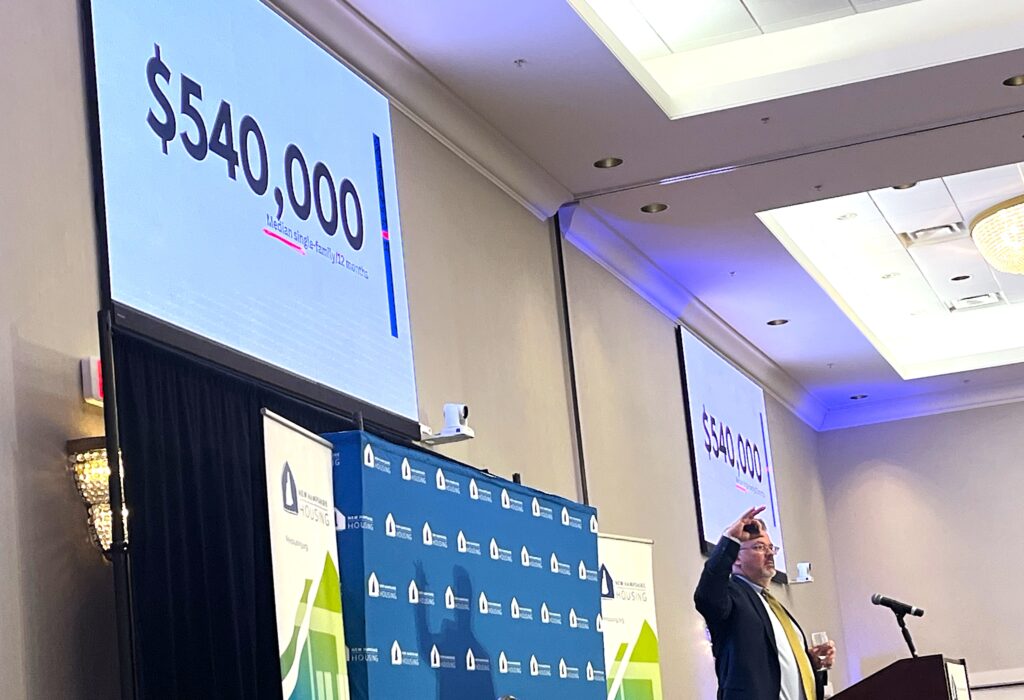
Low inventory for single-family homes is one reason that prices are so high he said as the January median of $540,000 lit the screen behind him. While the median sales price of a single-family home has risen 125% in the last decade, median income has only gone up 58%, he said.
Last year’s increase in building permit requests was for multi-family construction, he said. Single-family permits have decreased. “If we’re going to get more single-family houses, that is going to have to change,” he said.
Quinn said that while some legislators say that high-priced new construction doesn’t help the housing crisis, it’s actually not the whole story. When someone leaves the home they’re in for a high-priced new-construction house, it opens up their lower-priced house for another buyer.
One of the keys to housing churn – people moving to new properties and opening up what they were in for others – is new construction at the end of the chain.
“If there’s not new construction, [the market] doesn’t change,” Quinn said.
The legislative season hasn’t had the big housing changes that the previous one did, Quinn said, but some small changes will make a difference.
Some of the bills in the Legislature that Quinn said can help are:
- SB 564, which prohibits municipalities from limiting maximum road length and putting a cap on how many housing lots there can be on a dead-end road.
- SB 415, which doubles the size, to 20, of a condominium development that is exempt from registering with the state attorney general’s office before selling, which streamlines the process for developers.
- SB 456, which changes the face the ordinance that the developer is seeking a waiver of from that it presents an “unreasonable hardship” on the developer to that it’s an “unreasonable restriction” on the property.
- HB 1103, which allows municipalities to use community revitalization tax relief credits on a wider variety of properties and structures.
All of the bills were approved in the legislative branch they originated in, and now must be approved by the other branch and go to Ayotte before they can become law.
Ayotte also said that she wants to hear creative solutions to fixing the housing crisis, and state officials are also looking at state property to see if it can be used to create lower-cost housing.
Federal housing help
Two bills in Congress could also help ease the housing crisis, though partisan infighting doesn’t make their passage a sure thing, the panel with Hewlett, Emery and Stockton Williams, of the National Council of State Housing Authorities, said.
The Senate’s 21st Century ROAD to Housing Act and the House’s Housing for the 21st Century Act are similar. Normally, the leadership in Congress would meet and iron out differences, Williams said, “But that’s not how the process has been working out lately.”
Emery said that one issue is “people are trying to figure out they biggest solution they can to the issues or what they say as the issues” and it’s bogging down the process.
The bigger a bill gets, and the more elements it has, the harder it is to find agreement.
One issue bogging things down is something that’s not a big issue in the Northeast – institutional investor property purchases, which are property buys of multiple units by investment firms. The bills are focused on capping or limiting institutional investor purchases, but even finding agreement on how many units constitutes an investor purchase is difficult.
Hewlett said that the focus on fixing the housing crisis is great, and there is a lot of good stuf fin the bills, but there’s a concern among lenders that anything related to an institutional investor ban could hurt multi-family development.
The panel agreed that anything that would limit “mom and pop” investors who buy a small number of units would hurt the market and depress important investment.
Emery added, too, that no matter what the number of units were capped at, large investors would find a way to get around it. He also pointed out that it was institutional investors who helped the country climb out of the financial crisis more than a decade ago.
In the end, Emery said, “There isn’t going to be one thing that solves everything.”
NH Housing highlights
Despite the tight market and high prices, NH Housing was able to help 1,078 families buy a home in 2025, Julia Jussif, NH Housing chief programming officer, said.
Of the 1,078 mortgages it backed, 941 were to first-time homebuyers. Overall, it backed $348 million in mortgages, $5.4 million in downpayment assistance to 584 of the borrowers.
The average age of the homeowners was 36, average household income $97,000 and average mortgage $322,000.
Help for homebuyers not only came through mortgage and downpayment help, but also financial education resources and special grants, including work with Granite State Independent Living and Habitat for Humanity.
NH Housing also financed 1,915 units of multifamily rental housing, oversaw 15,000-plus rental units and administered federally funded rental assistance for 9,000 households.