
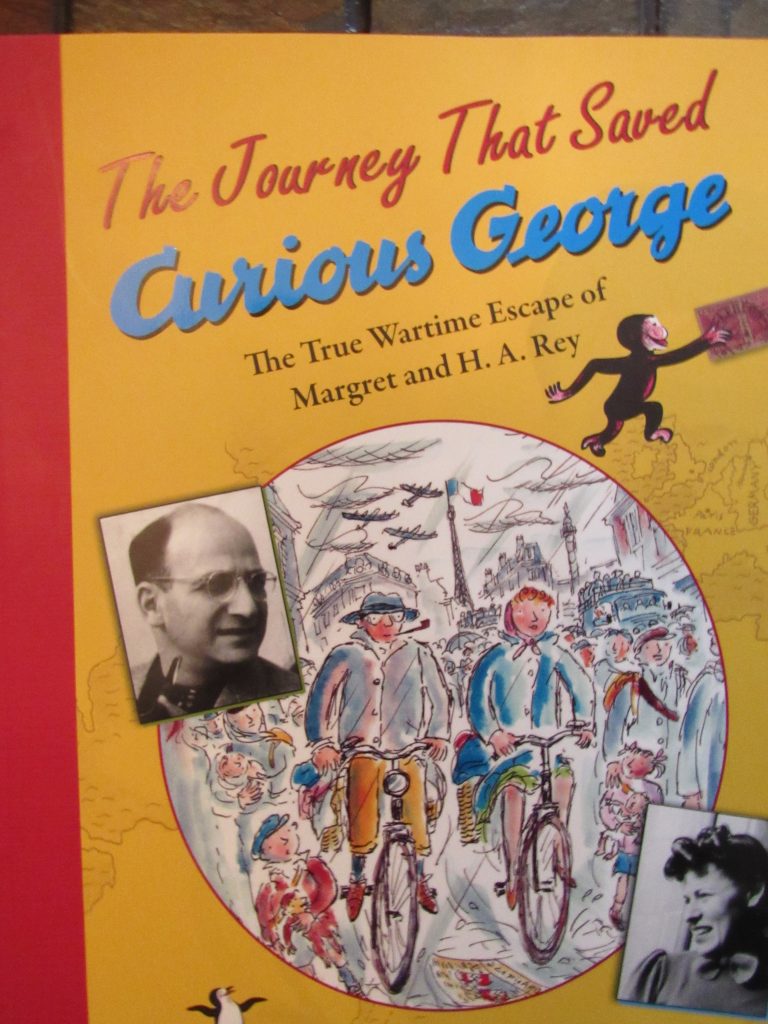

The long and winding road that landed Hans and Margret Rey into a modest cottage for 20 summers in Waterville Valley starting in the 1950s, is no less enticing than the adventures of their creation, a clever and now-famous monkey named Curious George. The perennial children’s book and now media favorite first appeared in 1941, a year after the Reys fled Paris on bicycles constructed by Hans from a tandem bicycle and spare parts. They got out of Dodge in June 1940, just 48 hours before the Nazis marched into Paris. The Reys were Jewish. They carried the manuscripts and artwork for The Adventures of Fifi (eventually titled Curious George), Whiteblack the Penguin, Raffy and the 9 Monkeys, and two lift-the-flap books in a satchel placed in a bicycle basket. Every other plane, train and automobile out of Paris had been spoken for days ago. Ditto for horse-drawn carts and barges on the Siene.
They were good to go by train through Spain and Portugal after pedaling 104 kilometers over three days to Orleans, sleeping during their ride wherever they’d landed at dark. A French official on the train suspected them of being German spies as their spoken French had decidedly German accents. They had the right papers to enter Spain but papers can be forged. The real proof they were a harmless children’s book illustrator and writer came when they opened the satchel and manuscripts and drawings of magical animals came out.
But let’s back up.
Between Germany’s post-war hyperinflation and an economy wracked by the costly Treaty of Versailles, there was nothing to hold Hans in Hamburg, Germany. He arrived in Brazil in 1924. Margret followed a decade later with the Nazis casting an increasingly dark shadow over Europe. Hans had been a friend of Margret’s family in Hamburg. They soon got married and became Brazilian citizens. A European vacation turned into a four-year stay in Paris and they were vacationing in the Normandy region when war broke out in September, 1939. They returned to Paris in January, 1940, falling into the false sense of security that all of France was under. The German army’s Blitzkrieg was referred to as the Sitzkrieg or “phony war” in France that winter. The catchy English words to one ukulele tune joked, “I’m biding my time on the Maginot Line.”
But Parisians weren’t laughing when the weather warmed and German tanks punched through the heavily forested Ardennes in a matter of days. Suddenly, all of France lay open to the German army from the border to Dunkirk on the English Channel.
As Brazilian citizens, the Reys had a crucial advantage over other refugees. The Portuguese consulate in Lisbon gave them the necessary papers to cross Spain and Portugal by train and then the Atlantic by steamer. Their second stay in Rio was only long enough to secure passage aboard the Angola for New York City, near where Margret’s sister lived. They had little money but secured a four-book contract from Grace Hogarth, an editor at Houghton Mifflin in New York. Hogarth, like the Reys, had fled the war. The editor was familiar with their European work including Zebrology and Le Cirque. The publisher’s only request was that they change the monkey’s name from Fifi. Thus Curious George was born.
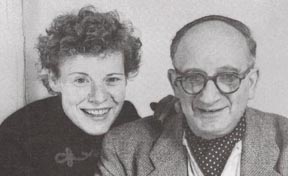
Anita Silvey, a former vice president at Houghton Mifflin and the author of 100 Best Books for Children, said in the the 2017 movie Monkey Business: The Adventures of Curious George’s Creators, “Every children’s book tells a story, but every children’s book has a story behind it.”
After the Reys passed, Hans in 1977 and Margret in 1996, Silvey found the artwork and text for Whiteblack the Penguin Sees the World in the H.A. and Margret Rey Papers, now in 300 boxes at the University of Southern Mississippi’s de Grummond Children’s Literature Collection.
The 2005 book The Journey That Saved Curious George-The True Wartime Escape of Margret and H.A. Rey, by Louise Borden and illustrated by Allan Drummond, tells the Reys’ bicycle/train/steamer story.
Hans was an astronomy buff. In search of a place that offered a clear night sky, the couple found Waterville Valley. They worked on The Stars: A New Way to See Them (1952) and Find the Constellations (1954) during their New Hampshire summers. Both were children’s books.
In general, Margret wrote the text and Hans illustrated their books. It was a true collaboration, however, as they acted as each other’s editors. Hans has been called a Renaissance man but that is incomplete as Margret was a Renaissance woman who taught creative writing at Brandeis, and had a solo show of her watercolors after studying art and photography at Germany’s Bauhaus between the wars. She was also an astute businesswoman.
The mission statement for the Rey Cultural Center in Waterville Valley reads, “…to foster curiosity, creativity and community through programs that promote the arts, sciences, nature and literacy for all ages, honoring the Reys’ legacy of lifelong learning and discovery.”
The Reys never had children of their own but the community’s children were welcome at their cottage. Hans was able to throw his voice, thus peopling the local nature trails with all kinds of animal and human friends for young children. The original cottage was finished in 1958 but has been moved several times. It is now houses the Rey Cultural Center and the Curious Cottage Preschool on Noon Peak Road.
“We call the Curious George Cottage ‘The House that Hans Built,” said Leah Elliot, executive director of both the H.A. and Margret Rey Cultural Center, a non-profit, and the preschool.
“Hans liked to give his drawings to children,” Elliot continued. “There are still people around who were given original illustrations by Hans Rey when they were children. The drawings were completely Rey-like, really well done.”
Lay Lee Ong opined in an Ink Link Soap Box contribution four years ago that the Curious George Cottage was better served as a landmark for visitors rather than as a preschool. Lay was Margret Rey’s housekeeper and close friend for almost 20 years as well as literary curator and executor of the Reys’ estate. She has worked extensively with the Reys’ de Grummond Papers.
Elliot has a different opinion.
“The cottage already had quite limited hours,” the director said. “Margret was in support of what we’re doing, the education of little humans.”
The Reys’ legacy is obvious in the Waterville Valley community. Their interest in the environment is reflected in updates to the cottage including insulation, more efficient water usage and solar panels. It is now a green demonstration house.
The cultural center hosts literary and current events discussion groups, the Mary Bierbrier Community Garden, nature trails, a summer camp for both families and children, stargazing, photography, a speaker’s series, the Music in the Valley performances and art shows. The primary focus for children is on experiential learning.
If Curious George were actually alive today? Born in France, he has been called the “ultimate immigrant.” His friend The Man with the Yellow Hat was unnamed until he was given the moniker Ted Shackleford in the 2006 Curious George movie. This was the same unsettling juju that Mr. Bean took on when he first spoke in his movie. Paraphrasing Elvis: “Some things aren’t meant to be.”
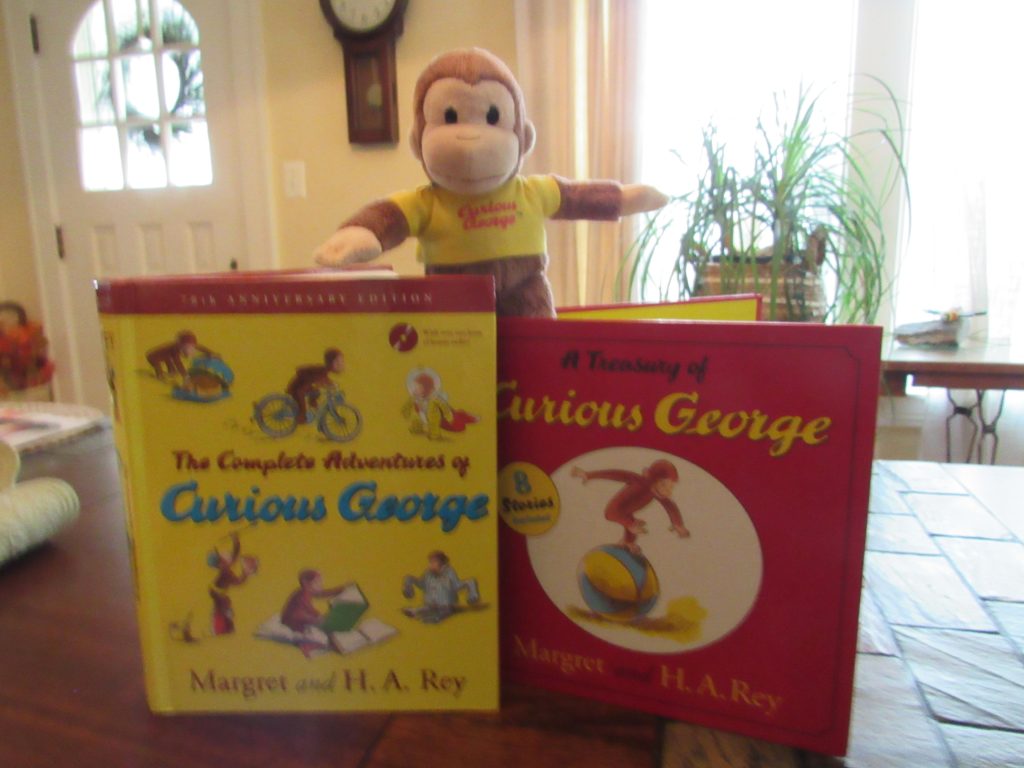
George is now officially Big Business. The Reys wrote seven George books between 1941 and 1966, starting with Curious George and ending with Curious George Goes to the Hospital. These are known as the “original” adventures as opposed to the “new” adventures. There are now over 130 titles. The 2006 movie, the first of eight full-length animated films, grossed $70 million. The lovable monkey’s television show aired 108 episodes over nine seasons. A 2016 New Yorker article by Adrienne Raphel titled “Curious George Learns About Brand Recognition” states the tipping point had been reached. The original books are now on a secondary vine in sales and recognition to other Curious George media for the preschool set. Yes, there are Curious George books for Christmas, Halloween, Easter and Ramadan and half a dozen books in Spanish, but plush toys, video games, DVDs, a store in Harvard Square and streaming on Hulu push the original adventures lower on the charts. Curious George’s Facebook page has 722,000 followers. His website has 5.45 million subscribers…if you are curious.
You can reach John Angelo at timelywriter@hotmail.com.