

MANCHESTER, NH – Some people knit. Some run marathons, bird-watch, collect rare books or garden gnomes. To my utter bafflement, lots of folks I know have hobbies that involve hiking up mountains and sleeping on the ground in tents.
Now, my longest-standing hobby, begun years ago as a business reporter, involves wandering around trying to figure out what makes an enterprise, especially one that’s locally owned, to thrive.
I can’t help myself. I go to do an errand at a busy neighborhood market or even a tidy strip mall with every space filled…and forget what I came for. Instead, I wonder: What’s the secret sauce here? How do these places thrive through economic ups and downs, staff shortages, a pandemic, all in a time when Amazon-the-Goliath and superstore chains are throwing their weight around?
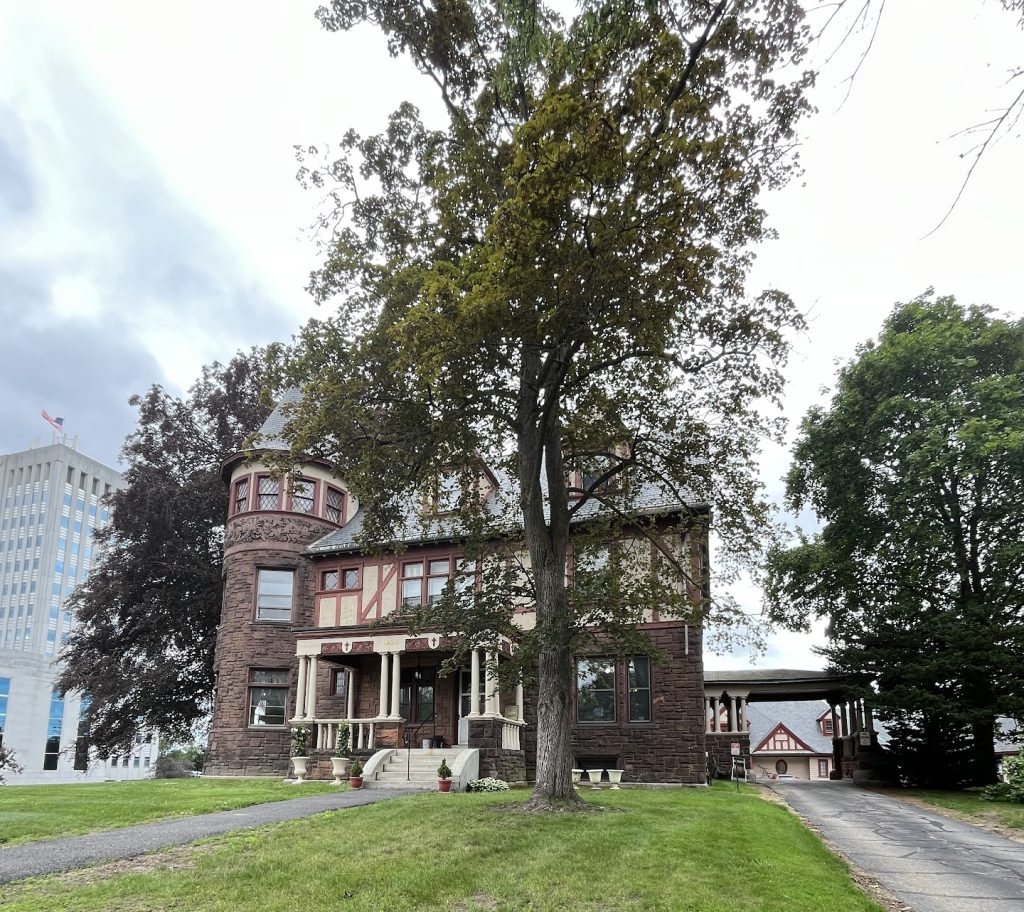
All of which brings me to Elizabeth Brooks’s Elavina Salon & Spa at 1802 Elm St. in Manchester. For the past 14 years the business has operated in the carriage house in back of the circa 1800s Queen Anne-style Frank Pierce Carpenter mansion I’ve admired on many a walk.
It’s hard to imagine what Carpenter (1845-1938) would have made of this transformation of his property, which since 1994 has had a proud place on the National Register of Historic Places. Surely he would have approved of the name. “ ‘Elavina,’ combines the first names of his wife and one of his daughters” Brooks explains. But stepping inside the humming 2,800-square feet of a place catering to the hair and skincare needs of so many women and men might be pretty mind-blowing.
(Or perhaps not. Carpenter, who served as President of the Amoskeag Paper Co., and was a bank and railroad executive, as well as a very open-handed philanthropist in his later years, might well have appreciated the buzz and overlapping daily demands of such a business. They didn’t call it multi-tasking way back in his day, but the principles were pretty much the same.)
TEAM BUILDING
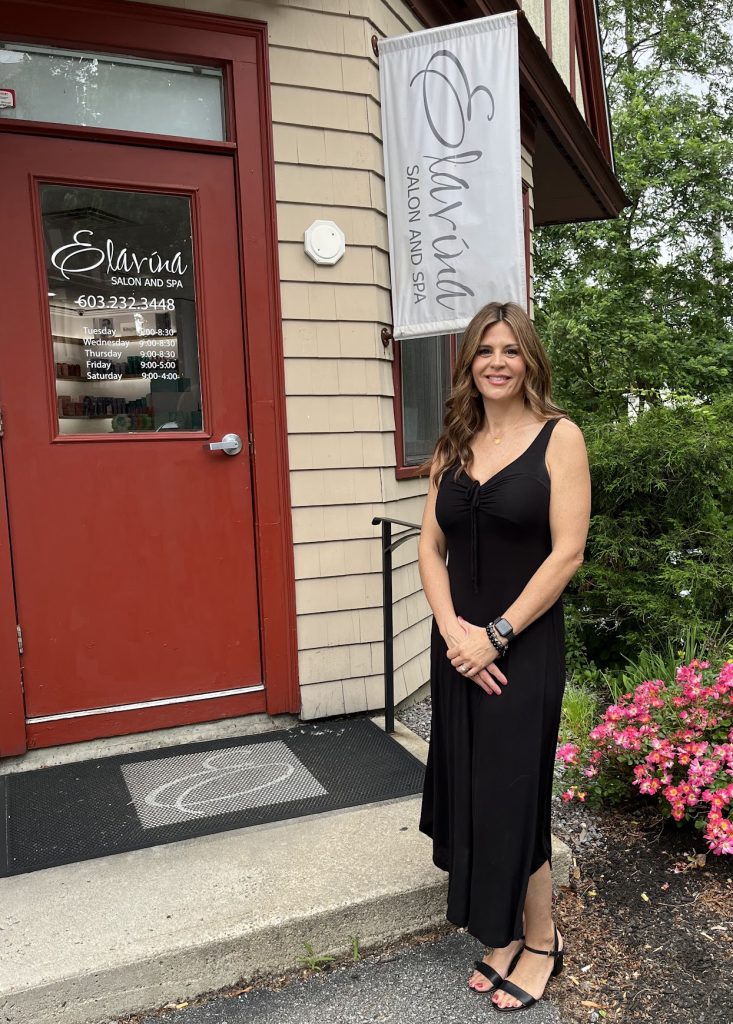
I asked salon owner Brooks to describe some of the things that have helped her build a business in an industry where longevity is hard to achieve. It helps, of course, that the work she does comes from an attraction that took hold early. “My best friend’s mom had a salon, and I fell in love with it,” she says. Her next answer mirrors the one thing that I’ve learned is common to nearly all successful small businesses: close attention to the needs of her workforce.
“I work for them,” says Brooks, when asked how she manages a team with a mix of creative folks, both veteran stylists and those earlier in building their experience. “I’ve learned over the years how to listen to them,” she says, “and the point is to always try to lead by example and give them what they need and want in order to keep growing in their work.” She elaborates: That means fostering a culture supported by ongoing training, both inside the operation and outside, at industry events and courses. Further, all 15 (give or take) of Elavina’s stylists, estheticians, and front-desk staff are offered benefits that support retirement and healthcare costs.
This means that Elavina staff are employees rather than contractors, a significant difference from those salons that rent chairs to stylists. That rental model goes back for generations and can be a steep climb for those fresh out of beauty school, and a challenge for even many long-career professionals.
Hiring and retention, perhaps the biggest hurdle for most small businesses today, is particularly so in the salon industry, says Brooks. This work requires some paradoxical abilities. “A good hair stylist has artistic sensibility as well as complex, always-evolving technical skills,” says Brooks.
(If you’ve ever really bombed at coloring your own hair, nothing further needs to be explained by me on this point.)
Brooks describes the successful employee as a very close listener who can provide unique services suited to a client yet also adapts to the overall salon character and environment. “Consistency is the key,” says Brooks. “We all have to be on the same page about delivering services as professionals.” That, she adds, is reinforced by her clear expectations, shared in regular all-team meetings and a detailed handbook.
BEHIND THE SCENES
Not all of the folks who are terrific at providing hair and skincare services are as comfortable on the retail, promotional, and facility demands of the business – the nearly endless dealings with outside vendors, tricky maintenance of the space, and targeted marketing. But without those things, even the best colors or cuts, brow waxes or facials won’t be happening for long. Brooks appears strong on both sides of this equation, and she credits her parents and husband for their early and constant help with planning and financial guidance, and her staff for making it possible for her to step back from the chair in 2023 and focus on the business.
Brooks doesn’t put it quite this way, but it’s also clear from observing her salon that part of an owner’s focus must be on ensuring clients feel that the inevitable increases in time and money that come with today’s services make sense and are worth their investment. Getting that perfect hair color or treatment you want today is a very different dance than it was a few years ago. Now, she says, it “typically has multiple steps, which means more time, more training for the colorist, and more careful advance consultation with the client.” That glow from a facial relies on more training for the aesthetician and a bigger inventory of products for a range of skin-type needs.
Recently that has meant offering more appointment times (Elavina has recently added Monday hours – meaning a six-day week); urging clients to come in for hair consultations at a modest fee; and updating the salon space itself. Brooks’s latest round of changing up lighting and display space, updating wall and floor coverings and furnishings is, she says, as important as staying up with new hair and skincare techniques. Atmosphere matters.
I’d wager that all of this would definitely delight the late and innovative Mr. Carpenter, even if he was bemused by what goes on today in his carriage house.
Kimberly Marlowe Hartnett is a Manchester-based author, teacher, and longtime journalist.