
Story Produced by Concord Monitor, a Member of
Nowadays, when Marc Guillemette enters a hospital room to perform the sacrament of the sick, he feels like a character out of Star Wars.
Guillemette, the director of the Chaplain program at Catholic Medical Center, wears a large plastic gown, gloves, and talks loudly to cut through both his surgical and N95 mask. He is glad he can be there to bless patients who desire a visit from the clergy while most hospital visits are still limited.
But he admits that many aspects of end-of-life rituals now feel cold and dystopian through layers of personal protection equipment and electronics. Saying goodbye through an iPad isn’t the same as holding a loved one’s hand as they die.
“There is something that is missing when you’re looking at someone through the monitor,” he said.
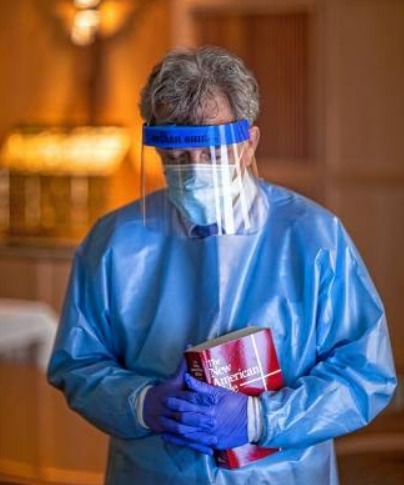
Chaplains in hospitals across New Hampshire are grappling with how to do a routine part of their jobs, like comforting and praying with sick patients and performing end of life rituals.
Kate Morse has seen the countless end of life requests in her time as the Chaplain for Concord Hospital, religious and secular alike.
One family asked the staff to play a college fight song every day at noon for a patient who loved college football. Another patient asked to hear Christmas music in the middle of the summer.
Since the pandemic started, many of these rituals have disappeared. Morse thinks it is largely because family members haven’t been in the hospital rooms helping to articulate what the patient wants. Until recently, most hospitals gave family members limited access until the very end of life to reduce the danger of COVID-19 to vulnerable patients.
In Concord, hospital staff has tried to create meaningful end of life experiences for their patients— one nurse gently braided her patient’s hair while another moved a patient’s hospital bed to face the window every morning.
But Morse worries that without shared rituals, families aren’t able to properly recover from a loved one’s death.
“I think of this as a second pandemic in our country,” she said.
Throughout the human experience, rituals have accompanied dying.
The specific flowers sent to the grieving, the precise prayers recited at the deathbed, and the etiquette followed at funerals, all give the mourning a framework to process the overwhelming emotions that accompany death.
However, since the beginning of the pandemic, the very rituals that were supposed to offer comfort and normalcy became potentially dangerous. The CDC offered a number of guidelines – don’t share prayer books, don’t drive to funerals together, don’t touch the deceased.
To the horror of religious leaders and grief researchers, many death rituals started to dissipate altogether during the pandemic, leaving many concerned about what this will mean for those who are grieving.
Robin Nafshi, the Rabbi at Temple Beth Jacob in Concord, said since common end of life rituals have disappeared, grief has looked different. It seems deeper. It lasts longer.
“It’s not just the death of a loved one,” she said. “It’s the absence of the communal norms that brought them comfort. It is the absence of what is familiar. It is grief upon grief upon grief.”
This isn’t just her hunch – it’s a well-studied phenomenon. In psychology literature, it’s called prolonged grief disorder, which is often characterized by a debilitating yearning for the deceased that lasts longer than six months.
Researchers most commonly see upticks in prolonged grief after natural disasters with many causalities and significant societal disruptions.
Researchers are expecting a surge of long-lasting, complicated grief from coronavirus related deaths. The authors of one article examining grief during the coronavirus pandemic predicted that “worldwide, PGD will become a major public health concern.”
Funerals
Nafshi has presided over several funerals since the start of the pandemic. Consoling families without in-person contact has created a host of complications she never considered before COVID-19. For example, when she’s consoling a family on Zoom, where is she supposed to look?
If she looks at their faces on her computer screen, it seems like she’s gazing at some arbitrary point but if she looks at the camera she can’t actually see the person’s face.
Then, there’s audio feedback and delays and any other multitude of difficulties that arise when technology in a sensitive process.
“Being in someone’s physical presence is really different,” she said. “It’s different to hear your voice without a second delay and to see a real smile. It’s not normal for human beings to be so isolated.”
Even when she meets with families in person for burial ceremonies, it’s more difficult than it once was. The number of people allowed at the funeral is restricted, the time they have at the plot is limited and rituals have been altered.
Crowds of community members singing prayers and offering hugs have been replaced with small pockets of families, donned in masks and reciting, not singing, the prayer, as not to spew tiny infectious droplets into the air.
Nafshi often finds her mind wandering to issues of safety – who is standing too close? Who doesn’t have a mask on? If people take off their masks to speak, what does that mean?
“I shouldn’t be thinking these things at a funeral,” she said. “I should be thinking about how to comfort the family.”
The restrictions are so frustrating for people, many are forgoing ceremonies altogether, Nafshi said. A couple have opted to visit the plot during the unveiling of the headstone about a year from now instead.
Jerelyn Serra, a staff member at Concord’s Bennett Funeral Home, said her team worked to solve similar logistical problems – what is the best video conferencing app? What is the best combination of microphones to makes sure the families can hear the service?
“Wi-Fi in the cemetery is not always the easiest,” she said.
All of these considerations are the backdrop for a job that is already incredibly difficult during the pandemic. With a global pandemic and an economic recession, it’s harder than usual to guide people to see the light in the world, Nafshi said.
She said there is something special about the physical presence of people at a funeral that comforts families in a way that Zoom calls cannot. A couple of years ago, a beloved man in the community passed away and 150 people packed the sanctuary for his funeral. Even if each individual attendee didn’t talk to the family members, she said the family could see his legacy just by looking at the number of people who showed up to his service.
“The impact an individual has made on other people becomes lost,” she said. “They’ll get notes and cards but that’s really different from 150 people standing in a room to honor somebody’s memory.”
Grief in a pandemic
Natalia Skritskaya, the head of the Complicated Grief Center at Columbia University, said mourning is complicated because close relationships are complicated.
Relationships permeate into various psychological processes like decision making, emotion regulation, and even appetite. When the relationship is suddenly lost, people are often caught off-guard by the swirl of emotions and physiological changes.
Enter rituals.
With events that are planned down to the attire and the words that will be exchanged, those who are grieving don’t have to think about how to fill their time, and friends and family know exactly what’s expected of them to help.
The pandemic has not only upended this predictability but added additional anxieties for those who have to worry about the logistics of rituals during strict social restrictions.
Skritskaya said the most important thing to do while grieving is to remember that your mind and body are fighting for your recovery. It’s not just a platitude, it’s science. Humans have been dealing with loss for as long as they’ve existed, she said. Yet nine out of 10 people adapt to their loss and re-engage with their lives within months of losing a loved one.
Skritskaya thinks there’s an instinctive internal mechanism that has evolved to help the body move on from a loss. Trusting that the mechanism is the first step in healing.
Next, she said allowing yourself small indulgences, like taking time to enjoy your coffee or going out for a walk, can create a buffer against negative emotions.
Finally, she said it’s important to lean on friends and family members for emotional support, even if social distancing guidelines prevent you from doing it in person.
“We don’t grieve well alone,” she said. “We need people.”
 These articles are being shared by partners in The Granite State News Collaborative. For more information visit collaborativenh.org.