
O P I N I O N
URBAN HIPPIE
By Irene Martin
With February being Black History Month I thought I would dedicate this column to a woman I never met but I heard about my whole childhood, Fanny. Fanny was my mom’s caregiver when she was a little girl. Her parents were divorced, and this was in the 1920s, before divorce was common. My mom’s parents both worked, her father drove the 69th Street trolley in Philly and her mother worked in the PX at the Navy Yard. I think. My memory is not so great these days and my Mom is gone more than 20 years now. She talked about her parents a lot and I learned about my grandparents through her but the person she spoke about most often when she spoke about her childhood years was Fanny.
Fanny was a Black woman who lived in Philadelphia who cared for my mom through a good portion of her early childhood, mid 1920’ to mid 30s. Fanny taught my mom songs, stories and country medicine. My mom told us the story of when she got lice in school Fanny wrapped her hair up in kerosene or something like that and all of her hair fell out and she was a bald little girl. Her mom got her a wig to wear until all her hair grew back. Fanny also believed in onions in your socks to draw out a fever or ill health, salt in a sock held against your ear would help relieve an earache and all kinds of crazy things that my mom tried on all of us.
Fanny also took her charge, who was called Flossie as a little girl, back and forth to her dance classes. Philadelphia has had desegregated public transportation since the late 1800s and since neither Fanny, nor Flossie’s mom, had a car it was walking, trollies or buses to get around town.
I wish I had paid more attention to my Mom when she used to tell me of their adventures. Her entire face would light up as she remembered those happy days. Fanny took Flossie all over Philadelphia, and much of the city’s history she learned on those outings. My mother’s deep love of her city was cemented in her childhood and she passed that on to me. Fanny’s love and example to her little Flossie impacted generations.
Flossie grew up to become Florence and had seven children of her own and while she talked lovingly of her parents and older brothers, it was Fanny who she referred to the most often. She raised her children without prejudice and with a deep sense of compassion and love for all people, while teaching us about the social injustice that was happening in our world, especially racism. And most of her grandchildren and great grandkids have the exact same loving hearts.
I don’t know who my mom would have been without Fanny as her moral compass, and I’m glad that Mom instilled those same core values and morals in me. Mom often wondered what had happened to Fanny. They lost touch and there was no internet to search back then. I don’t think my Mom ever knew Fanny’s last name. But she never ever forgot Fanny, the woman who loved her, taught her and helped her become the person she grew into.
Of all of the stories she told me that she learned at Fanny’s knee the ones that really grabbed my attention were the exploits of Grandma “Moses,” real name Harriet Tubman. I heard about Grandma Moses – the emancipator not the painter – my whole life from my mother. She talked about the Underground Railroad and how there were many stations in Philadelphia and the surrounding counties. And the brave, simple woman who saved hundreds of lives through her incredible courage and cunning. I remember not knowing Grandma Moses had another name until my teens. I learned her real name was Harriet Tubman and that is now how I refer to her. Black History was taught in fits and starts when I was a kid. Honestly, my mom talked about the shameful horror that was slavery and Jim Crow and the evil that is racism a lot more than I what learned at school in the 60s and 70s. But the Underground Railroad was one of her favorite topics of discussion and we often would wonder about routes and stations, etc.
When we moved to Bucks County, Pa., my Mom was convinced almost every Old Stone building she saw along the Delaware was an underground railroad station. We would drive through the streets and my mom would point and say that building was part of the Underground Railroad, and so on. I’m not sure where she was getting her information from – there was no internet then – but there were newspapers and books and my mom was always a voracious reader and encouraged us to read as well.
My research taught me that Philadelphia was the city Harriet escaped to when she fled enslavement. She then used Philadelphia as a major hub on the Underground Railroad with the help of local abolitionists and Quakers. She returned again and again to the South to rescue family members and others who were enslaved. She was a simple, uneducated woman who left her world a better place than when she found it and helped bring down the evil and inhumane business that was slavery. What an amazing, inspiring life.
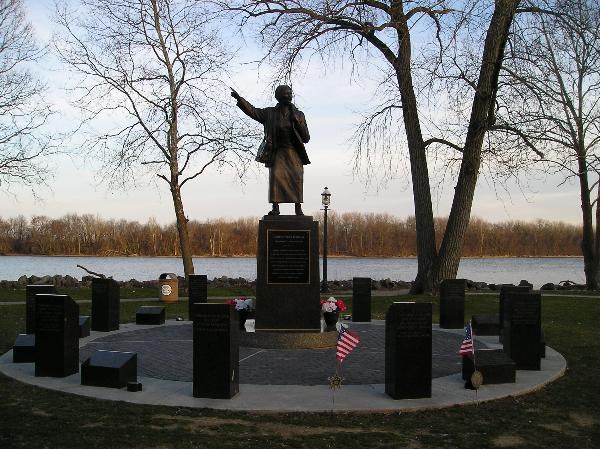
In her later years my Mom moved to Bristol, PA – fell in love with the place. It’s a gorgeous little town on the Delaware River and once played a huge part in shipping up and down the river and eventually onto the canals that ferried goods onward to the north and west. She spent a lot of time at the Bristol Wharf there enjoying the many free concerts and festivals that seem to happen year round. It was right down the street from her apartment and was one of her favorite places. So it was bittersweet for me when, just a few years after Mom died, that a tribute to Grandma Moses herself, Harriet Tubman, was placed among the other monuments along the River. I know my Mom would have been so pleased and would have visited Harriet often – just as her daughter does now. Whenever I’m there I think of Mom and Fanny. And am so grateful that they had each other and for the lessons of love and life they shared. And I think of Harriet, and once again, I am in absolute awe of her.
So in honor of Black History Month I lift up Fanny, a simple woman whose ripples of love continue to this day. And Harriet Tubman, Grandma Moses to me. A simple woman who refused to accept the unacceptable and found within herself a level of bravery that still ripples through all generations that come after her.
Black History IS American History
Peace 

About Urban Hippie Irene Martin: A middle-aged tie-dye wearin’, tree-hugging, hippie who is trying to leave the world a little better for having been here. She can be reached at ireneemartinother@gmail.com.