
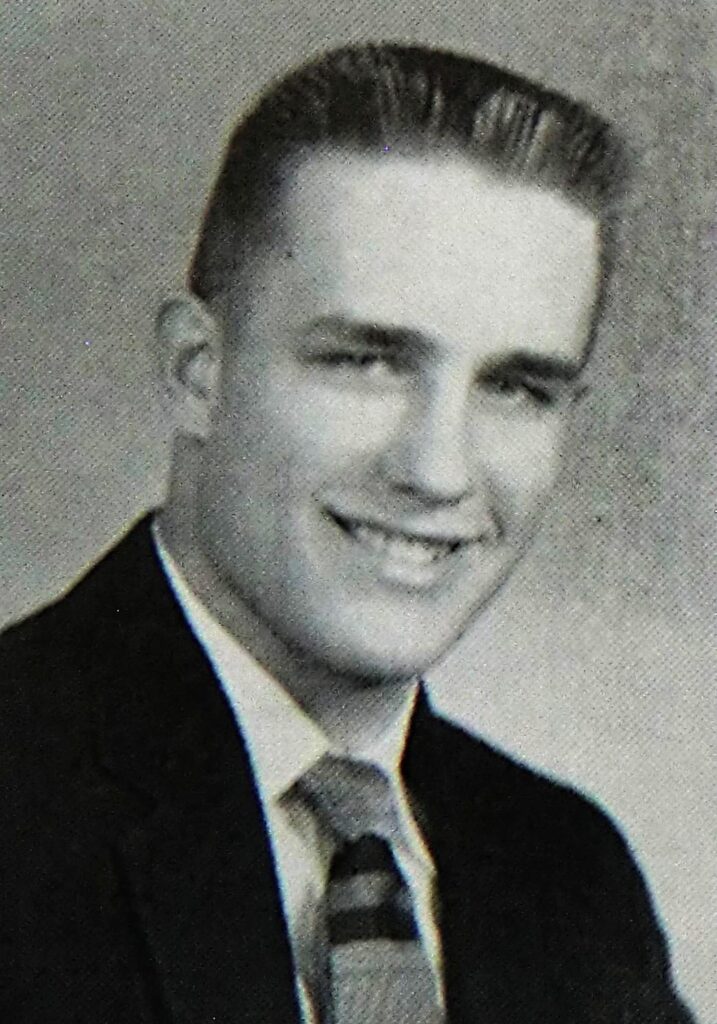
MANCHESTER CENTRAL HIGH SCHOOL
Part 1

The ride from my home to the McIntyre Ski Complex takes about 7 minutes depending on traffic lights. On the way, I stopped on Bridge Street Extension (across from Precious Blood Monastery) to take a few pictures of the absolutely beautiful colors of the changing leaves on the 17th fairway at Derryfield Country Club…gorgeous enough to stop me in my truck tracks as I headed for my interview with the subject of this issue of “WHERE ARE THEY NOW?”
Little did I know that the beauty of nature that caused my brief sojourn to the back nine at DCC would pale in comparison to the “colorful” story of local legend, Don (real name “David”…see FACT below) Sarette.
I use about 43 questions to get the info I need for a story and we had started conversing shortly after 9 a.m. I glanced down at my watch. 12:55… Looking back to my sheet, I realized that I was only on #28 and wondered briefly where I might be sleeping that evening.
I had already called my wife around noon to tell her I was going to be late to which she replied…
“I figured as much. If you had been interviewing a woman, you’d have been back in a half hour…45 minutes at best. But since it was a guy, I figured at least two – maybe three – hours because you guys just don’t know when to shut up, particularly when you’re talking sports!”
After completing 28 pages of notes over a five hour period, I walked slowly, almost as if in a daze, to my truck parked near his office at McIntyre, opened the door and climbed in for the return trip home. As I sat at the lights at Bridge and Mammoth, I picked up my notebook and quickly flipped through its content…“Holy crap! This isn’t just an article. This is a book!
A JAW-DROPPING QUESTION…
Let me begin by telling you that no question I would ask Don could top the one posed by his editor-in-chief grand-daughter as she was interviewing him for her school newspaper, Central’s “Little Green.”
Before we started he provided a little more detail and, thinking he was going to be asked about his illustrious athletic career, I guarantee this 71-year-old owner-operator of Manchester’s McIntyre Ski Area who still works 7 days a week; this former high school All-state/All-American basketball player; this former QB of the ‘59 NCAA National Champion Orangemen of Syracuse University, was never hit harder by any opponent than he was by her opening verbal “sledgehammer.”
“Grampy,” she began, “how does it feel to be getting closer to dying?”
Talk about a blind-side hit…there was NO WAY he ever saw that one coming…and I know it absolutely leveled him! He said he absolutely froze and didn’t know what to say.
It stunned me, too, and I never asked him how he answered her.
Why? Because I’m 67…and have two knees that were recently replaced with titanium, a metal that has a “life-span” of about 20 years.
When I informed my immediate family that I was a little upset after reading that “scientists” had invented a new “life-time” metal about one week after my surgery and that now a knee would never wear out while I‘d probably get another 15 years out of mine, my youngest son jokingly responded…
“What do you care, Dad, you won’t be around by then!”
“Ha, Ha.” my finger answered.
Needless to say, through his grand-daughter’s “bizarre question” and my son’s “bizarre answer,” Don and I “bonded” quickly…and I hadn’t even asked my first question.
FACT: Don’s name is actually David. His Dad’s name is also David, so it was decided that the younger would be called by his middle name, Don, to eliminate any confusion.
THE EARLY YEARS
I had always heard that David (call me “Don”) was tough…REAL tough…and had always wondered how that athletic “necessity” had come to be. Within the first 10 minutes, I found out.
As a youngster, from the age of three to seven, he didn’t live with his parents. As I mentioned, Don’s in his early seventies which would mean his early childhood was during World War II. His Dad was in the Navy and was first stationed at a base in the southern part of the country. As strange as it may seem today, during that time period, many wives of the soldiers, instead of staying back home, headed south to be with their husbands, living temporarily on the same military bases until their spouses were shipped overseas for battle.
My Mom was one of them, too.
Don’s Mom, not wanting to put her young son through the rigors of that life-style, chose to leave him with her husband’s mother to guarantee, as best she could, two very important factors would remain constant in Don’s life…stability and family.
And this is where his toughness got its roots. Man, did it ever!
He lived with his grandmother (a woman who birthed her children – all NINE of them – at HOME) and three of her sons, his uncles…each of whom would have a dynamic influence on his young life.
It began with the four boys sharing one room and ONE bed. (I put it in italics so you, the reader, wouldn’t miss it.) As Don put it, “My uncles, Walter “Okoo“ Zielinski, Richard “Twang“ Zielinski, Steve (no nickname and I don’t know why) Zielinski, and I shared the same bed.. Our home had two rooms, no heat, and no water. There was a woodstove in the other room, but it’d get cold at night after the fire my grandmother made went out. We got our water from a well located in a field not too far away. Hot water came from the bucket my grandmother kept on top of the stove. We took sponge baths instead of a regular bath and there was no shower.”
He continued “I had to go to bed first, not because I was the youngest, but because I had to warm up the water bottle that was in our bed before everybody else piled in. That way, I warmed the bed up for them. I was the first one in bed and the first one out ‘cause Okoo, being the biggest and already in high school, usually pushed me off the bed by morning. He ruled the roost.”
I thought to myself, “My God, I was born around that time and we didn’t have it anywhere near as tough as that!” Being the only child at the time, I went south with my mother so we could be near my Dad who was in the United States Army. My Mom didn’t have any family to leave me with so we “bunked” in both Texas and Mississippi for brief periods of time. I can remember a couple unusual things, like the woman who lived in the same building we were in taking a broom and going out into a field behind the “house”, using it to whack away at a nest of rattlesnakes to rid them from the area. I also remember my Mom blowing cigarette smoke into my ear to stop the ear ache I experienced while on the train ride back to NH. Both a bit unusual, perhaps, but nothing as bizarre as what Don was going through.
Don continued “Our bathroom was outside – a 2-seater in a small building.”
I couldn’t resist asking “two-seater? What for? Surely no one was going to use the ‘opening’ next to you, right?” WRONG! “Sure! Why not?” he answered. “We were a close family…and we were kids!” Then he added another example of just how tough his grandmother was…
“I was sitting on one of the holes one morning and suddenly I heard noise coming from underneath me. I jumped off and looked down to see what it was and there she was… Gram, shoveling shit into a bucket to carry out to a dump (sorry, didn’t want you to miss the pun) area.”
…And you wonder where he got his toughness?
He lived with her for four years then reunited with his family when his dad returned after the war concluded.
As tough as that “experience” was, he firmly believes it had a major impact in shaping his life…and all in a good way.
“Gram had a huge garden that supplied all our vegetables. She also had trees and shrubs that supplied our fruits and berries. We ate beans, carrots, tomatoes, and potatoes. We ate pears and apples and raspberries and blueberries. I can still smell and taste her blueberry pirogues (smacking his lips as the “dish” rolled out!) We never ate fried food because the stove never got the water hot enough so everything was par-boiled. We ate chicken, too. She’d chase one down, whack its head off and then let it run around ‘til it dropped. A few hours later, it was on the table.”
I can hear some of you readers saying to yourselves “Oh my God, how barbaric!” But that’s exactly the way it was back then. Shortly after we were married back in the late ‘60s, I can remember listening to my wife, Karen, describe her Dad doing the exact same thing.
Don’t think I need to remind you, but there was no supermarket you could cruise up to and purchase a pre-cooked “mini-chicken” already barbequed, wrapped in a plastic basket and warmly-waiting under heated lamps beneath the counter for more “civilized” yet hungry customers with numbered slips in their hands instead of a butcher knife.
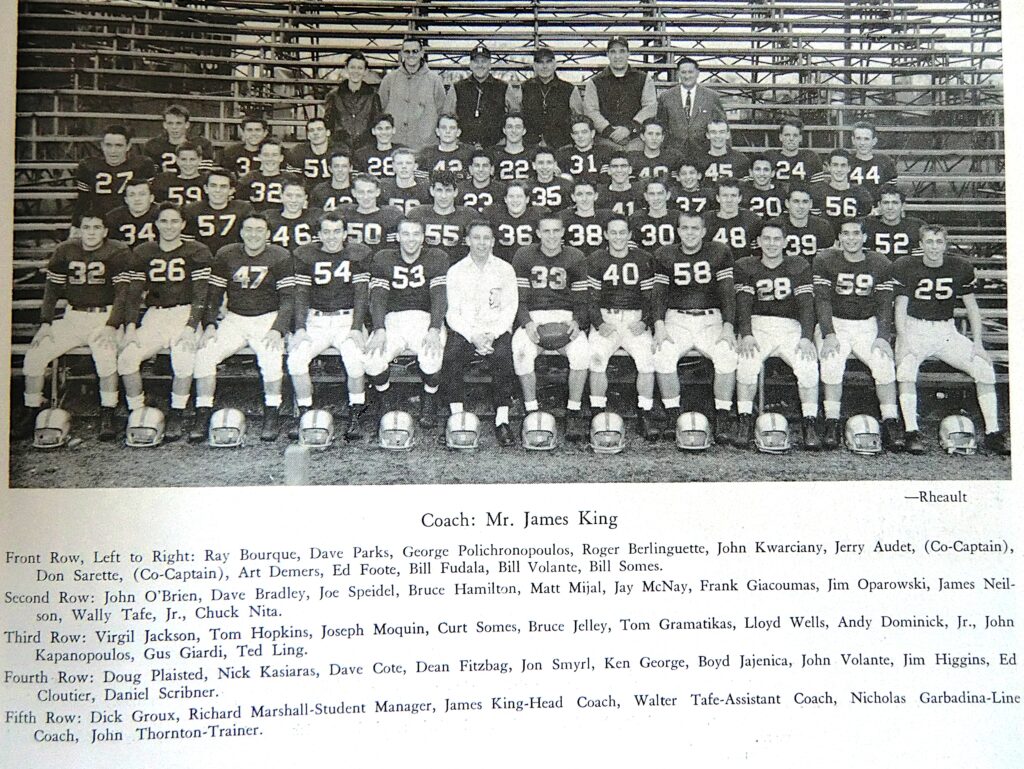
HIS INTRO TO SPORTS
The first coach Don encountered was less known, but highly-respected Bob Crowley during a tryout at Bakersville Elementary School.
“I’d never met him before, but I had heard about him and that he was supposed to be both tough and good. He started hitting me easy ground balls that I had no problem fielding. After stopping a few of them, he sent several more my way…this time a little harder. Again, I had no problem with any of them. Interested, but not yet convinced of my skill, he hit ground balls to each side of me, each one a little farther away, each one a little faster. End result? The same…I stopped ‘em all. By now, however, it seemed like I had intimidated him, made it seem like he wasn’t challenging me, so he started sending really hard hit balls at me…some rockets…each of which I stopped.
Then he suddenly stopped. The next thing I knew he had picked me for the school team. He also coached one of the new Little League teams, Boys’ Club, that were just starting at Central Little League, and needless to say, I made that club, too.”
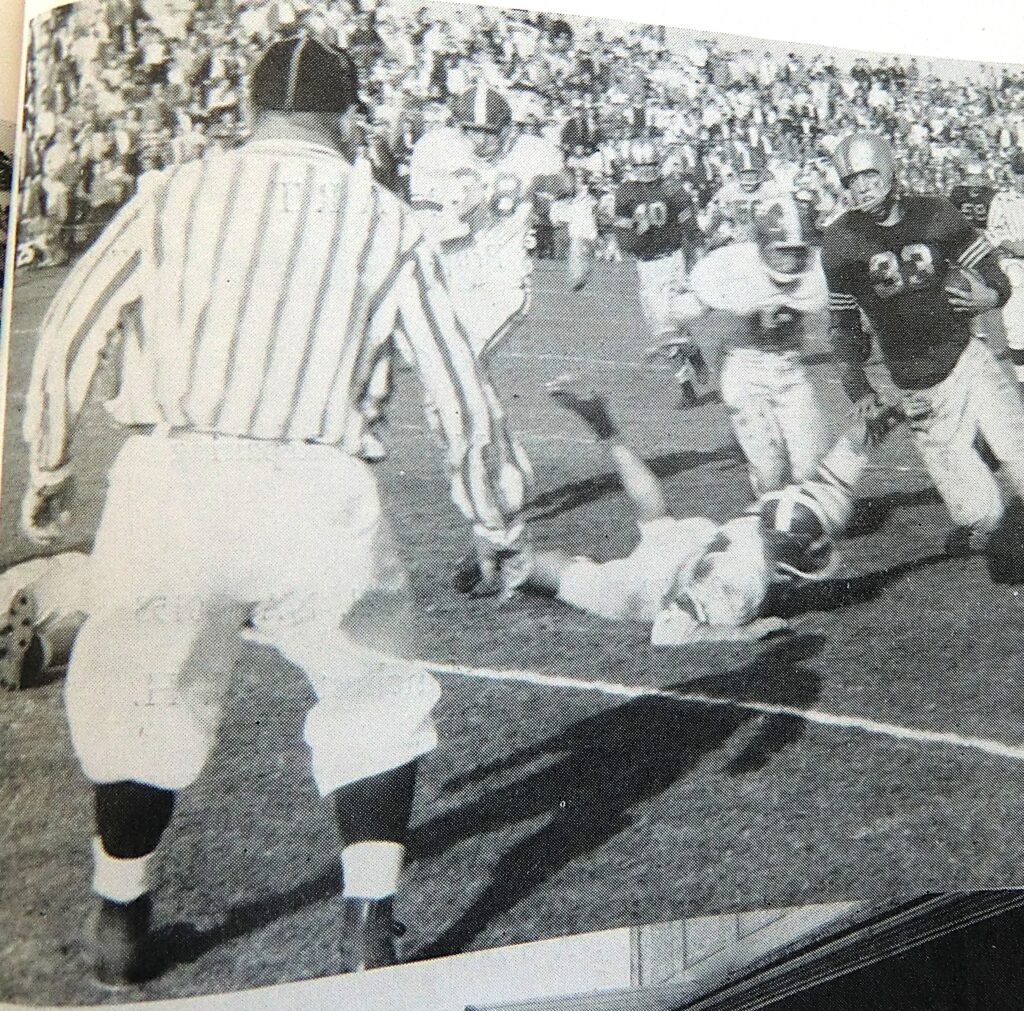
One of the other coaches in that league is considered one of the grandfathers of Manchester’s Little League, Louis Basquil, the coach of Scotty’s, who passed away just recently joining an elite coaching staff “upstairs”.
Also impacting Don greatly at this time was his uncle, Dick, and, though he was never one of his coaches, he “taught” him much.
“’Twang’ would bring me to the Boys’ Club to get me into games with the older kids. It was located next to Central back then so I spent a lot of time there and met a lot of kids. I played hoop for Bakersville and for Blessed Sacrament CYO, too. We played at the old St. Joe’s gym on Bridge Street.
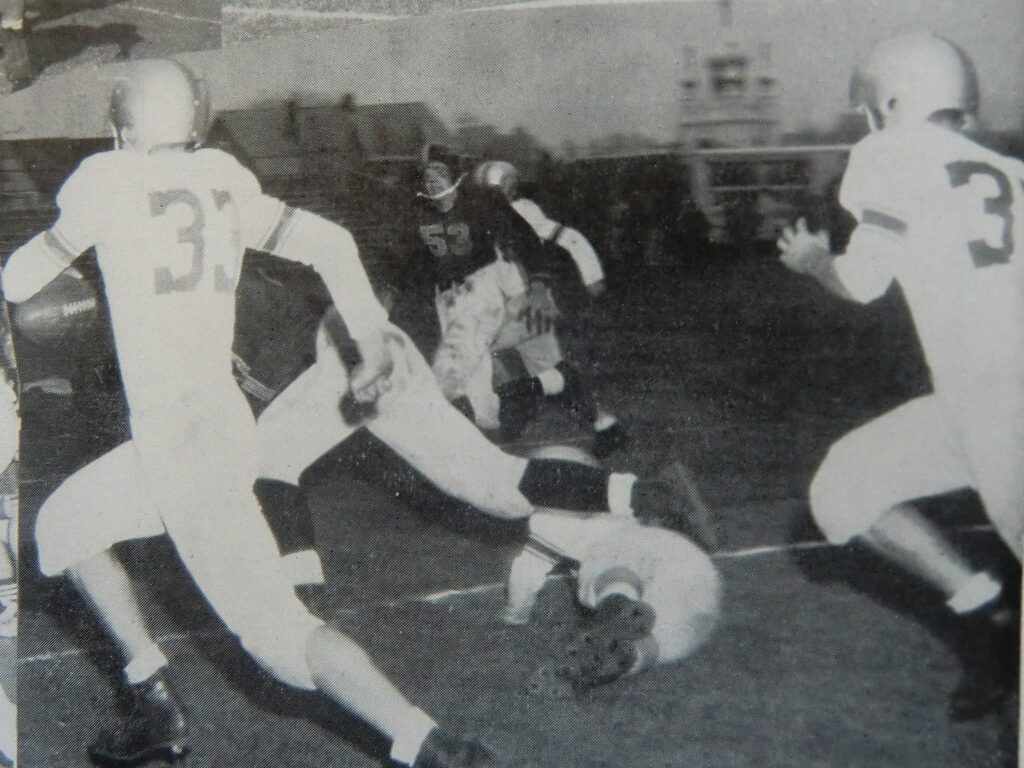
Don’s was introduced to football through neighborhood play called “rough-house football“.
“We didn’t wear pads, but hit each other hard…and it wasn’t two-handed touch either!” he added, his voice emphasizing the latter part of his description.
One of his greatest memories of that time?
“Okoo, now a member of Central’s football team, came home one afternoon after practice with one of the most awesome things I had ever seen at the time. Central was changing over to new equipment and he had one of their old, now destined for the scrap heap, helmets. It was made of leather and you could literally fold it up and put it in your back pocket. I know because I did it. It was silver with two dark green stripes that criss-crossed over the top like just like a cross and had a garter belt for a chin strap. It was the coolest thing and when I put it on I thought I would really be protected…until the first time I got hit wearing it. Part of the problem was that it was too big, but, then again, everything I had was too big ‘cause I always got someone else’s hand-me-downs, particularly from my uncles.”
He continued “The problem didn’t end with the clothing either. The basketball we used was made of leather, not like the rubber ones used today, and the panels would always be peeling off. We’d use it until it wouldn’t hold air. Our baseballs were the foul balls hit by members of the old Sunset League teams. We’d out-race the ball-boy to get them and use them until they started to fall apart. Then we’d wrap them with black tape. Since a baseball is supposed to be white, I never understood why. (It was at this time that one of Don’s employees, who had been ease-dropping on our conversation and upon hearing Don’s description of the black baseball, yelled “Hey, did you guys use those balls at night?“ to which Don replied “We don’t need ant wisecracks over there!“
One explanation Don offered was that they thought only rich people had white tape…“And we certainly weren’t part of that crowd. Our bats also came from Sunset ballplayers. There were no such things as metal bats back then. All of them were made of wood and they’d often crack or break. We’d grab them, take them home, then put them back together with a screw or nail, then wrap the area with…you guessed it…black tape.”
He took a quick look over to his wise-cracking employee expecting another possible comment, but this time the worker was totally immersed in his job…or at least he made it look that way.
After listening to Don describe the many moves his family made before they finally settled into their “permanent” home, it could be fairly stated that he lived all over the city…and I mean ALL OVER the city.
“After moving out of my grandmother’s house, my family and I lived in barracks that had been built for returning soldiers. They were situated near Silver and South Willow Streets. That’s when I first started to go to Bakersville. Two years later we moved to an apartment near Hall Street in the city’s North End so I had to take the bus to Bakersville for a couple years because I didn‘t want to leave that school. The next move took our family to Maple and Silver Streets, a three-tenement building (where Domino’s Pizza is now). That was followed by a move to Elmhurst Street in the South End. As a sophomore at Central, I’d walk down to the shoe shop where I’d meet my friends and we’d head for school. My old friend, Ed Ganem, had access to a car and he’d stop and we’d all pile in.
My Dad finally got tired of all the moving around and ended up building a house near a very familiar place…the 17th fairway at the DCC…on Watts Ave off Bridge Street Extension. In fact, I used to caddy there before golf carts eliminated that job. Even used to make spare change by retrieving golf balls and selling them to golfers as they passed the 17th. That lasted until the Pro, Red Ryan, found out, chased me off the course, and banned me from caddying.”
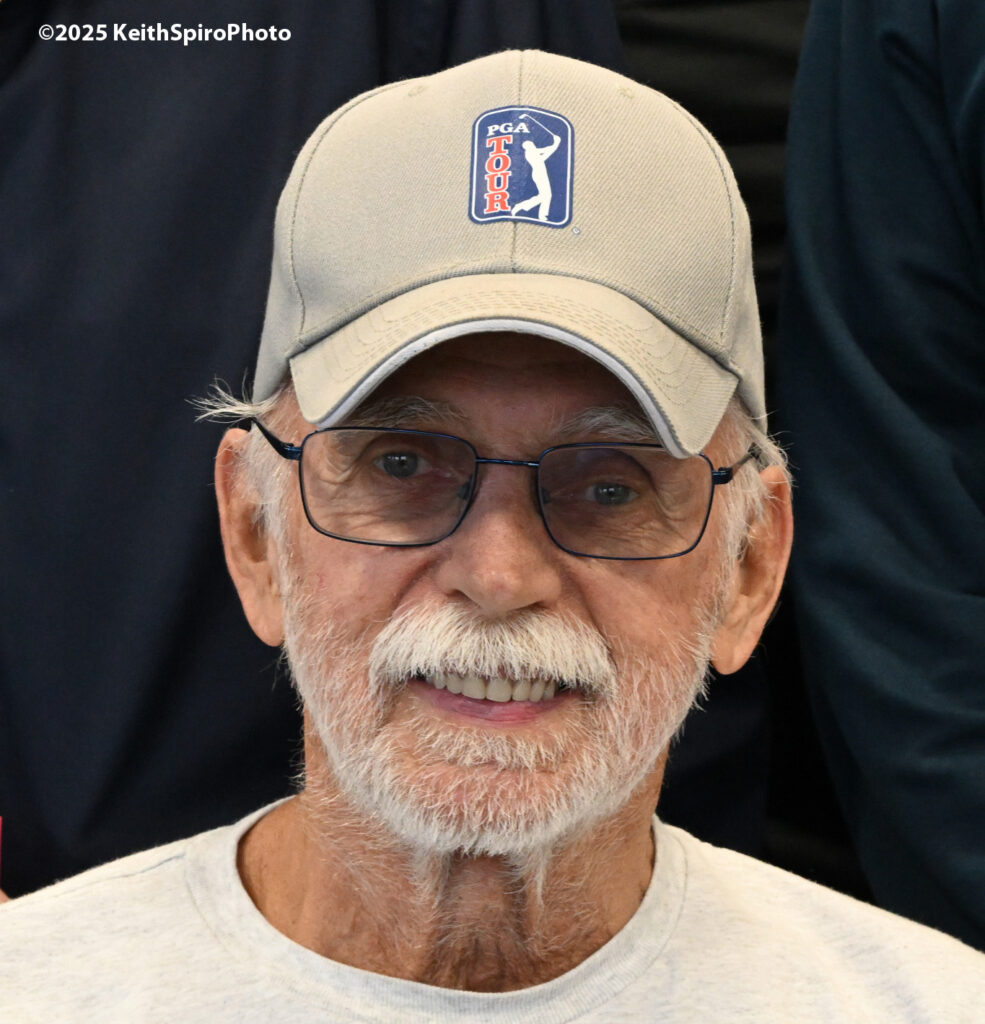
Ted Menswar Jr. is a life-long resident of the Queen City and a retired member of the English Department of Memorial High School who has been involved in local sports for 70 years as a player, a coach, a mentor and a fan. He can be reached at tedmenswar@outlook.com