
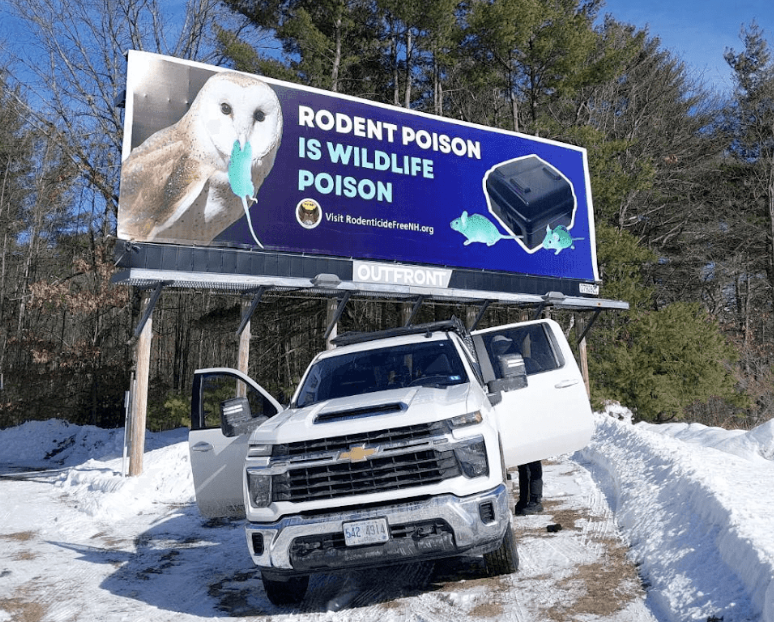
HOOKSETT, NH – A new statewide public-awareness billboard launched Feb. 3 along Route 293 in Hooksett delivers a stark message to New Hampshire drivers: Rodent poison is wildlife poison.
The billboard, created by Rodenticide Free NH (RFNH), warns that rodent poison doesn’t just kill mice — it also kills the animals who eat them. Owls, foxes, bobcats, and other predators routinely ingest poisoned rodents, leading to internal bleeding and slow, agonizing deaths.
“These poisons are wiping out the very animals who provide natural rodent control — free of charge,” said a spokesperson for Rodenticide Free NH.
Rodenticide Free NH advocates for safe, effective, and humane rodent control. Most rodent problems are human-caused — such as inadequate trash containment and free access to animal feed — and RFNH encourages practical solutions and prevention, never poison.
Pest control companies offering rodent control rely heavily on poison placed outside in bait boxes. In their sluggish state, poisoned mice are easy targets for hawks, eagles, and other predators — some even hang out near the boxes!
Many pest control companies now require customers seeking help with rodents to enroll in ongoing contracts. These arrangements can cost homeowners and businesses hundreds of dollars per month, often without addressing the root causes of infestations. Poison may even worsen the problem by continuing to attract rodents.
The Rodenticide Free NH web site offers alternatives to rodenticide, along with a list of poison-free pest professionals.
New Hampshire is considering House Bill 1018 to ban the most harmful type of rodenticides, known as second-generation anticoagulants, or SGARs for short. Second-generation poisons remain in animal tissues longer, posing a greater risk to non-target animals.
Anyone who wants to end the tragic poisoning of wildlife should support House Bill 1018 and oppose House Bill 1676, which would hand pest control companies a monopoly on SGAR use and expand their profits by locking more people into never-ending rodent control contracts.
For more information: