
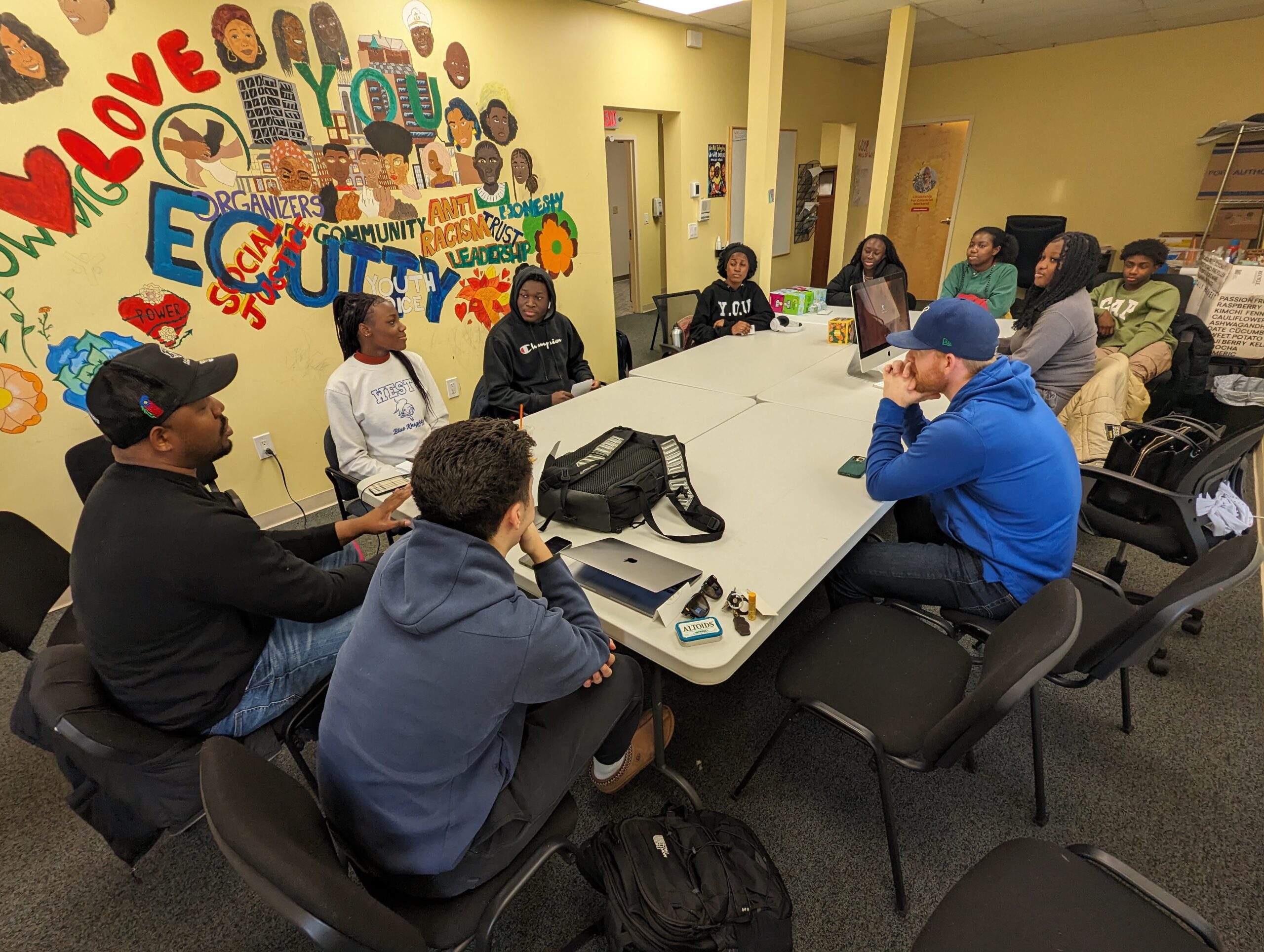
MANCHESTER, NH – A group of students who lobbied for an Advanced Placement course in African American Cultural Studies got the chance to experience this week what progress feels like.
A pilot program they worked on for two years finally launched – one day late due to a snow day – but better late than never, said Sudi Lett, who has helped shepherd the project through as program director for Young Organizers United (Y.O.U.) for the Granite State Organizing Project.
“This is a big deal,” Lett said, directing further questions to Manchester School of Technology senior John Alade, who has been involved since the start.
John was among those students who helped to manifest the idea of a class in which they could learn about the positive contributions of African Americans to our country’s history and culture. It was two years ago when, during a Y.O.U. after-school session, John said out loud what he’d been thinking for quite some time.
“I said I’m tired of learning about George Washington. We learned the same thing in second grade and fifth grade and I’m a sophomore and I’m still learning about George Washington; let’s learn about something else,” recalls John, who serves as a student member of the city’s Board of School Committee and recently was named to the National Honor Society.
Lett asked him what he wanted to learn.
“He said, ‘about black people,’ and that’s literally how we started going about it,” Lett recalled.
In the process students learned about self-advocacy and all that goes into a curriculum, which led them to this sweet victory lap – the launch of an AP class, available to any student interested in learning about positive contributions of African Americans as an integral part of their education.
The pilot curriculum was prepared collaboratively – Manchester NAACP, Y.O.U., Manchester Community College and the New Hampshire Black Heritage Trail worked alongside the Manchester School District under the guidance of the district’s Chief Equity Officer Tina Philibotte and Jillian Corey, Director of Curriculum and Instruction. The class will be offered in the Manchester Community College catalog even though it is being held at Central. In its description, the class seeks to explore the Black history of New Hampshire with stories that connect learners to the broader national and global dialogue.
Students who complete the course earn three college humanities credits in social studies and a half-credit of social studies. The course is taught by a Manchester Community College faculty member and there is no cost to the Manchester School District or students.
“I’m very excited to take this class and that other students who come after me will have a chance to be able to take this class, too,” said Central junior Mia Rose Taylor.
“The point is that we get the opportunity to learn this material in the classroom where we’re supposed to be learning this type of stuff. I’m excited students will be able to see themselves reflected in the classroom,” she said.
Mia Rose grew up in the Manchester school district and said that up to this point in her education she has mainly been taught about slavery in connection with Black American history, “which just gets glossed over,” she said.
“Or you learn about the same people – Rosa Parks, Martin Luther King, Frederick Douglass – those are the only people who come to mind,” Taylor said.
She said she would be excited to learn more about Manchester’s Black history as a way to feel more connected to the community she grew up in.
Chevanese Williams, a senior at Manchester School of Technology who plans to become a travel nurse after graduation, said she is hopeful she can fit the class into her schedule. As a senior there are many demands on her time and the African-American studies class is the first class of the day. She is starting another new class on the same day at the same time – EMT training – and there are strict requirements for attendance.
“I hope I can make it work,” she said.
She helped in the effort to get the class approved because it’s not only exciting but important to learn about Black history.
“As a senior, I didn’t get the opportunity to learn about my own [cultural] history in the classroom. “I’m glad students coming after me will.”
Lett said as a pilot program, the course is available to students from any school in the district but they must get their own transportation to Central for now – which is not ideal, but he’d rather rise to the challenges of scheduling than delay the start of the class any longer. The goal is for the course go through more evaluation and tweaking and then be available to all students at all schools for the 2025-26 school year.
The process itself was educational for the students, who learned about things like subjective and didactic goals, said Lett.
“We had to figure out where the class would fit into the existing curriculum, as a history or civics credit, an English class, and then we dove deep into it and tried to create something meaningful from scratch,” Lett said.
Along the way they had support from Garrett Walker, a former teaching assistant at Memorial High School who served as a point person and helped them stay on track building assignments, quizzes and tests as they passed through the district’s curriculum committee.
They also reached out to school board members to gauge support for the course and found champions in several, including Julie Turner of Ward 1, Sean Parr of Ward 2, Karen Soule of Ward 3 and Leslie Want from Ward 4.
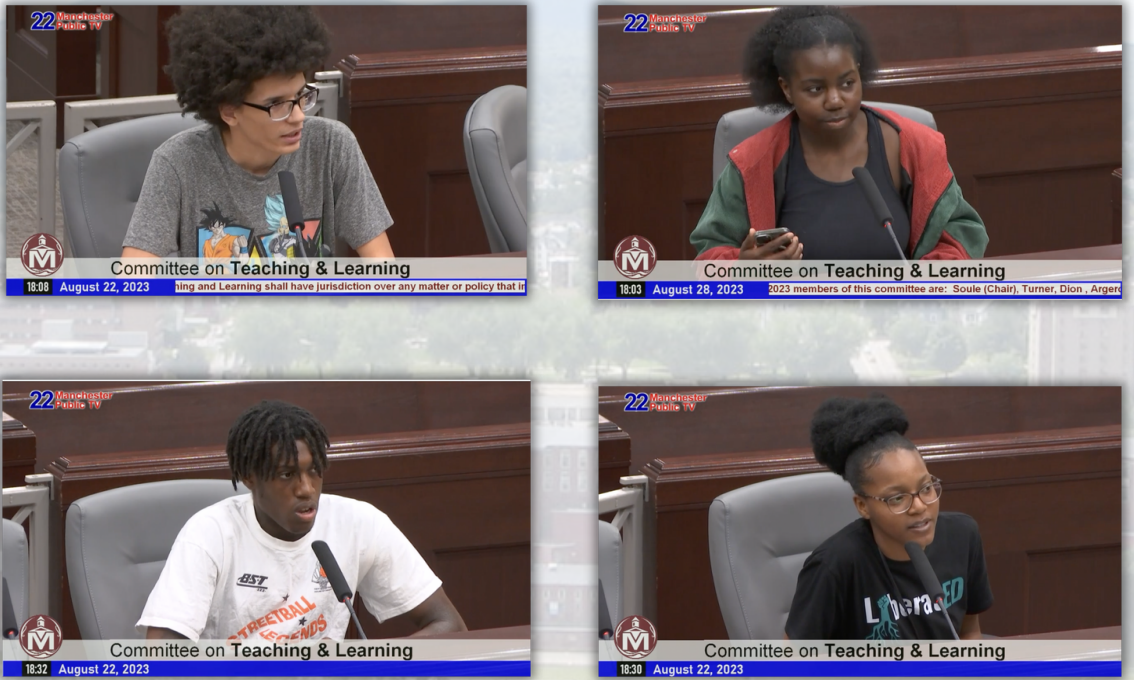
“They encouraged the students to really push and start building a base of students and parents to go before the school board to speak in favor of the course during public comment, which they did,” Lett said.
As described in the course listing “The African American Cultural Studies Course offers an opportunity for learners to work within an inquiry model to explore concepts of empathy, culture, and humanity.”
Philibotte said that the class will also likely evolve in the future as its curriculum is not yet set in stone and it could become a year-long class. She also noted that this class came about in large part due to student advocacy asking for the class.
“I hope this encourages other students to advocate for their needs and what you want to see in the curriculum,” she said.
The school district’s presentation on the African American Cultural Studies Course as presented during the Dec. 12, 2023 Teaching and Learning Committee meeting is below.