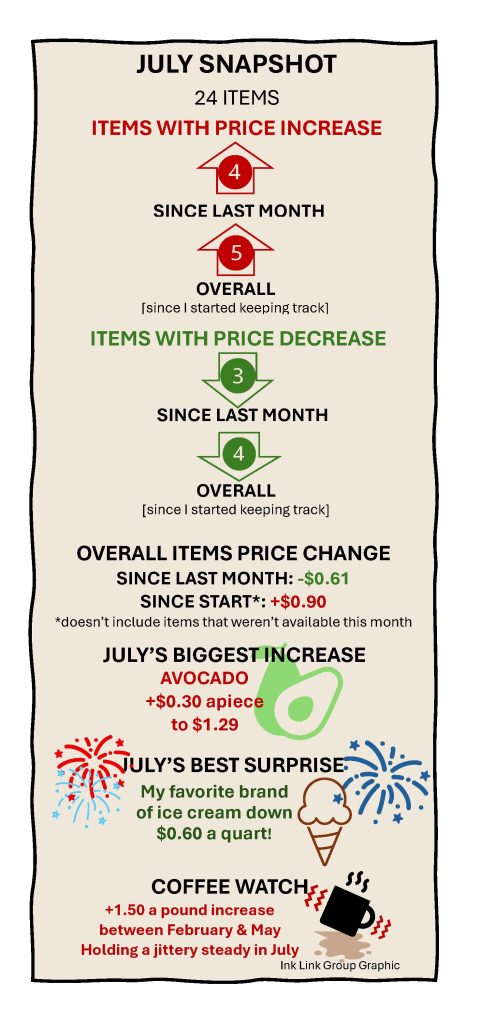
Price increases are still outpacing decreases since I began keeping track. That said, the past month’s grocery snapshot was low-key. In fact, thanks to dry cat food going back to what it was before last month’s startling increase, per-item price totals decreased.
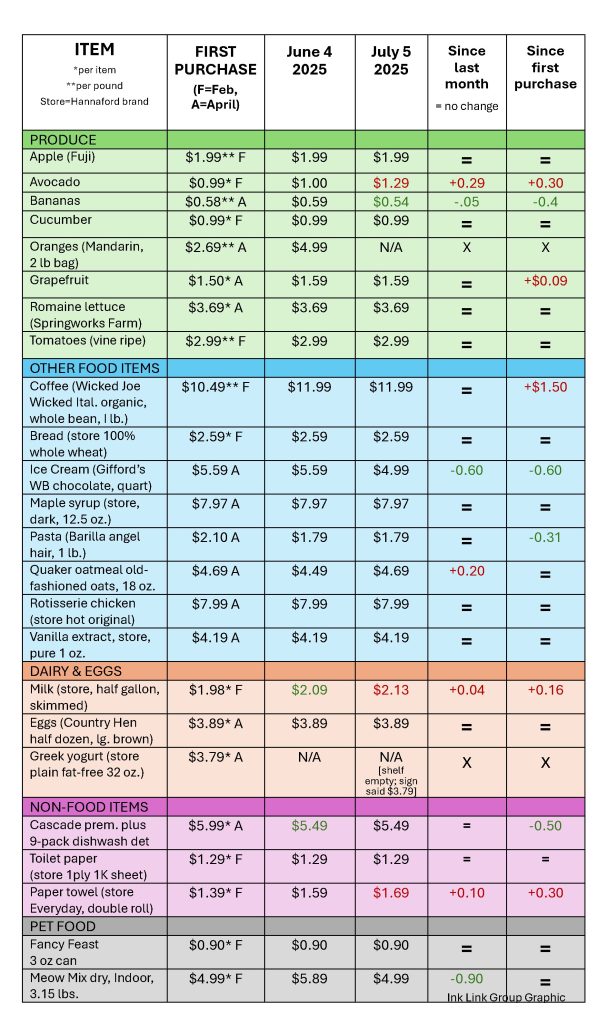
There were four items with higher prices than in June, and five higher than when I first started keeping track. [There were seven in that last category in June, but this month there was no 2-pound bag of Mandarin oranges, and a pound of bananas decreased]. There were three items that decreased, and four that are less expensive that when I first started keeping track.
This relatively placid period could all change in the coming months. President Trump’s deadline for countries to “make a deal” on tariffs is Wednesday. Any country that doesn’t will be hit with the previously announced tariffs, which go into effect Aug. 1. At least that’s how things are as of this minute. It could all change by the time you read this.
A quick summary of tariffs so far: Trump in April set a 10% tariff rate on almost every country, and since then has also set, or threatened to certain countries, rates as high as 250% (Canada, bienvenue!). It’s been a wild ride. For instance, China at one point was at 145%, but is now at 30%.
After the initial announcement, the effective date for many of the higher levies was put off until July 9. That is still the deadline to “make a deal.” Trump claims “many big deals” are being made even as I write this.
Trump Sunday also announced a tariff increase to 20% for the BRICS nations – Brazil, Russia, India, China, South Africa, Egypt, Ethiopia, Indonesia, Iran, Saudi Arabia, and the United Arab Emirates. The announcement came after the leaders of those countries issued a statement condemning Israeli attacks on Gaza and U.S. attacks on Iran, as well as warning that the rise in tariffs threatened global trade. Trump said in a social media post the statement was “anti-American.”
What does any of that have to do with your grocery bill? A lot. Actually, your future grocery bill.
In general, here are some of the imports we get from BRISC countries that you may see price hikes in, unless a “big deal” is made:
Seafood: India imports a significant amount of shrimp to the U.S. As we already know, we also get seafood from non-BRICS companies that also are being affected by tariffs, including Canada, Chile, India, Indonesia, and Vietnam.
Coffee: Nooooo!!! If the $1.50 increase in a pound of my favorite coffee since February isn’t enough, Brazil, with Colombia, is the largest importer of coffee to the U.S. Other BRICS importers are Indonesia and Ethiopia. A non-BRICS coffee importer is Vietnam, which just made a “big deal” with the U.S., agreeing to a 20% tariff on all goods produced there and 40% for all that travel through Vietnam to get here.
Rice. We get a lot of rice from India. We also get it from Thailand, which is scrambling to make a deal, according to news reports, under the threat of a 36% tariff. We also get rice from Côte d’Ivoire (Ivory Coast), in West Africa, which has been levied a 21% tariff.
Nuts. Another big Brazilian import, mostly Brazil nuts and cashews. We also get nuts from Thailand and Vietnam. Côte d’Ivoire also imports a lot of our cashews and will be affected by the tariffs.
So, that’s the latest tariff news. Here’s what my grocery snapshot looked like when I went shopping July 5:
What was up?
A roll of paper towel increased 10 cents. While that may not seem like much, it’s been inching up since February. The type I buy, Hannaford’s store brand Everyday double roll, is now 30 cents more than it was five months ago. Paper towel costs have been rising for the past two years – 4.2% since 2023 – because of supply chain and other issues. But tariffs on Canada have speeded up the increase. We import 30% of Northern Bleached Softwood Kraft (NBSK) pulp from Canada, a key ingredient in paper towel. Toilet paper also uses NBSK, but isn’t increasing at the same rate because of production differences. That may change, of course, as tariffs set in.
Milk, too, has been creeping up, and is now 16 cents more a half-gallon than it was in February.
The price of avocados, as predicted, has also increased, even though the recent USMCA (formerly NAFTA) agreement renewed the 0% Mexican avocado tariff. The issue is that we also get avocados from other countries, like Peru, Colombia and Chile. That means there’s less supply available, and that drives up prices. Avocados are now 30 cents more expensive apiece than they were in February, they did spike up to 50 cents more in late spring for a few weeks.
Oatmeal, which was down 20 cents in June, is back to what it cost in February.
What is down?
It’s with great relief we can report that the startling 90 cent increase for a 3.15-pound bag of my preferred cat food (or rather, Milo and Penny’s preferred cat food) has gone back to what it was in February.
The price of bananas, the source of much debate on the floor of Congress recently, have remained remarkably stable at my grocery store, though reportedly not at others. They even decreased 5 cents a pound from last month, and are down 4 cents a pound from February.
And maybe it’s just because of the season, but a quart of Giffords’s World’s Best Chocolate ice cream was $4.99, a whopping 60 cents less than the $5.59 it’s been at Hannaford since February. That’s at Hannaford. I’ve found that the price of Gifford’s ice cream, which is made here in Maine where I live, can be as much as $3 more a quart at smaller grocers and convenience stores. Like coffee, it’s not something I’m willing to give up, no matter the price.
What we’re watching
We’ll keep an eye on BRICS imports, as well products that may be affected by tariffs on other countries. Since paper towel and milk have both gone up in price every month since I began keeping track, they’re definitely on the watch list.
Aside from that, this is the month the rubber hits the road on tomatoes. A 21% tariff on tomatoes from Mexico goes into effect sometime this month, though the U.S. Department of Commerce has been squishy on the date. Tomatoes had been tariff-protected, like avocados, but didn’t make the cut in the new NAFTA… um, I mean USMCA… agreement, because they’re more widely grown in the U.S. than avocados are and presumably the tariff will boost U.S. production. That said, 86.1% of the tomatoes sold in the U.S. last year came from Mexico, which can grow them year-round. Most U.S. growers, unless they are using greenhouses, have a more limited season. The tariff is likely to have an impact on the price of tomatoes, but may not be obvious until the summer is over.
As mentioned last month, 50% steel and aluminum tariffs went into effect at the beginning of June, so may cause some grocery item price increases because of extensive use in packaging. This could take a while to pan out, since many items that are packaged are done so well in advance.
That’s the same, too, for goods with a longer shelf life that fruit and vegetables. Tariffs that affect rice and nuts, for instance, will likely take longer to see, because there are more stored in warehouses.
We’re also watching store brand nonfat plain Greek yogurt, which once again wasn’t on the shelf when I went shopping July 5. There was a spot for it, but it was empty. That happened in June, too, the first time I’ve ever seen that. Flavored, as well as low-fat and whole yogurt, was on the shelves, just not the store brand non-fat, plain that I buy. It was there during a shopping trip a couple of weeks ago, though not in abundance. The price tag on the empty shelf July 5 said $3.79, the same price as February. But, since I couldn’t buy it, it’s not on the chart.
There were also no 2-pound bags of mandarin oranges. There were navel oranges, but that was it for oranges. Oranges are not in season, and as I’ve mentioned, the Florida crop was affected by a bad weather and a fungus. We’ll keep an eye and see if they reappear. While they increased $2 from February to the last time I bought them, they’re not factored in to the overall price snapshot change snapshot, since they’re not available.
I like a good cup of coffee, so we’re keeping an extra eye on coffee. The BRICS tariffs have made me very jittery. As a side note, not part of the chart, I had to do an emergency coffee buy at a local “country store” a couple weeks ago and it was $14.59 for a pound (and no whole bean!). Some of that, like my ice cream, was likely the typical country store high price, but it’s definitely hard to find an inexpensive pound of good coffee these days.
The Disclaimer
The purpose of this monthly column is to keep an eye on how some grocery items on my regular list change month-to-month.
This is just a snapshot of a variety things I regularly buy, not a scientific analysis. Aside from tariffs, a lot goes into price fluctuations, including seasons, weather, store preference and store decisions. I’ve included items likely to be affected by tariffs as well as some that may not be. There are likely different prices and fluctuations at other stores of what I buy, but this is a reflection of my shopping list, not a comparison-shopping exercise or a definitive picture of what certain items cost everywhere.
This is not meant to be a brand endorsement or an advertisement for Hannaford. These are just the things I buy, and that’s just where I shop.