
Last month we were still in wait-and-see mode as far as the impact of rising gas prices on groceries. This month, the waiting is over, at least as far as produce goes.
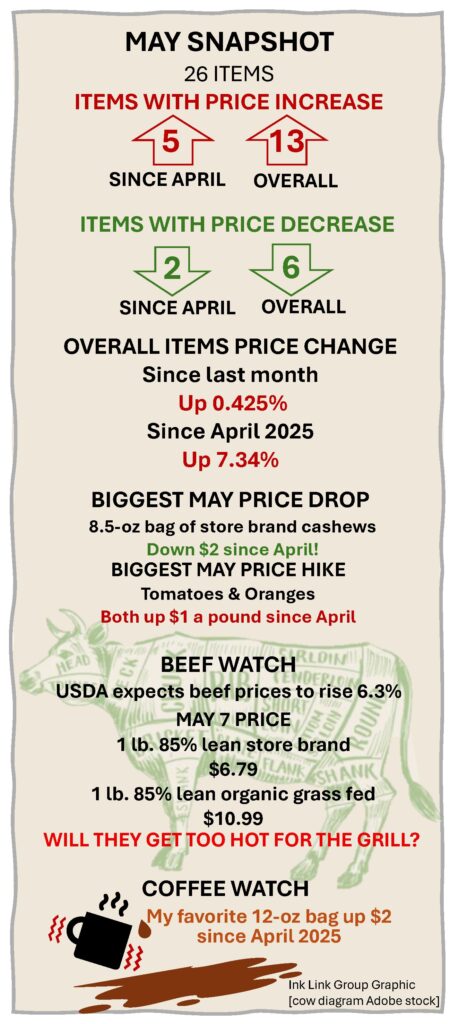
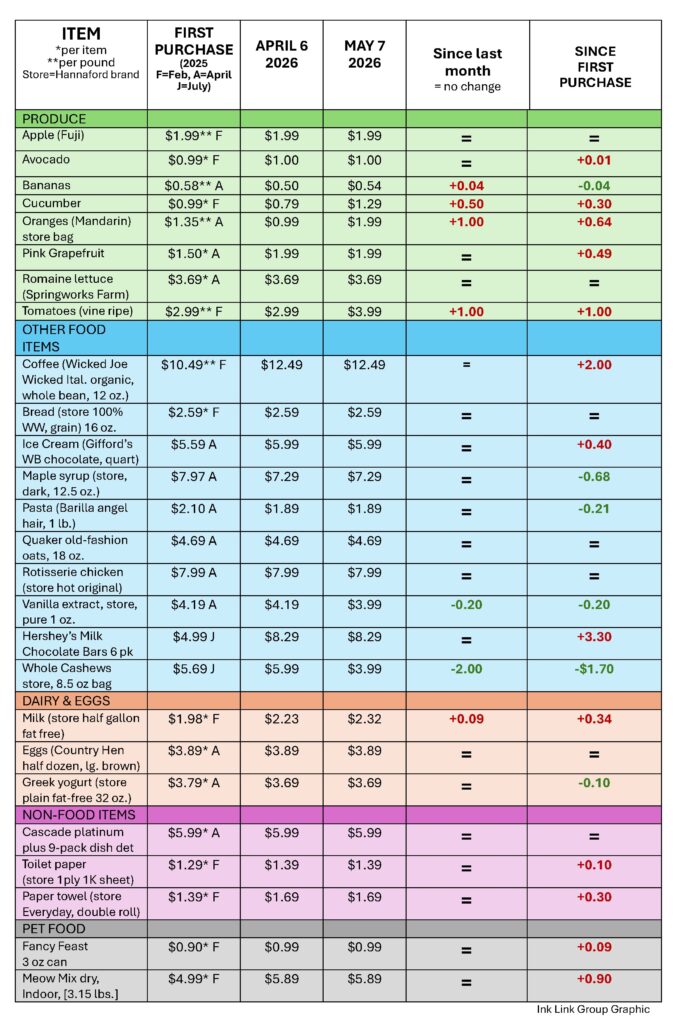
Overall, five items on the list of 26 went up in price, four of them produce. Two items decreased, both big drops, for a total increase from last month of 0.425%. While the overall percentage of increase month-to-month was low, it’s the long run that makes the difference. Since April 2025, my grocery list prices have gone up 7.34%.
According to the U.S. Department of Agriculture’s 2026 Food Price Outlook released at the end of April, prices for all items have risen 3.3% since March 2025, and food prices are up 2.7% since then. That means my list increase is more than two times higher than the average. Averages are averages – your own prices may be more, or less, than that, depending on your choices.
My biggest increases over the past 13 months are coffee and chocolate, “luxury” items that aren’t on every shopping list. But it’s worthwhile to note that despite the normal ups and downs of produce prices, five of my seven cost more than they did a year ago. These aren’t fancy items, but likely things most people buy – tomatoes, cucumbers, oranges, grapefruit and avocado.
One thing I neglected to put on my list a year ago that I should’ve is beef. It’s not an every-week purchase for me, though I do buy it frequently. The USDA is predicting beef prices will go up 6.3% in 2026.
Other USDA predictions for price increases in 2026:
- Sugar and sweets, driven mostly by chocolate increases, 8.1%
- Non-alcoholic beverages, driven mostly by coffee increases, 5.2%
- Fresh vegetables, 4.8%
- Poultry, 0.7% and pork, 0.4%.
Want some good news? Believe it or not, the price of eggs, the clarion call for rising prices two years ago, is expected to decrease an average 29.4% in 2026. This is largely because flocks have been restored after being decimated by diseases like avian flu two years ago.
Let’s take a look at the list.
What’s up
Four of my seven fresh produce products rose in price, the biggest hikes being to tomatoes and cucumbers.
Produce prices are always the most changeable on a grocery list, dependent on weather, season and more. They’re also dependent on things like storage and transportation costs, both of which rely on energy, and because produce has such a short shelf life, those factors have a much more immediate impact on pricing.
This time of year, warm-weather produce tends to rise a little in price because we’re seeing imports and off-season items. But that doesn’t account for the big spike of some items on the list this month.
I like the tomatoes on the vine, and they’re up to $3.99 a pound this week, up $1 from a year ago, and $1 from last month, and also up $2 a pound from the $1.99 they sell at a lot of the time. Besides the fact they’re out of season, the price hike is largely because of two things: a 17% tariff and rising transportation costs. It’s a wicked one-two punch.
Last July, tariff protections for tomatoes from Mexico ended. Unlike avocados and some other produce that still is tariff-protected, tomatoes are more widely grown in the U.S. and the thinking was that the tariff would encourage more tomato production here at home. It takes time, though, to increase production. Farmers plan years in ahead. Last year, 86% of the tomatoes sold in the U.S. came from Mexico, where they can grow them year-round. Most U.S. growers, unless they are using greenhouses, have a more limited season. Bad weather in Mexico this year, as well as Florida and California, have added to the shortage.
On top of it, most of the tomatoes we buy here in the Northeast this time of year have to be shipped here. The rising cost of transportation and energy it take to store them, because of the Iran war, has added to the price hike.
And cucumbers! Whoa. Up to $1.29 apiece from 79 cents last month and 99 cents a year ago. Some of the same issues affecting tomatoes are true for cucumbers, particularly the fact they’re out of season, combined with shortages because of weather, as well as rising transportation and storage costs.
Oranges are up $1 a pound for a bag of store brand Mandarins from last month. Last month’s 99 cents a pound price was a sales price, so we knew they’d be going back up. They’re 64 cents a pound more than they were in April 2025.
Rounding out the produce hikes is good old bananas, still a bargain at 54 cents a pound at my store, up from 50 cents, where they’d been for months.
The other price hike on my list was a half-gallon of store brand skim milk, up 9 cents from last month and 34 cents from a year ago. As we know, milk prices are regulated by the Federal Milk Marketing Orders, administered by the USDA, which are adjusted for industry factors. Processing and transportation costs have gone up, as well as the cost of raising and feeding milk cows. Hence, the price of milk goes up as well.
What’s down
Both of the price decreases this month were big surprises to me.
The price of my little 1-ounce bottle of store brand pure vanilla extract dropped 20 cents after not changing, except as a December store loss leader, since I began keeping track. I don’t do a ton of baking these days, but I love putting the vanilla in oatmeal, French toast and sometimes a little bit in my coffee. Yes, another luxury item, but a little goes a long way.
A year ago, tariffs and bad weather and crop failures in countries that grow the delicate vanilla bean were destined, I was sure, to drive the price up at some point. But now, the crop has stabilized and supplies are up, so prices are down. That said, whenever a price on a product that’s been pretty stable decreases significantly, I see it as temporary and expect the price to creep back up. Prices that go up don’t tend to drop that much for long, and a decrease is often to lure buyers back. Maybe I’m wrong. We’ll see.
The same can be said for cashews. My 8.5-ounce bag of store brand whole cashews dropped a whopping $2.00 from last month, from $5.99 to $3.99. It’s a $1.70 decrease since I added them to the list in June. Cashew prices skyrocketed because of the big tariffs on countries that produce them, particularly Vietnam, Brazil and the Ivory Coast. Supply also dropped because of the tariffs. Cashew-eaters apparently decided they could do without, and global demand dropped as well. Now there’s an over-supply, leading to the price drop. Like vanilla, I don’t expect that huge decrease in the price of cashews to be permanent. They may not go back up to $5.99 a bag, but my prediction is that they’ll go up. If I’m wrong, you’ll be the first to know.
What we’re watching
While beef is not on the grocery list I follow for the purposes of this column, it’s worth keeping an eye on since it’s on most people’s list. About 88% of Americans regularly buy beef, and as many as 70% eat it once a week, according to the USDA. That’s second for meat consumption after chicken, which is 83%, but chicken’s already on the list.
A pound of store brand fresh 85% lean ground beef is $6.79 this week at my supermarket and a pound of store brand organic, grass-fed 85% lean ground beef is $10.99 a pound. We’ll keep track of how that changes monthly on the Grocery Snapshot graphic.
The USDA predicts a 6.3% increase this year. Transportation, fertilizer, processing and cattle-housing costs are all going up as the cost of energy rises with the war. Even if it were to end tomorrow, the effects would continue for much of the year. The longer the energy pipeline is disrupted and the higher energy costs rise, so will the average cost of beef.
On the other hand, large supermarket chains like mine can absorb some (but not all) price increases, especially for a big mover like ground beef. That could keep prices from spiking too much. Stay tuned!
The Disclaimer
This monthly feature a snapshot of a variety grocery items I regularly buy, not a scientific analysis. It’s simply a way to look at prices and what affects them.
Aside from tariffs, a lot goes into price fluctuations, including seasons, weather, store preference and store decisions. I’ve included items likely to be affected by tariffs as well as some that may not be. There are likely different prices and fluctuations for similar items at other stores, but this is a reflection of my shopping list, not a comparison-shopping exercise or a definitive picture of what certain items cost everywhere.
This is not meant to be a brand endorsement or an advertisement for Hannaford. These are just the things I buy, and that’s just where I shop.