
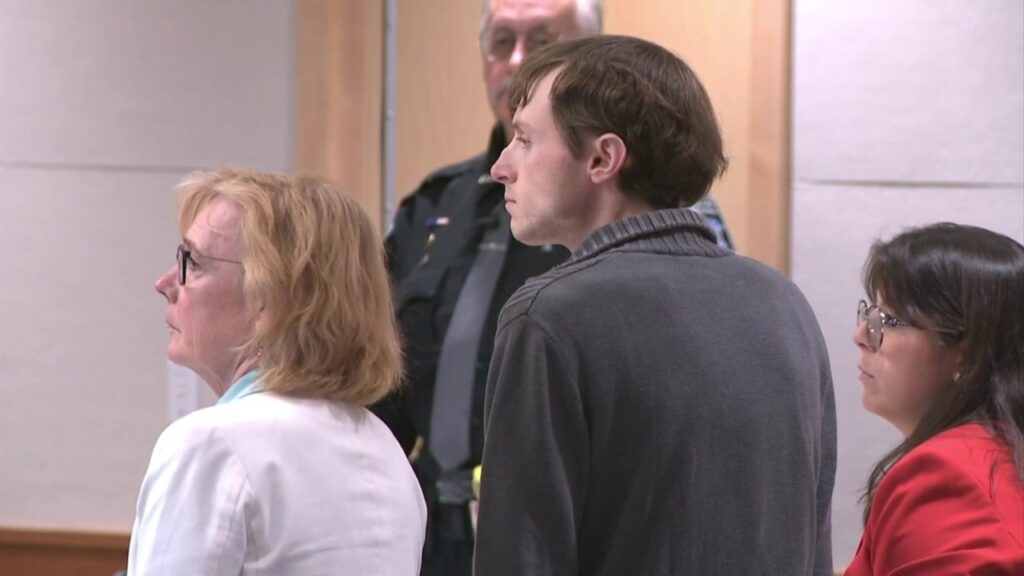
CONCORD, NH – Logan Clegg’s claim that evidence used in his trial should not have been allowed because it was obtained after a warrantless cellphone data search has been denied by a Merrimack County Superior Court judge after the state Supreme Court in March remanded the motion to the court for further review..
Judge John Kissinger ruled that evidence police uncovered after they got Clegg’s cellphone location information without a warrant was admissible under the inevitable discovery doctrine, which is a rule of law that holds that unlawfully-obtained evidence can be used in court if the search is justified and if the evidence would have been found in a subsequent legal search. Kissinger is the same judge who oversaw the trial and denied Clegg’s May 2023 request to suppress the evidence on the same grounds as the current motion.
Clegg can appeal the Superior Court ruling to the state Supreme Court, according to the state Office of the Attorney General.
Clegg, 30, was convicted in October 2023 in the shooting deaths of Djeswende and Stephen Reid on April 18, 2022, on a trail in Concord near the Reid’s apartment. He was sentenced to 50 years to life for each of the murders in December 2023.
The New Hampshire Supreme Court in March sent Clegg’s motion to suppress evidence gathered after his cellphone information was obtained back to the Superior Court for review after it found that police erred in relying on exigency to get the phone data without a warrant. An exigency request to get information without a warrant can be made if the emergency circumstances meet a certain threshold.
The high court asked the Superior Court to decide whether Clegg’s motion to suppress, on the basis of the inevitable discovery doctrine, met the standards for an exigency request or if it did not and should have been denied.
The Supreme Court’s decision said that “important considerations” in applying the inevitable discovery doctrine are whether the police benefited from the initial illegality and whether they acted in good faith in going ahead without a warrant – in other words, the court says, that police didn’t deliberately or consciously deny the defendant of his constitutional rights.
Concord police made three exigency requests Oct. 11 and 12, 2022, to Verizon through its hotline for information on a cellphone number that Clegg had used to buy an Oct. 14 airline ticket from New York to Germany. Police believed it could take weeks to get the information without the request. They also believed, given how long it could take, they didn’t have time to get a warrant.
Clegg’s defense had argued in May 2023, as well as in the March and April hearings, that law enforcement could’ve used the exigent circumstances request while still getting a search warrant to back it up.
The Concord Police Department in 2022 used a Verizon online portal or fax to file search warrants for judges to sign, and one was signed by 11 p.m. on Oct. 11, 2023, for a U.S. Marshal cellphone simulator that the department ended up not using. That was about five hours after Concord police first submitted the first exigency request to Verizon. The department started getting information about half an hour after submitting their exigency request.
The defense had argued that showed the police had time to get the warrant and still get the information. They said that the department’s argument was “If we hadn’t done it wrong, we would’ve done it right.”
The Supreme Court agreed that there was time to get a warrant, ruling that there was no “objective basis in the record for the [Concord Police Department’s] apparent belief that using the [Verizon] exigency hotline and obtaining a search warrant were mutually exclusive.
“The record reflects, as the trial court found, that the delay caused by obtaining a search warrant alone would have been ‘a few hours’…The record also demonstrates that Verizon responded to CPD’s request for ping data via the exigency hotline in less than thirty minutes,” the Supreme Court decision said.
Kissinger in his Friday ruling said that the state met its burden of proof that it was inevitable the police would find the evidence in the future, but that they believed they didn’t have the time to wait. The fact that Clegg had a plane ticket for Oct. 14, three days away, as well as that he was armed, and that he’d shot the Reids at random, all meant finding him was urgent, the state argued and Kissinger agreed.
Kissinger found the state met its burden of proof that the police acted in good faith when they decided not to wait for a warrant, even if they were wrong about how the process would work.
“Each officer who testified about this issue confirmed his mistaken but genuine belief that obtaining a warrant would have required [Concord Police Department} to use Verizon’s traditional warrant process rather than the exigency hotline,” Kissinger wrote.
He said the understanding was also held by an FBI agent who was advising Concord police and that a Verizon employee that the police called to ask about was even confused about the process, frequently putting the officer on hold to ask someone else.
. “A Verizon employee’s confusion on this very issue undermines any suggestion of culpability concerning CPD’s confusion,” Kissinger wrote.
He wrote that good faith was proved by the fact that an officer “thought about whether to apply for a warrant and completed some research into that issue before CPD pursued the warrantless exigency requests.
“This demonstrates that CPD was not attempting to run roughshod over Mr. Clegg’s constitutional rights, but rather that CPD was following the process the CPD officers genuinely believed to be,” Kissinger wrote.
Kissinger’s decision came after an April 21 evidence hearing in which police and Verizon officials testified about the process of getting the cellphone information and the warrant issue.
Clegg had objected to holding the hearing on the grounds that it would produce no new evidence, just speculation, on what police were thinking and doing in October 2022.
Kissinger in his ruling Friday said that motion, filed by Clegg’s attorneys Maya Dominguez and Thomas Barnard, continued to be overruled. He said the appellate process allowed the state “a narrow opportunity to supplement the record so the Court could make the factual findings necessary to resolving the State’s invocation of inevitable discovery.”
A post-remand hearing was also held in March, before the evidentiary hearing.
The appeal that led to Kissinger’s ruling is a replay of a pre-trial motion Clegg’s defense made in 2023.
In a three-day pre-trial hearing in May 2023, Clegg’s attorneys made the same argument about suppressing the cellphone evidence, which led to police finding Clegg’s laptop and a loaded gun in his backpack, both of which played a part in Clegg’s conviction.
The state also made the same arguments – that police would have inevitably gotten the same information if they’d gotten a warrant, but they believed they didn’t have time. They also argued that Clegg didn’t have a legitimate expectation of privacy in his location as revealed by cellphone location data, but even if he did, the exigent circumstances justified the data request.
Kissinger in June 2023, just as he has three years later, found that the state met its burden on proving the warrantless search of the cell data falls within the exigent circumstances provision. He also ruled that probable cause existed for the data request.
Clegg was found guilty of nine charges: two of second-degree murder for “knowingly causing the death” of each of the Reids; two of second-degree murder for “recklessly” causing the death of each of the Reids; four more for falsifying evidence, two of those for concealing the Reids’ bodies under leaves and woodland detritus after he shot them, one for clearing his computer history and data in the days after the shootings, and one for burning down his tent site with all his possessions in them after the shootings.
He didn’t know the Reids, who were out of a walk in the Broken Ground Trail System a short distance from their apartment on Loudon Road.