
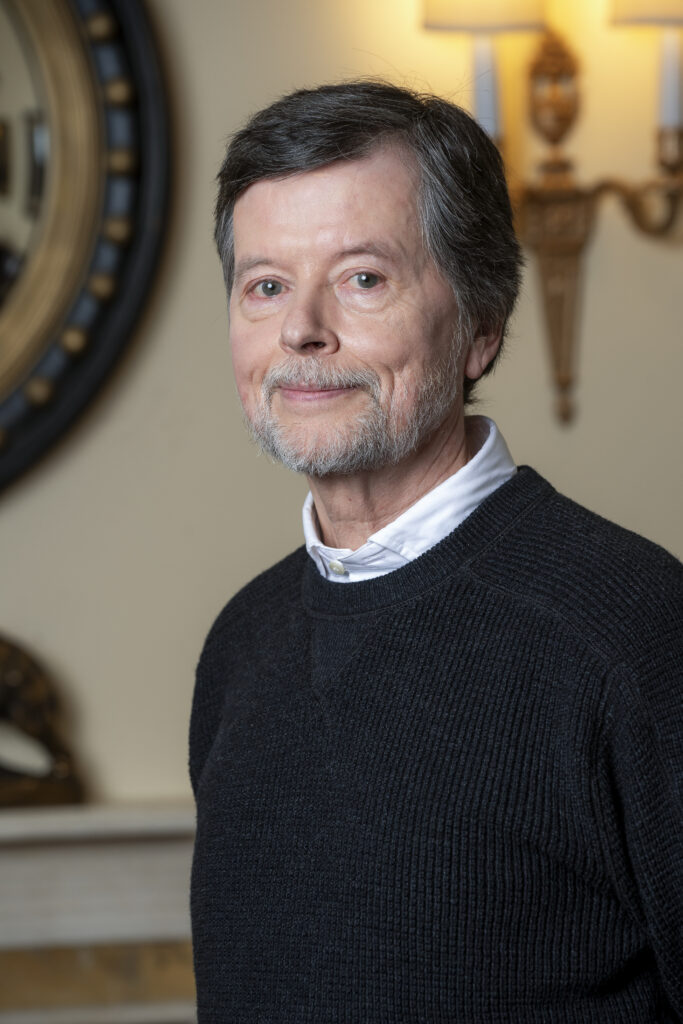
KEENE, NH – If you’ve grown up in public schools, or attended a history class in college since the ‘90s, chances are that you’ve seen a documentary made by Ken Burns. The same can be said if you’ve ever tuned into your local PBS affiliate, which has been the central outlet for the Brooklyn, New York, native and current Walpole resident since his documentary on The Civil War first came out in 1990. Fast forward to that time to now, Burns has amassed a vastly prolific filmography, with his most recent release being the documentary series, “The American Revolution,” that was released on November 16. On December 4, he’s going to be at the Colonial Theatre in Keene to have a talk with the Colonial’s Executive Director Keith Marks, show clips from the series, and do a Q&A with the audience starting at 7 p.m.
Although the event is sold out, Burns and I had a talk ahead of the event about the filming and work that went into the making of the series, wanting Americans to understand that they have a shared history, how his work has lasted through the tests of time, and looking forward to being in front of a home audience.
Rob Duguay: For the making of “The American Revolution,” yourself, Sarah Botstein and David Schmidt spent time filming in various locations such as Providence, Rhode Island, Philadelphia, Charlestown, New Hampshire, and the Adirondacks, among others. Some of this was done during the winter months, so how much did the weather have an impact during this particular process?
Ken Burns: Our whole idea was to film live cinematography, including people who do reenactments in every season at every time of day at every vantage to get the weather particular because it was such an extraordinary force in the story of the American Revolution. We know what’s coming for a week in advance, but they had no idea what was happening. Ships were getting blown off course all the way to the Caribbean, or people froze to death before The Battle of Trenton. It’s a big factor, so it was very important for us to have every kind of weather.
RD: When it came to the reenactments, how did you go about getting these different groups involved? Did you already have a database on hand so you already knew who to reach out to?
KB: We just reached out. We did a lot of research and we reached out to a lot of groups. We spoke to them about filming in order to understand how serious they are about it, appreciate how dedicated they are about it, and what their parameters were. Quite often, they didn’t want us invading the scene they were doing, so we would use drones or be far away while embedding ourselves with uniforms. Our cameraman, Buddy Squires, would put on a Continental uniform, or whatever it was, while using a smaller, kind of GoPro size, but professional equipment that allowed us to get some really extraordinary shots.
RD: How would you describe the research when it came to gathering information on this time period from from the mid-1770s to the 1790s? Did you find yourself looking through physical materials, such as dusty books that are hundreds of years old, did you do most of your research online, or was it a balance of both?
KB: We do a lot of research with scholars and their contemporary work. There’s been a lot of new scholarship and we sometimes work with primary materials. I wouldn’t call them dusty, people do very hard jobs to make sure they’re not dusty, and we have to avail ourselves to online things. There are no photographs, and it was real, so it makes our job more difficult, which is why we did so much filming with reenactors. Not to reenact a particular battle, but to collect a critical mass of imagery that’s sort of intimate and impressionistic where it doesn’t see faces with muskets firing, a cannon going off, darkness at night, feet trudging through mud or snow, hands warming by a fire, and large groups of people from a distance so you don’t have this sense of modernity, all of which are combined with paintings and a lot of maps.
We have more maps in this film than in all of the other films combined, and with the primary documents, such as the Declaration [of Independence] and things like that. We were able to offset, if you will, an absence of having any photographs or newsreel footage.
RD: For the voice acting, you brought in a murderer’s row of actors such as Michael Keaton, Josh Brolin, Claire Danes, Kenneth Branagh, Jeff Daniels, Ethan Hawke, Craig Ferguson, Samuel L. Jackson, Meryl Streep, Liev Schreiber, Laura Linney and others. What was it like getting all of these people involved?
KB: Well, I’ve been doing this for the last 50 years where I’ve been using first-person voices to compliment the third-person narration, which is written in this case by Geoffrey Ward. I’ve worked with a lot of people, and we’re not trying to get celebrities, we’re trying to get people who are the best actors in the world. I believe the cast, even though it’s all read off camera, is the finest that’s ever been assembled for any film documentary, feature film, television series, or anything. They are the finest of the fine, working with them is always a thrill and they add new meaning and dimension to the words and the quotes that we bring up while helping bring alive the war. It’s not just the familiar “Founding Fathers,” but we introduce you to scores of other people, like teenage kids who are fighting for the patriot side to German mercenaries to French diplomats to the King of England, his ministers, his generals, his soldiers and all of the varieties or patriots and loyalists there are.
As well as Native Americans and free and enslaved Black people, it’s an incredibly dynamic and dramatic story that’s as complicated and as interesting as anything we’ve ever worked on.
RD: That’s incredible. We’re in a time of political unrest with the current Trump administration along with the cutting of various programs, including the National Endowment for the Arts, which threatens the existence of public media. With this being apparent in our society, do you feel that releasing this documentary at this time has a different significance for you as a filmmaker than with your previous works?
KB: No, not at all. I wouldn’t call it political unrest, there’s divisions, but it’s nowhere near the divisions and the political and military unrest within America during the American Revolution. The revolution was a civil war in addition to a revolution, and it was also global where it involved more than two dozen nations, European as well as Native American. We started this film when Barack Obama still had 13 months to go in his Presidency, we don’t plan for the moment. We know as Mark Twain said that “history doesn’t repeat itself, but it rhymes,” and we’re always aware of rhymes, and they change and do that. I think having Americans understand that they have a shared history, and whatever political point of view they might have today might have them reexamine what they believe in and the gift that we’re given by that revolutionary generation of this first-ever democracy in the history of the world.
RD: Do you have a habit of working on multiple documentaries at a time?
KB: Yeah, I always have. Usually it’s kind of kookoo, but I have like four or five going on.
RD: Okay, that makes sense since I recently saw a list of other films you have coming out over the next couple of years. As a documentary filmmaker, you’ve reached a point in your career where your aesthetic and the way you craft your films has become synonymous with yourself. It’s kind of a similar way to Hollywood film and television directors like Martin Scorsese, Stanley Kubrick, David Lynch, Quinten Tarantino, and Jim Jarmusch, for example. When you’re watching one of your documentaries, you know it’s a Ken Burns film, much like when you’re watching a Scorsese or a Kubrick film. You’ve had your work become the subject of entire classes in various colleges and universities while also having them being shown in public schools across the country, so what are your thoughts when it comes to having your work being held in this regard?
KB: I’m thrilled. I’m very honored by the question you put me in with extraordinary company and I’ve worked my entire life making films that were first shown on PBS so that they do have the most robust access to schools across the country, so it’s win-win. As we’re talking, my Civil War film, which is over 35 years old, is being shown hundreds of times. Not all of it, but 40 minutes of a certain battle, or Lincoln, or Black soldiers, or women, or whatever it would be.
RD: That’s actually how I got into your work, from watching that Civil War documentary when I was in middle school.
KB: Yeah, see what I mean? It’s so exciting to me that most broadcast television, which is what this was when I started out, dissipates like sky writing, which disappears with the first breeze, but these things live on.
RD: It’s a testament to your work. For this event centering on “The American Revolution” documentary happening at the Colonial Theatre in Keene, what are you most looking forward to when it comes to what you’re showing the audience, and what can people expect when they attend?
KB: I don’t know, to be honest. It’s going to be the first time I’ve done an event after the broadcast and the streaming began, and I’ve been on the road for nine months, so I know exactly what it’s like to go to a different place, show 45 to 50 minutes of clips from across six episodes that total to 12 hours, and have a Q&A and conversation with folks. With this one, it’s home, and that’s very meaningful to me. The idea that in some ways I’m coming home with all my stories, and that’s a really wonderful and satisfying thing.