
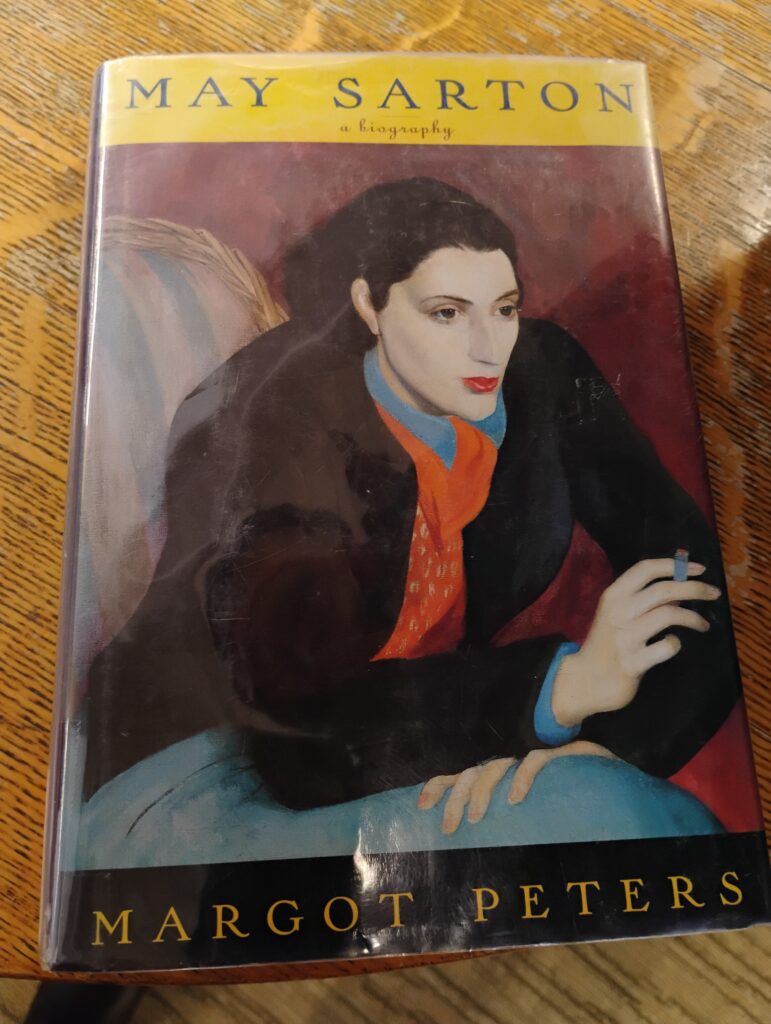

Writer and poet May Sarton prefaces her 1968 memoir Plant Dreaming Deep with an untitled poem whose last two lines are “…Homeward at last toward the native source /Seasoned and stretched to plant his dreaming deep.”
The writer uses the short poem to compare her search for Home with Odysseus’s 20-year hero’s quest to find his way Home in The Odyssey. He and his brave men took on hungry cyclops’ and tempting sirens (Odysseus tied his men to the masts of the ship and put wax in their ears), among other challenges and dangers. True, Sarton on the outside only had to deal with local lenders, realtors and Yankee contractors, but as the saying goes, “Home is where the heart is.” She didn’t look for a house as much as rely on all of her her senses to find a home with a good heart.
Sarton was 46 years old in 1958 when she moved to an “18-century farmhouse in rather poor condition” in Nelson, New Hampshire. The village, about 20 miles northeast of Keene, showed a 2020 population of 629.
The well-traveled and then well-known writer was coming off an extended series of readings and lectures, mostly on the national college circuit, and was in need of a true place for her soul to settle. Her recent two-month tour stop in Santa Fe put the historic New Mexico town on her short list (as it is for this writer!) when her friend Ray Baldwin suggested the Monadnock region of New Hampshire. Sarton’s only previous connection to New Hampshire had been a month in summer stock theater in Dublin several decades earlier.
“I behaved like a starving man who knows there is food somewhere if he can only find it,” she writes of that May morning spent with a realtor looking at five regional properties. The first four offered nothing to her. The beautiful warbling of an oriole cut through the silence of the town square in Nelson, the fifth stop, and the birdsong rekindled a fond childhood memory. “…he had appeared on the maple like an angel,” she tells us. When she experienced the sunlight highlighting the beautiful wood floor in the for-sale Nelson farmhouse’s main room, she clearly “saw the light.” The farmhouse, badly tilting barn and 36 acres of fields and woods were hers for $3,900, but another $7,800 was needed pronto to make the home habitable before winter arrived. Needed were a chimney, an entire plumbing system with a cesspool and continued general contract work with problems that popped up as readily as faces in the Whac-a-Mole game at the county fair’s midway.
Plant Dreaming Deep perfectly captures the balance between seeking the solitude to write, she set three hours aside every morning, greeting a small parade of well-meant neighbors, steering workmen and entertaining house guests. Sarton’s partner Judy (the couple were only recently separated) lived in Cambridge, Massachusetts, “within the perimeter,” the writer says. She describes the local Yankee workmen as quiet but generous. She counts almost daily visitor Perley as a handyman par excellence. “He might have been an apparition from another age,” Sarton writes, “an age when a workman still had the time and the patience and the wish to do a patient, perfect job, not for the money, not even for the praise he might get at the end of the day, but out of self-respect and out of the love of the work for its own sake.”
When neighbor and good friend Quig was actively dying in the fall of 1960, Sarton took stock of how much his paintings were a valued emotional part of her home. Even a somber browns and grays Maine seascape of fishermen setting up their nets is described as “a painting that drinks light.”
When Quig died in January, Sarton wrote: “I am, I think, more of a poet than I was before I knew him, if being a poet means allowing life to flow through one rather than forcing it to a mold the will has shaped.”
Sarton, a recipient of both a Guggenheim Fellowship and an American Book Award, was a prolific writer. She penned 17 books of poetry, 19 novels, 17 non-fiction titles and two children’s books. Inclusion in anthologies and books of her letters add to the total. The May Sarton New Hampshire Poetry Prize is awarded annually for an unpublished book-length manuscript of poems, though previously published individual poems within the submission are accepted. Manuscripts from around the world are encouraged with the caveat that the submission has to be in English.
The Belgian-born writer passed away at 83 in York, Maine in 1995 but chose to be buried in Nelson, where she had lived for approximately 15 years. Her 1967 book As Does New Hampshire and Other Poems was a bicentennial tribute to her adopted hamlet in the form of poems detailing a year’s cycle of local nature as she embraced it.
Recurring themes in both Sarton’s free-verse poetry and prose are an awe of the broad brush of nature and the necessity and wonder of love in all of its universal forms. She also eloquently addressed the inner-life themes of the creative life, gratitude, gardening, resilience and aging. The writer was both an early feminist and a lesbian but like the gay poet Walt Whitman, she saw love as a deep well that nourished all. Big Love. A line from Whitman’s 1855 Song of Myself was echoed in Sarton’s writing a century later: “Stop this day and night with me and you shall possess the origin of all poems…”
The Work of Happiness, one of Sarton’s best-known poems, includes the lines, “…A shelf of books, a table and the white-washed wall-/ These are the familiar gods of home/ And here the work of faith can best be done.”
The third cinematic version of The Odyssey that I am aware of will wash ashore from Hollywood this July with Matt Damon starring as Brave Ulysses. A Best Actor Oscar would pale in comparison to the heart-felt journey Sarton, Quig and Perley undertook to ascend Mt. Olympus without ever leaving Nelson, their beloved sanctuary.