
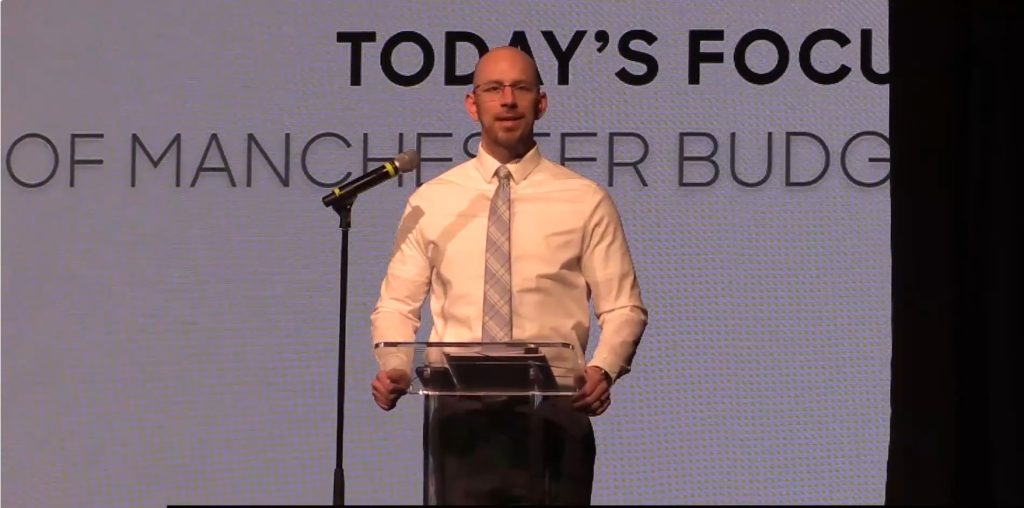
MANCHESTER, N.H. – With municipal budget season well underway in the Queen City, Manchester Mayor Jay Ruais joined the Greater Manchester Chamber’s for a question and answer session with the public on the ongoing municipal budget process on April 9 at the Rex Theatre.
Ruais reiterated highlights from his recent budget address, noting that the process was part of several months of discussion among the city government’s department heads as well as upcoming potential amendments from the Board of Mayor and Aldermen.
The mayor added that most municipal employee union contracts will need to be renegotiated for renewal this year and that all modifications to the budget would be made with scrutiny and after creative solutions were investigated for any obstacles. He also noted that given the size of the budget, which he has proposed at $195,751,642 for the upcoming fiscal year, it is still possible to dive deeply into certain parts of the budget in ways that may not be possible for the budgets of larger government entities.
There were concerns from the audience regarding the Manchester School District annual budget, which is also finalized by the Board of Mayor and Aldermen but constructed by the Manchester Board of School Committee (BOSC).
Manchester resident Rick Blais expressed frustration with what he saw as a lack of long-term planning, an assertion challenged by BOSC Vice Chair Jim O’Connell, who expressed frustration with the fact that the Manchester School District has the lowest per-capita student spending in the state and that the increase in last year’s budget was largely swallowed up by increased utility costs.
Ruais noted to O’Connell that the school budget prior to his tenure was significantly lower than the BOSC’s current requests. Following the theme of his budget address, Ruais stated that a strong school district is important and that more will be allocated over time but support for local property taxpayers is also important the needs of both groups must be taken into account. With Blais, he noted the unique challenges faced by the Manchester School District compared to the rest of the state, such as the disproportionately large amount of new students who are learning English as a second language.
Later in the event, Ruais reiterated the uniqueness of Manchester among New Hampshire’s municipalities due to its comparative size, and that the larger media presence here compared to the rest of the state ensures that people from elsewhere in the state are always well aware of the bad in addition to the good.
And while that bad exposure can occasionally present Manchester in a bad light and make people coming in from elsewhere feel that the city is dingy or unsafe, one member of the audience reported that she did feel safe downtown and people she knew coming from out-of-town for professional conferences were pleasantly surprised by Manchester’s downtown.
Ruais noted that most crime metrics have gone down over the last six years in Manchester, with the Chamber’s President and CEO Heather McGrail also noting that many people have been impressed with downtown cleanup efforts by the relatively new Streetplus team.
The mayor was also enthusiastic about development in the Millyard during another question that was asked, noting that more housing and potentially a new park may be coming to the area given the boom in development related to the biofabrication industries that now occupy parts of the city’s historical industrial waterfront.
Blais asked another question wondering if building developers should be required to guarantee affordable housing in exchange for any tax cuts, most notably regarding 79E grants, which have become common-place for project such as the former Lamont-Hanley building.
Ruais said that generally the Board of Mayor and Aldermen have only offered short-term tax relief for developers not offering affordable housing and often it is not financially feasible for developers to include affordable housing without some form of government support.
He also felt that concrete thresholds for offering tax relief could cost market distortions on the housing market and preferred to address each request on a case-by-case basis.
The event marked the third edition of the Greater Manchester Chamber’s Future Focus series, following events on the City’s Planning and Community Development Department and its Police Department.
The event can be watched on-demand on the Manchester Public Access Television website.