
INK IN THE WILD
By John Angelo
Meredith Hall’s memoir Without a Map (Beacon Press; 2007) and novel Beneficence (David R. Godine; 2020) turn on single shattering events that leave families emotionally adrift before navigating decades-long journeys involving loss, missing puzzle pieces, redemption and ultimately forgiveness and love.
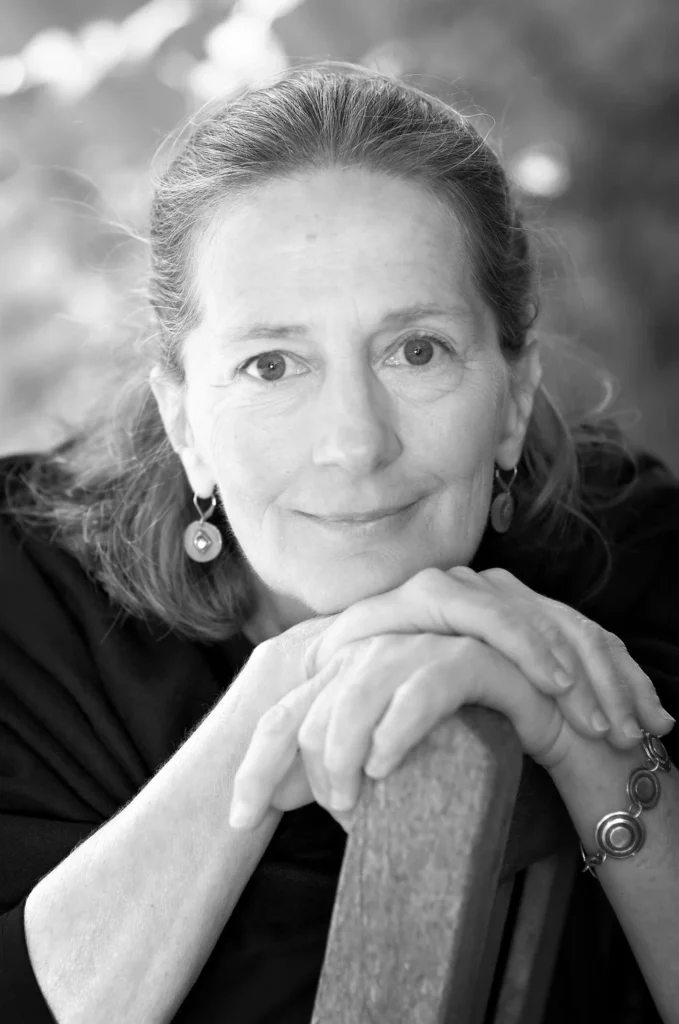
Hall, born in Hampton, was a 41-year-old freshman at Maine’s Bowdoin College and is now an impressive English professor emeritus at UNH, having taught a memoir writing course among others. Her qualifications for teaching memoir writing run deep.
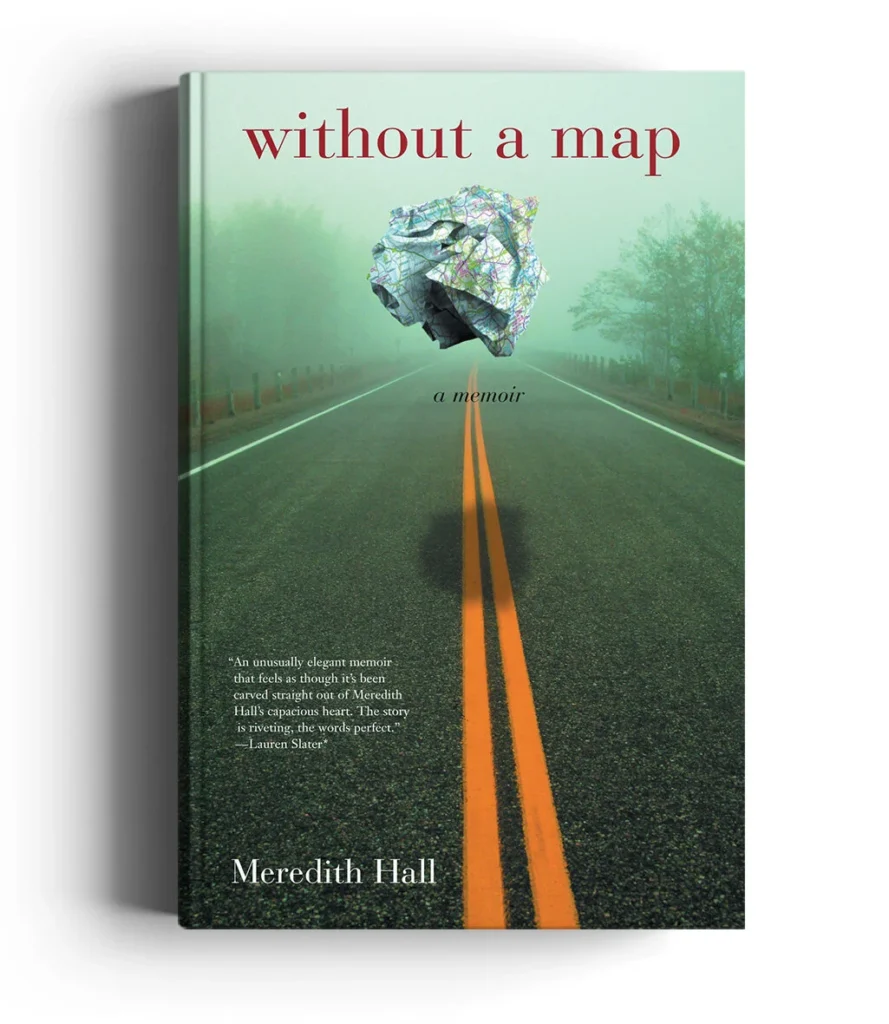
Without a Map’s prologue “Shunned” was awarded the prestigious Pushcart Prize with the book making the New York Times’ extended bestseller list. Hall received a $50,000 Gift of Freedom Award through A Room of Her Own Foundation to complete the book. The award empowers a woman to complete a major literary or artistic project. Without a Map was subsequently a best book of the year by both Kirkus and BookSense and was “Readers’ Pick of the Year” by Elle magazine.
Hall was 16 years old when she gave birth to an out-of-wedlock boy conceived at Hampton Beach in 1965 with a college senior. Under coercion from everyone around her, the baby was immediately put up for adoption, whisked away from his mother, a fait accompli. Hall said in a 2025 Danielle Richardson Lament of Hope podcast, the delivery doctor, with cigarette dangling from his lips, gave this warning: “Don’t you ever go searching for this child. It would destroy him.”
“But the good family must protect its secrets,” Professor Hall tells us.
As she writes in Without a Map, ”This sort of shunning had the desired effect of erasing a life.” Hall wasn’t allowed to even see her baby after delivery, return home or attend the church she’d been a member of. “I had a keen sense of my baby and me being outcasts together.”
Halls mother’s words were unambiguous: “Well…well, you can’t stay here.”
Her father and stepmother in Epping were little better. Meredith could stay temporarily but couldn’t leave the house or even appear in a window during the day. She never set foot again in her father’s and stepmother’s house after the age of 19. She wasn’t allowed to.
Hall’s cloak of invisibility after giving birth extended to her understanding of a New Hampshire law at the time that teen mothers were forbidden to attend any public school. This “run amok” sex thing might be catchy. She completed her high school education through a full scholarship at the Waldorf High Mowing School in Wilton.
Her subsequent travels are a tireless push-pull wandering to both escape memory and to hold her baby close. This well-crafted angst is the heart of Without a Map. She paints internal multi-layered watercolors of her baby’s age and developmental stages. If this maternal ache for both herself and for her baby sounds far-fetched, it mirrors singer/songwriter Joni Mitchell scanning the crowds at her concerts for the baby girl she gave up for adoption at nineteen.
The author partnered with Erik in Cambridge for three years after high school but while her internal compass pointed to her wounded soul, his made a spur-of-the moment plan to buy the Jenny D, a commercial fishing boat, and to cast his net with a friend in Alaska.
“We need each other,” Hall writes, “partners in myth-making.”
She broke it off.
Hall opted out of the Into the Wild sketchy adventure, but this being the early 1970s, she soon made plans with next partner James for a four-month hitchhiking trip through Europe with the final destination enlightenment in India. The plan was for James to fly to Amsterdam two weeks before the author arrived in Luxembourg and for her to then take a train to Amsterdam. Instead, she spent $4.50 of her $70 to telegram James through Amsterdam’s American Express office that she was going solo, familiar ground to her. James had their $600 stake.
She broke it off with James too. She couldn’t shake the anchored plinth of the scarlet “A” she carried inside.
What follows is the beginning of the resilience and ultimately self- forgiveness she learns to nurture within. She walks a self-imposed pilgrimage. Italy. Turkey. Syria. Greece. Lebanon. She sheds her backpack, socks, shirts and underwear for money. She exchanges her boots for sandals and seven dollars, leaving her with $21. She sells her blood for three dollars at different Red Crosses, hoping nurses won’t see the needle marks from too-recent donations. The author takes to sleeping on the beach and stealing food from sidewalk stalls. By this point her only possessions are a dirty white frock, sandals and her passport. It feels less like meaningful losses and more like a bare to the blood-and-bones cleansing.
“I don’t think I am lost,” Hall writes, “but I can not explain where I am.”
Slowly, the wheel begins to turn. Near Beirut, Abrahim gives Hall hot loaves of bread from the doorway of his bakery and invites her to stay with him and his family for three days. After then sleeping for two weeks on a rocky and cold beach in Syria, an elderly shepherd leads his flock to her one night, milks one of the ewes and heats the milk over a small fire he has made, wordlessly offering the sustenance to Hall after dropping a sugar cube into her bowl.
“There is joy here,” the author says. “I have forgotten this kind of happiness, happiness that looks forward.”
Ahead is caring for her mother for the thirteen years Hall’s parent declined from Multiple Sclerosis. Also in the future is a sunny October, 1987 morning overlooking Monhegan Island, Maine, where she first meets her 21-year-old son Paul. They eventually learn the delivery doctor had thoughtlessly placed baby Paul in Epping. He grew up knowing a man with no idea that he was his grandfather. There are understandably many fits and starts in the mother-son relationship, but Annie Dillard’s book Pilgrim at Tinker Creek is an auspicious shared talisman. Can coincidence alone explain their concurrently reading Dillard’s paean to the natural world when they initially meet?
Hall is passionate in illuminating the dark woods of her soul and then finding her way out of the forest with an expanding compassion: “Memory remains the obsessive images we circle, struggling to make meaning,” she concludes.
The words of writer Richard Wright in Black Boy come to mind: “I would hurl words into this darkness and wait for an echo…”
Without a Map is a book well worth listening to.
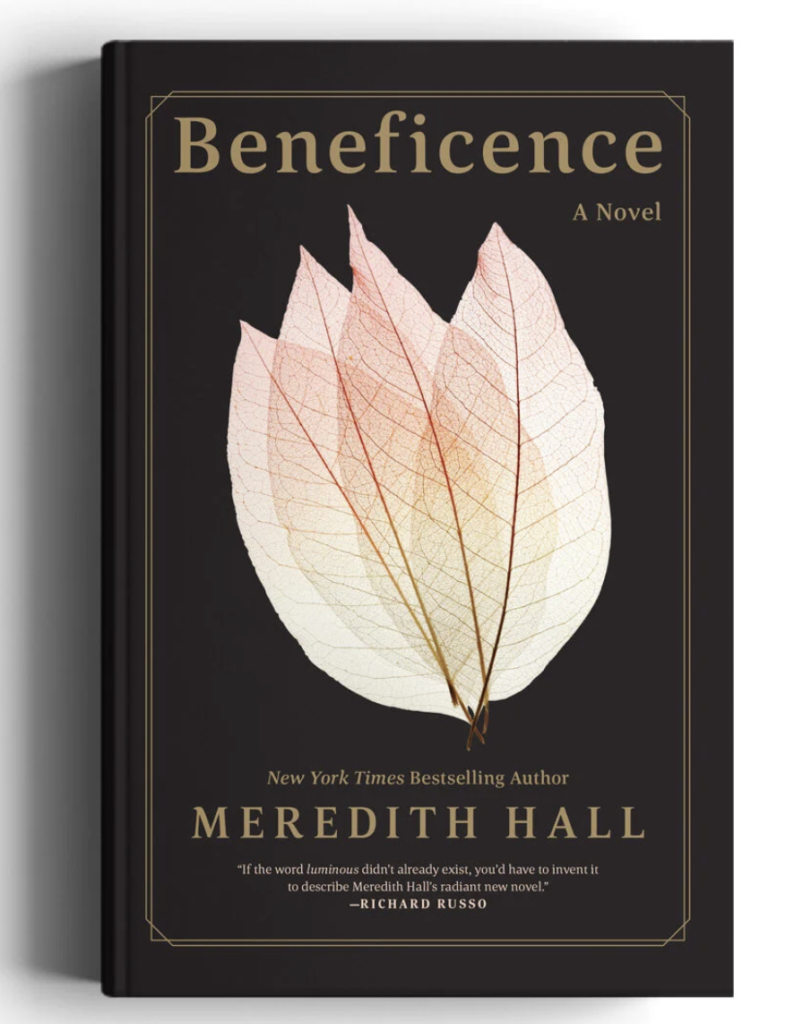
The definition of a Buddhist bodhisattva is almost interchangeable with the meaning of beneficence, the interesting title of Meredith Hall’s 2020 novel. A.I. tells us “A bodhisattva is a person who is able to reach nirvana but delays doing so out of compassion in order to save suffering beings.”
Benificence revisits the major themes of Without a Map, though not as impressively. The novel is set on the fourth-generation Senter farm in fictitious Alstead, Maine. The story spans the years 1947-1965 with the key event the accidental fatal shooting of oldest child Sonny when he is thirteen in 1948. Suffering and compassion are evident on almost every succeeding page.
In John Knowles’ classic A Separate Peace, set at New Hampshire’s fictitious Devon School, main character Gene revisits the prep school grounds fifteen years after the tragic event that changed his life. The novel is told in the first-person through him. The sometimes reckless and sometimes friendly classmate Phineas ascended the twenty-five feet of wooden footholds that the boys had hammered into a tall tree. As Phineas finished the climb and stepped onto a tenuous branch, he lost his balance and fell to the ground, breaking his leg. He subsequently and unexpectedly died during surgery.
Gene is torn by an unresolved guilt that he still carries after fifteen years. Had he shaken the bending branch of the tree Phineas had fallen from accidentally or intentionally?
Professor Hall writes of a similar set of events but doesn’t quite pull it off. Father Tup blames himself for having a loaded rifle hanging by its strap in the milk room. Mother Doris blames herself for momentarily taking her eyes off the children. Nine year-old daughter Dodie thinks she may have hit the barrel of the rifle as she grabbed for it, thus re-directing the fatal shot in the milk room of the barn. Or was it much younger son Beston, Dodie asks herself. “I see an arm reaching. But not mine. Was it? I don’t know.”
Sonny’s friends Hovey and Daniel were also in the milk room adjoining the barn. Was one of them reaching for the rifle?
Hall worked a Maine family farm as an adult, but Dodie’s words of “We got the old gun we liked to play with…” just don’t ring true for children raised on a farm in the 1950s with three thirteen year-olds present. Tup leaving a presumably loaded rifle where anyone could reach it is a stretch.
Professor Hall attempts an almost impossible task in Benificence. Chapters are in the first person through the alternating eyes of Tup, Doris and Dodie over almost two decades. William Faulkner took on an even harder task in his magnum opus The Sound and the Fury. This classic was also told in the first person but through additional and often unidentified characters. No wonder Faulkner suggested Random House use differently colored inks so the reader could more readily recognize members of “the cast of thousands.” Fittingly, one testimonial on Beneficence’s dust jacket mentions Faulkner.
The author is at her best describing the Senter family’s poetic connection to their farm and farm life. Her writing here is both lyrical and meditative, a beautiful combination.
Dodie describes through her adult eyes the Senter River as a metaphor : “A wild and powerful river swept us from shore, and then the current stilled and allowed us to make our way home.”
Forgiveness, compassion, love and soil eventually rebind the long-struggling members of the Senter family. A good family was there all along even as its members were consumed by individual blame and grief.
One Tibetan Buddhist monk says, “An end to the spiritual quest is when you realize there is no designated destination.”
Everything is holy now.
You can reach John Angelo at timelywriter@hotmail.com