
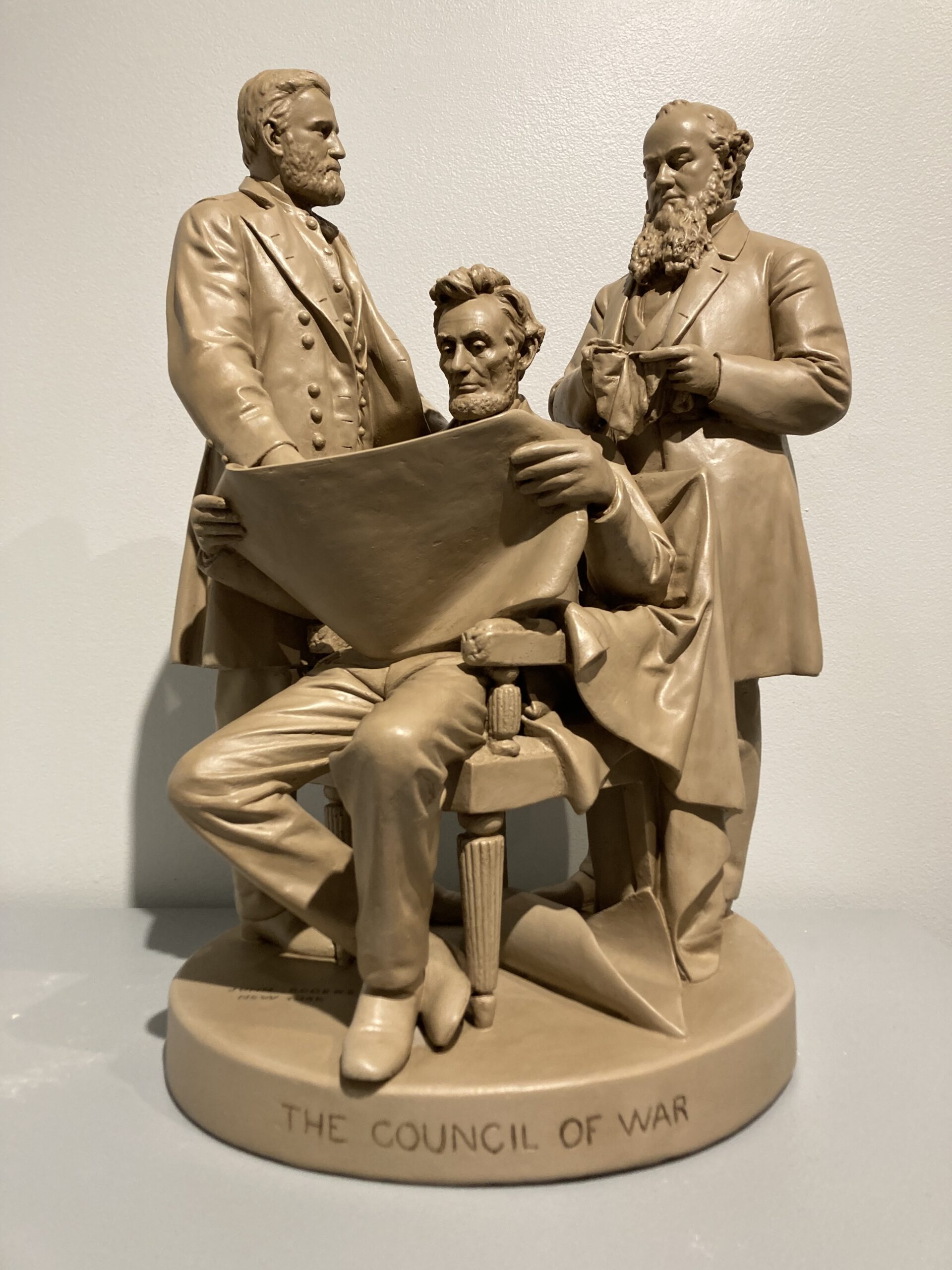
MANCHESTER, NH – The Manchester Historic Association recently opened a new exhibit: “The People’s Sculptor: The Life and Works of John Rogers” at the Millyard Museum.
John Rogers was a well-known sculptor whose statuary “groups” became extremely popular in the mid-to-late 1800s. He was the first American sculptor to mass-produce his work and worked mostly in plaster to make his sculptures more affordable. Although he was born in Salem, Massachusetts, and his business was centered in New York City, it was in Manchester, NH that he got his start as a sculptor.
Rogers came to Manchester in 1850 at the age of twenty and went to work as a draftsman, and later a mechanic, in the early years of the Amoskeag machine shop. Working in the drafting room, he learned to make carefully scaled drawings of textile machinery and locomotives.
While at Amoskeag, he first began to experiment with modeling sculpture. After struggling to find the right kind of clay, he discovered some that worked exceedingly well near the Merrimack River in Hooksett. In 1855, Rogers exhibited two sculptures at the New Hampshire Agricultural Society fair in Manchester for which he won a prize.
In 1856, Rogers left Manchester and eventually settled in New York City where he opened his art studio and began mass-producing his sculptures in the 1860s. He became known for his statues depicting a scene, usually involving two or more people, known as “groups”. The groups became very popular and were marketed through advertisements in periodicals and through sales catalogues, something no artist had done before.
Between 1860 and 1893, John Rogers created 80 different groups and sold over 80,000 sculptures. His pieces made fine art affordable and made the art of sculpture attainable to the American middle class for the first time.
Most of Rogers’ early groups depicted scenes related to the Civil War and slavery. An abolitionist himself, these groups were immensely popular with people in the antislavery movement. He is particularly noted for his both accurate and heroic depictions of African Americans.
Following the war, Rogers’ business continued to grow, and he turned his attention to scenes of everyday life which were often sentimental or humorous. Other groups depicted scenes from popular literature and theater of the time, including Washington Irving and Shakespeare.
Towards the end of his career, he gave one of his finest works, a seated statue of Abraham Lincoln, to the City of Manchester as a gift. A bronze replica of this statue was dedicated in 1910 and still stands today in the courtyard of Central High School.
The exhibit, celebrating Rogers and his art with an emphasis on the important influence Manchester had in his life, will run through September. Visit www.manchesterhistoric.org or call 603-622-7531.