
MANCHESTER, N.H. – The latest student assessment results are in for many of Manchester’s public school students, but a case can easily be made whether these results should be seen through a “glass half full” or a “glass half empty” lens.
During the Nov. 24, 2025 Manchester Board of School Committee (BOSC) meeting, Manchester School District (MSD) leadership released results from the New Hampshire Statewide Assessment System (NH SAS) data collected from MSD students during the Spring of 2025.
Under NH RSA 193-C:3 and the Every Student Succeeds Act or ESSA, New Hampshire school districts and public charter schools are required to assess students using the NH SAS: a series of standardized assessments for English language arts and mathematics for grades 3-8 and science in grades 5,8, and 11. In Manchester, grade 11 students also participated in English language arts and mathematics assessments.
In 2025, Manchester students tested below state English language arts averages in every participating grade. This actually marked improvement for some grades, with grade 3 rising six percentage points from their 19 percent proficiency score among students that took the assessment in 2021.
Within mathematics results, Manchester student results were even lower, coming in with scores less than half of state averages in every grade assessed, with grades 3 and 4 reporting the only results above 20 percent (26 and 28 percent, respectively).
Likewise in science, Manchester’s results were well below half of the state average, with Manchester’s eighth-graders leading their local peers at a 17 percent proficiency rate, compared to 37 percent statewide.
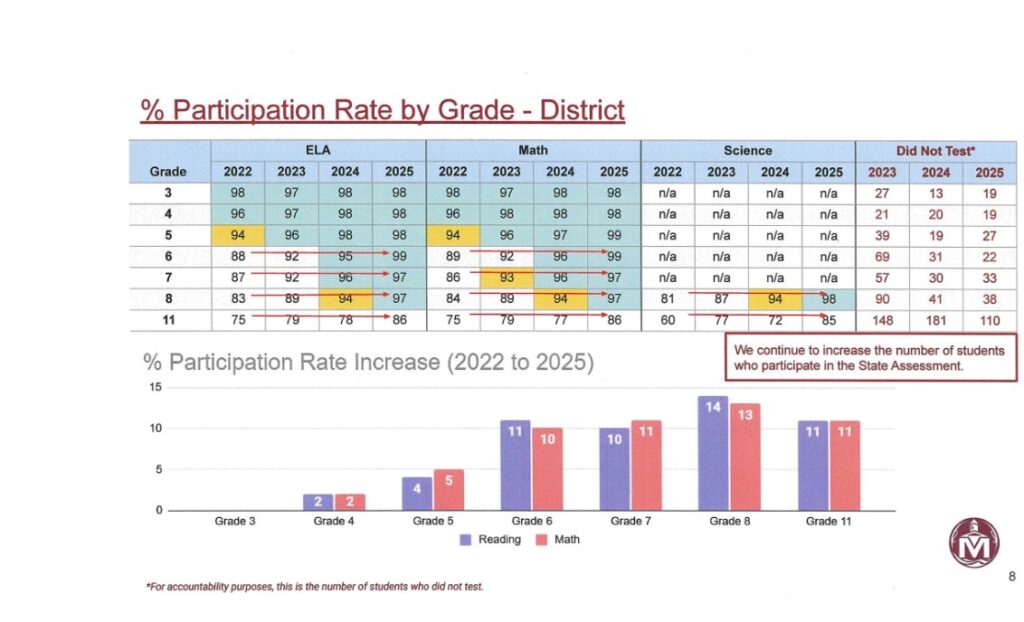
These scores were impacted by low participation rates in the 11th grade assessments, as grades holding participation percentages under 95 percent seeing their proficiency rates are negatively impacted. However, those assessments were the only ones with participation rates under 95 percent in 2025, compared to all grades except for grade 3 and 4 missing that benchmark in 2022.
Under the state’s ESSA guidelines, Beech Street Elementary School and Parker Varney Elementary School are classified as schools in need of “Comprehensive Support and Improvement,” a designation given to the lowest performing 5 percent of Title I schools in the state, although they will be reassessed in 2026 as part of a three-year process.
“Targeted Support and Improvement” schools, which have a subgroup performing in the bottom 5 percent of all schools for that subgroup for two consecutive years include the disabled student subgroups at Jewett Elementary School, McLaughlin Middle School and Parkside Middle School. Parkside and Jewett’s disabled student populations were joined by the disabled subgroups at Manchester Memorial High School, Southside Middle School and Highland-Goffe’s Falls as schools in need of “Additional Targeted Support and Improvement” or schools where a subgroup performs below the statewide cut scores in all available indicators. Jewett and Highland-Goffe’s Falls also qualified in this category for English Language Learners.
Data on high school graduation rates was also provided during the presentation. Manchester Central (71.43% to 69.66%) and Manchester Memorial (75.34% to 78.47%) remained fairly steady from 2023 to 2025, with a large rise during that time at Manchester West (68.23% to 76.62%) and Manchester School of School of Technology (68.23% to 76.62%). The state average graduation rate in 2024-2025 is 87.83% according to the New Hampshire Department of Education.
MSD Assistant Superintendent of Teaching, Learning and Leading Nicole Doherty, who led the presentation, noted the diversity of the district, with over half of the 11,848 enrolled students identified as races other than Caucasian. Additionally, as of 2025, the New Hampshire Department of Education (NHDOE) identifies 2,143 students in Manchester as English Language Learners, or students who speak a language other than English at home and need support to develop their English proficiency. In contrast, the average daily membership in attendance for New Hampshire school districts, one of the key indicators of a school district’s student population, is 805.76 as of 2025.
In addition to the diversity of the district and its status as a demographic outlier compared to other districts in New Hampshire, MSD Superintendent Jenn Chmiel also stated that factors such as test anxiety and differing learning styles can also place a role in assessment data, leading to the need for other methods for students to show their proficiency.

“At the bottom of every single one of these numbers is a human trying to show their knowledge and it’s our responsibility to find them the best vehicles to show that,” she said.
Members of the BOSC shared praise for the year-over-year improvements in the statistics presented, particularly graduation data, but also felt that other parts of the data presented were still in need of improvement.
“There are good things in here and there are some not good things in here,” said At-Large BOSC Member Peter Argeropoulos, who also asked for tangible things that can improve assessment scores and be placed into the district’s future budgets.
“Two things can be true: we can have great things and some things we can work on,” said Ward 2 BOSC Member Sean Parr, who also asked how the data can support where educators need to target their focus.
Ward 8 BOSC Member Jessica Spillers also praised the positive points of the results, but urged a redoubled focus on helping disabled students given the results from schools like Beech Street and Parker Varney.
“I want to make sure we’re really digging into what’s needed for students with disabilities,” she said. “We need to create opportunities for them to move out into society.”
Chmiel responded that special education needs are often a broad target as disabled students often face a disparate set of needs.
NH SAS data for schools and subgroups across the entire state, including Manchester, can be found on the NHDOE website.