
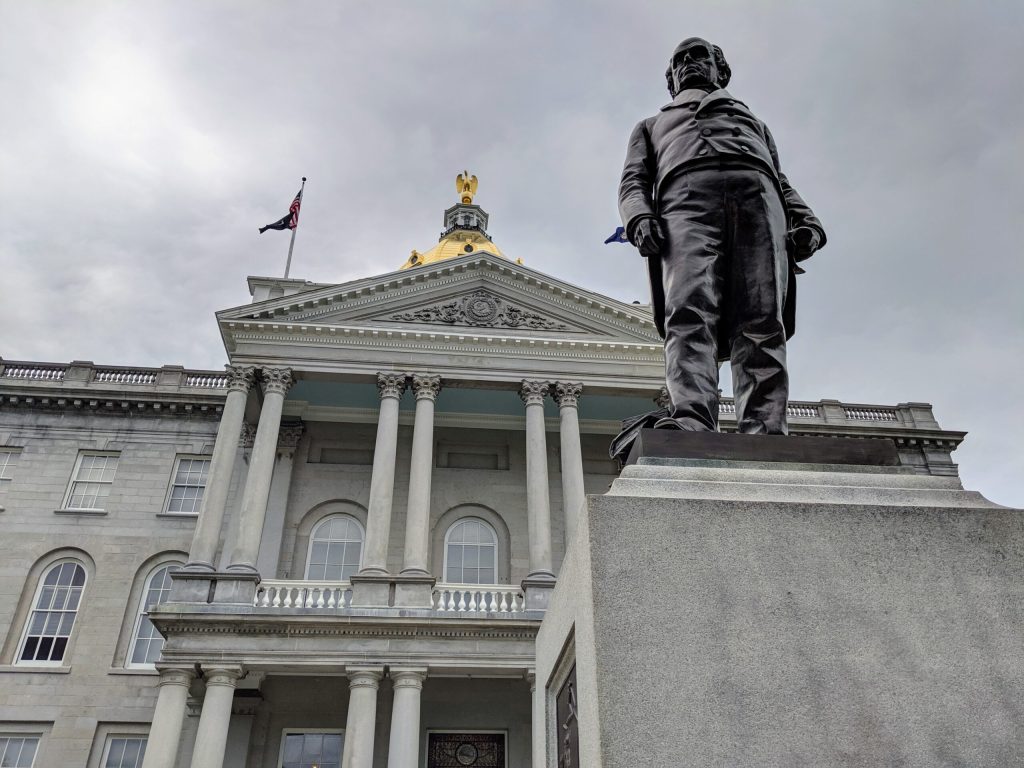
CONCORD, NH – New Hampshire is the only New England state that has not joined a group of 26 in a suit filed Tuesday against the federal government over it’s refusal to use a contingency fund to pay Supplemental Nutrition Assistance Program benefits beginning Saturday.
The states want the court to issue an injunction that would force the U.S. Department of Agriculture to pay November SNAP benefits to the program’s 42 million recipients. Those benefits won’t be paid as of Saturday unless the government shutdown ends or the USDA changes course.
If monthly benefits aren’t paid, it would be the first time in the program’s 61-year history.
The lawsuit wants the court to order the USDA to use a $6 billion contingency fund set up by Congress to ensure SNAP benefits aren’t interrupted.
Defendants in the case are the U.S. Department of Agriculture, USDA Secretary Brooke Rollins, the U.S. Office of Management and Budget, OMB Director Russell Vought, and the government of the United States of America.
New Hampshire has more than 75,000 SNAP recipients, but has not joined its regional neighbors Maine, Vermont, Massachusetts, Connecticut and Rhode Island in the suit, which was filed in U.S. District Court in Massachusetts Tuesday. While most of the plaintiff states have a Democratic governor, two – Vermont and Nevada – like New Hampshire, don’t.
The lawsuit charges that the USDA’s failure to provide SNAP benefits violates the Administrative Procedure Act, which lays out how federal agencies carry out policy, and allows courts to rule on whether they’re following the law in doing it.
USDA has claimed $6 billion in two contingency funds created by Congress can’t be used for the benefits during the shutdown because the money is “only available to supplement regular monthly benefits when” the appropriation is not sufficient. Since no appropriation exists, because the budget hasn’t been passed, the rule regarding the money doesn’t apply.
The lawsuit says USDA’s claim that the SNAP contingency funds can’t be used to for SNAP benefits during an appropriations lapse “is contrary to the plain text of the congressional appropriations law, which states that the reserves are for use ‘in such amounts and at such times as may become necessary to carry out program operations’ under the Food and Nutrition Act of 2008.”
The agency also said that the fund is “for contingencies,” and the fact the program can’t be funded because there’s no budget apparently isn’t one. It uses as an example the Disaster SNAP program, which provides “food purchasing benefits” for people affected by disasters. As an example, USDA cited Hurricane Melissa, which “is currently swirling in the Caribbean and could reach Florida.” The lawsuit points out that the statement doesn’t define “contingency,” and the shutdown qualifies as one under the general definition, as well as Congress’ definition when it created the fund.
The lawsuit also says that not allowing the fund to be used is “a dramatic change in USDA policy.” It points out that the Lapse of Funding Plan the agency was required to file in September in anticipation of a government shutdown cites the contingency funds as a way to keep paying benefits.
“Similarly, USDA’s 2021 contingency plan stated that ‘USDA and OMB have jointly determined that there is Congressional intent that core programs of the nutrition safety net, including [SNAP] . . . shall continue operations during a lapse in appropriations,’” the suit says.
It cites numerous USDA and OMB policies in recent years backing up that contingency money should be used when SNAP funds lapse or are unavailable.
The lawsuit notes that USDA used some of the $23 billion in its Agricultural Adjustment Act fund to pay benefits for the Women, Infants, &Children (WIC) program during the shutdown and into November. The USDA has also funded aid for farmers during the shutdown and keeping about 2,100 USDA Farm Service Agency offices across the country open.
Burden is on the states
SNAP benefits are provided by the USDA, but administered by state agencies – in New Hampshire, that’s the Department of Health and Human Services. Recipients’ benefits – in New Hampshire it’s an average of $169.56 a month – are loaded on to an electronic benefits transfer [EBT] card, similar to a debit card.
The lawsuit lays out how USDA in early October first indicated that it would work to fund SNAP benefits.
On Oct. 10, after directing states to keep accepting and processing applications for the coming months, directed states to also not fund EBT accounts for November.
USDA, in that letter, directed states to not transmit money into participants’ EBT accounts, because of “operational issues and constraints that exist in automated systems, and in the interest of preserving maximum flexibility.”
Despite the fact the letter said it was starting the “fact-finding” process and would issue further guidance and a contingency plan, “USDA did not follow up with States to provide any more detail about the result of this ‘process of fact finding and information gathering,’ nor any further ‘contingency plan.”
This is despite the fact several attorneys general representing states that are plaintiffs in the suit sent a letter Oct. 24 asking for information.
The Oct. 10 letter also did not provide any further guidance regarding availability of administrative money for November or subsequent months should the shutdown continue, the suit says. States are required by law to continue operating SNAP programs even when benefits are suspended, and the USDA directed states to keep doing so.
States pay 50% of administrative expenses to run SNAP, which will increase to 75% next year under the “One Big Beautiful Bill” passed in June.
“Plaintiff States are thus being forced to spend their limited resources to operate a benefits program while USDA fails to provide the underlying benefits,” the suit says. It points out states have spent millions in October to administer November benefits. “When those benefits do not go out on time (or at all), that investment will have been for naught,” it says. The USDA has also “given no indication” that states will be reimbursed for those “forced wasted expenditures.”
The suit also cites the fact that many states have spent money they didn’t expect to on informing recipients they wouldn’t get November benefits.
New Hampshire DHHS announced a contingency plan last week for the state’s SNAP recipients, which would use $2 million in revenues from the state’s Medicaid Enhancement Tax, and in partnership with the New Hampshire Food Bank, would provide increased resources to mobile food banks across the state, solely for SNAP beneficiaries. It does not provide SNAP benefits to those who are losing them because of the shutdown. It was approved Tuesday by the Joint Legislative Fiscal Committee and must also be approved by the Executive Council before it can become official.
The costs of shutting down SNAP
Other costs of not paying November benefits go beyond what can be calculated, the suit says. This includes:
- Communities that need SNAP benefits the most are often reluctant to enroll in SNAP. States have spent an “immense amount of resources to build trust in these communities to encourage SNAP participation” But suspension of benefits will destroy that trust. The risk is heightened because it’s the states themselves that are “forced into the position of trying to explain to needy, hungry people — who include hard-working individuals, families with children, seniors, and veterans — why they will not be receiving the benefits they have been promised, despite the availability of funds and the federal government’s decisions to fund other programs during this shutdown.”
- It will transfer costs to state and local governments and community organizations, as families increasingly rely on emergency services and public safety-net programs, such as local food pantries. “Food banks, for example, are already struggling to fill a growing nutrition gap in the face of other cutbacks in nutrition assistance from the federal government. USDA’s action suspending benefits will worsen the burden on food banks.”
- Public health and well-being will deteriorate, as the loss of SNAP benefits means more “food insecurity, hunger, and malnutrition, which are associated with numerous negative health outcomes in children, such as poor concentration, decreased cognitive function, fatigue, depression, and behavioral problems.”
- Health care costs in general will rise – low-income adults participating in SNAP incur about $1,400 less in medical care costs in a year than low-income non-participants.
- States will have to devote additional state resources, including healthcare expenditures and additional educational resources, to address challenges caused by loss of benefits.
- Economic consequences for local businesses and producers that depend on the program, or income from people buying food with SNAP benefits. This includes retailers who have ordered more inventory for Thanksgiving, but will now lose customers.
- Loss of secondary economic effects – the USDA has estimated that every $1 in SNAP benefits generates $1.54 in economic activity.
Besides the five New England states, plaintiffs in the suit are Arizona, California, Colorado, Delaware, Hawai’i, Illinois, Kansas, Kentucky, Maryland, Michigan, Minnesota, Nevada, New Mexico, New York, New Jersey, North Carolina, Oregon, Pennsylvania, Washington, Washington D.C., and Wisconsin. The states are represented in the suit by either the governor or attorney general of the state.