

New Hampshire’s labor market weakened in 2025. Employers filled fewer jobs than they did during the previous year, the number of employed Granite Staters remained relatively flat, unemployment increased compared to the last year, and average private-sector wage growth did not keep up with inflation. Recently updated data from New Hampshire Employment Security suggest that the State’s labor market remained strong compared to its bordering states and the United States as a whole, but the tight labor market conditions of 2022 and 2023 have lessened through 2024 and 2025. Despite market changes in 2025, unemployment remains low and New Hampshire industry employment mostly remains steady.
More Workers are Available
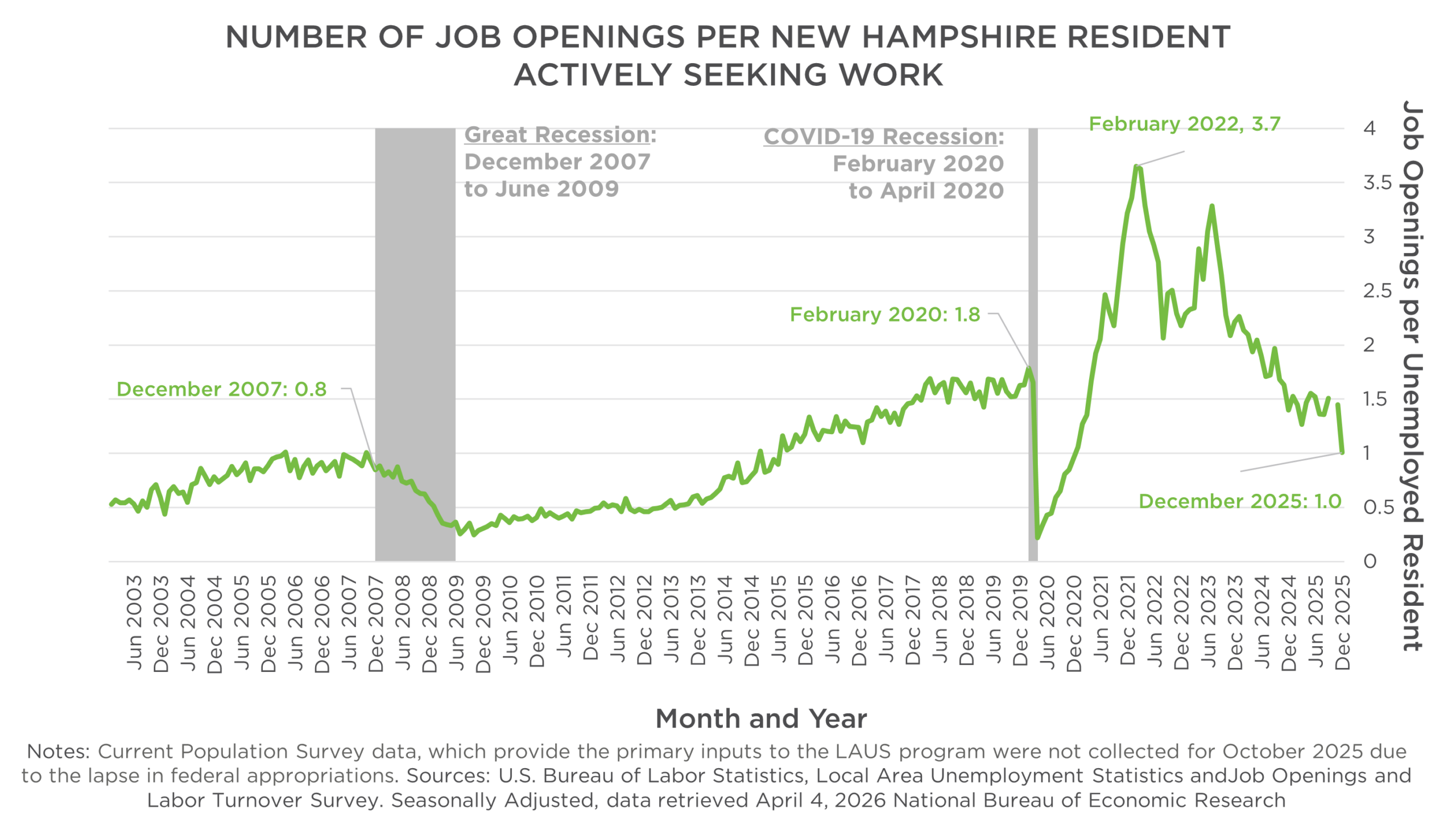
In the years following the COVID-19 pandemic, New Hampshire employers faced a tight labor market. At the peak of market pressures in February 2022, there were an estimated 3.5 job openings for every unemployed person in the state. That ratio averaged 2.9 in 2022 and 2.6 in 2023 before dropping under 2.0 in 2024. By December 2025, there was only about one job opening for every unemployed person.
These figures suggest that the State’s labor market was not largely defined by a shortage of available workers as had been previously: in 2022 and 2023, employers had to compete for a smaller pool of available workers. However, by 2025, more people were seeking work, and some were not finding jobs right away.
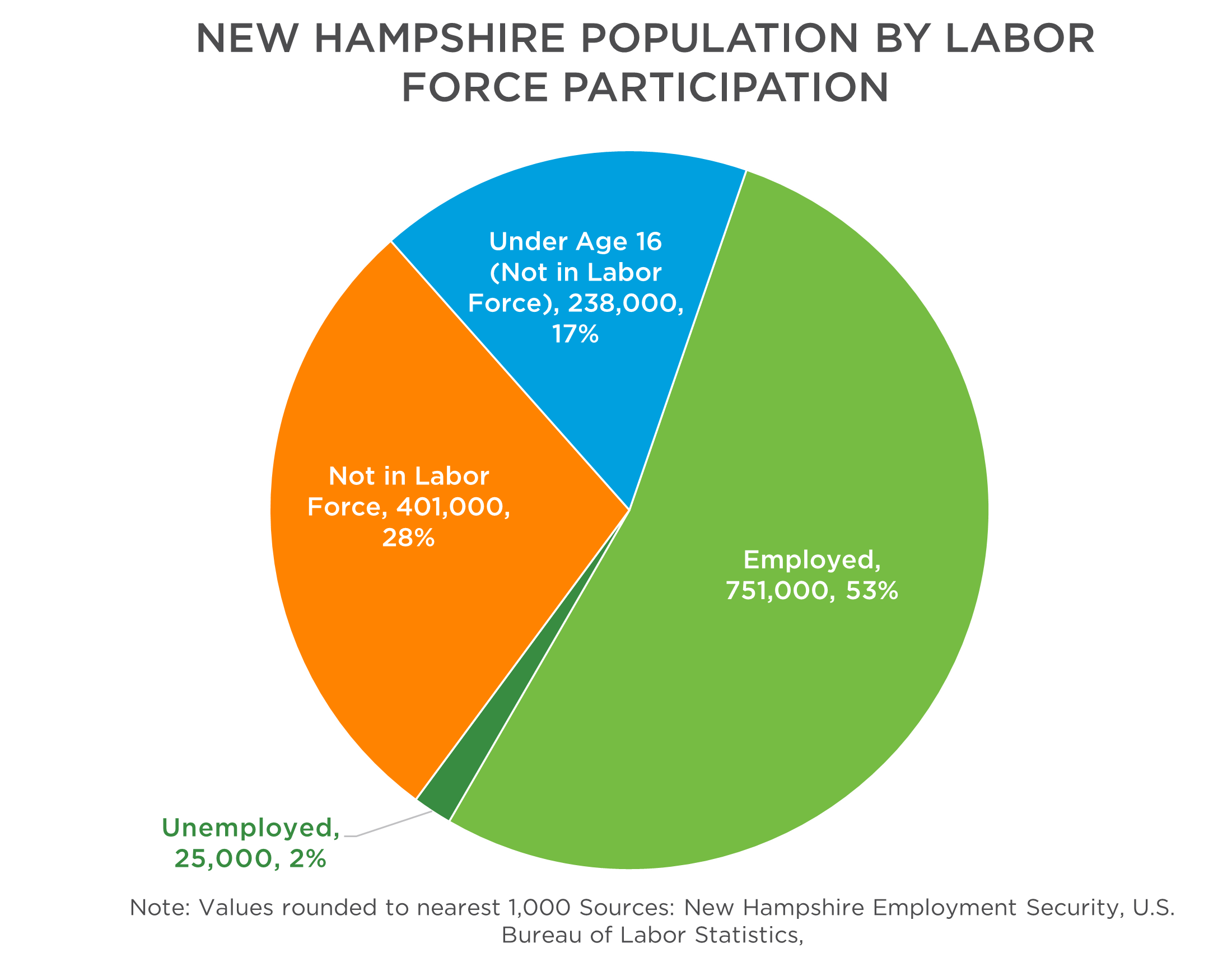
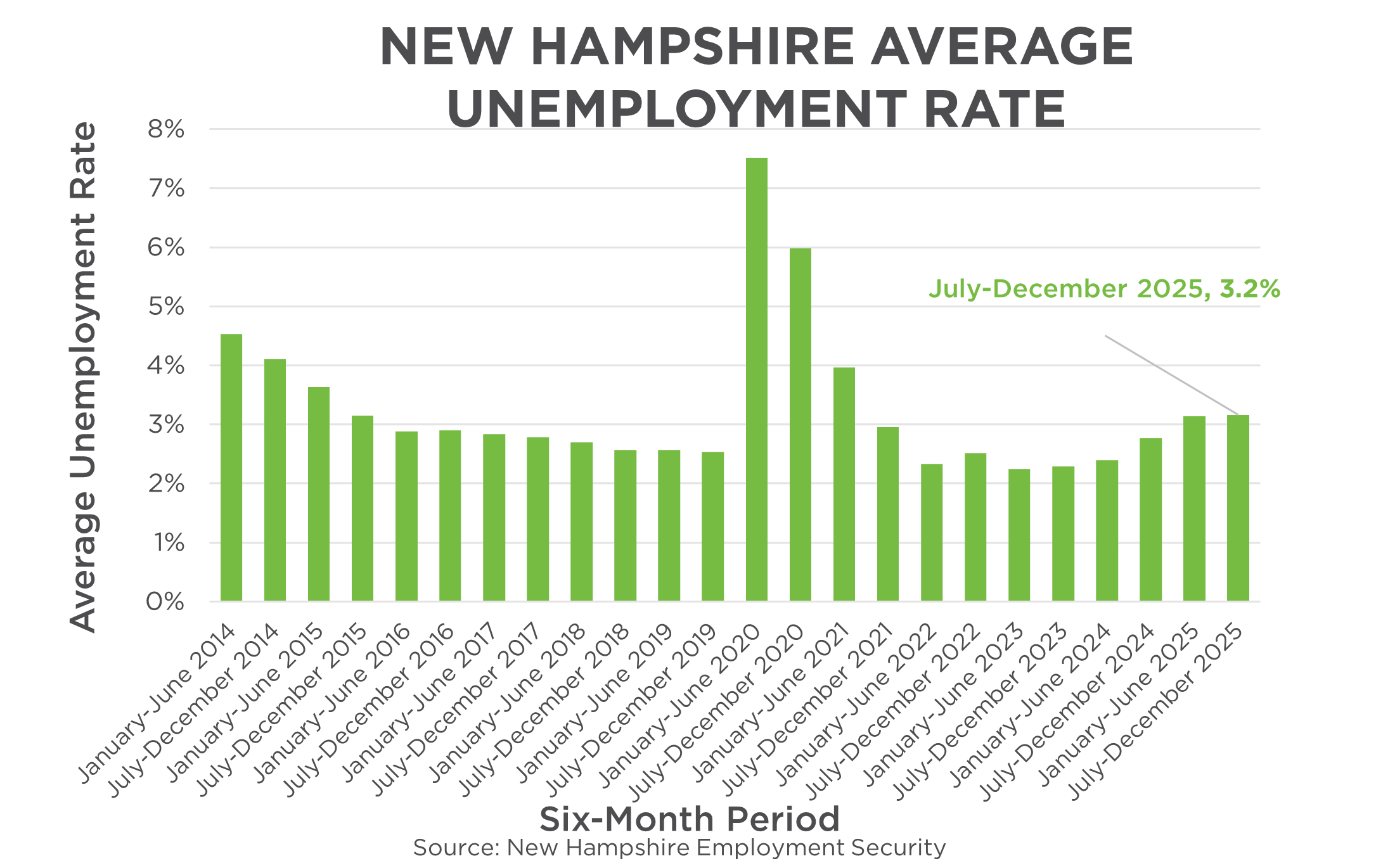
In 2025, there were about 776,000 people in the labor force, including 751,000 people employed and 25,000 people unemployed. About 97 out of every 100 people in the labor force were employed. While this remains a strong labor market compared to past standards, the unemployment rate did rise. The six-month average unemployment rate was 3.1% in January through June of 2025 and 3.2% in July through December, which were above 2023 and 2024 levels.
Fewer New Hampshire Jobs, Falling Behind National Growth
The latest benchmarked employment data suggests that employers in New Hampshire filled fewer jobs in 2025 than in the previous year. Based on the Current Employment Statistics survey, seasonally-adjusted non-farm employment averaged about 701,633 employees in 2025, down from around 703,833 in 2024 (a decline of 2,200 jobs).
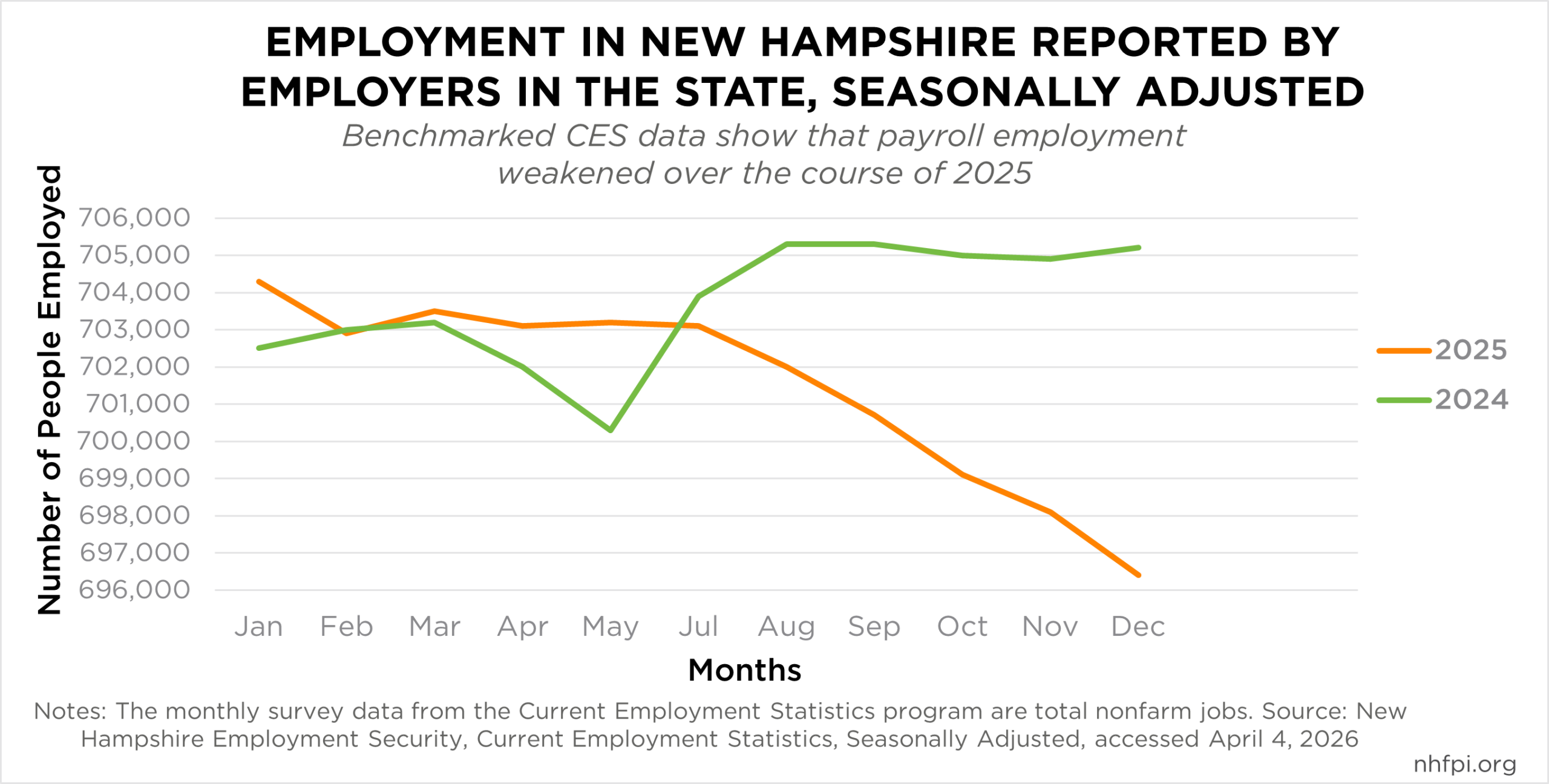
The start of the year faced differing trends. In January 2025, there were about 1,800 more jobs than in January 2024 and by May 2025 that gap widened to about 2,900 jobs compared to May 2024. However, market trends shifted halfway through the year. In June 2025, seasonally-adjusted employment dropped about 2,200 jobs below the June 2024 level. The gap continued to widen throughout the rest of the year and by December 2025, there were 8,800 fewer non-farm jobs than in December 2024.
The Current Employment Statistics survey relies on monthly payroll data, which can be volatile. The six-month rolling average of monthly employment changes offers another view of the employment trend. In January 2025, the six-month rolling average of monthly employment changes was 67 jobs. This means that while employment was still growing, it was slowing considerably.
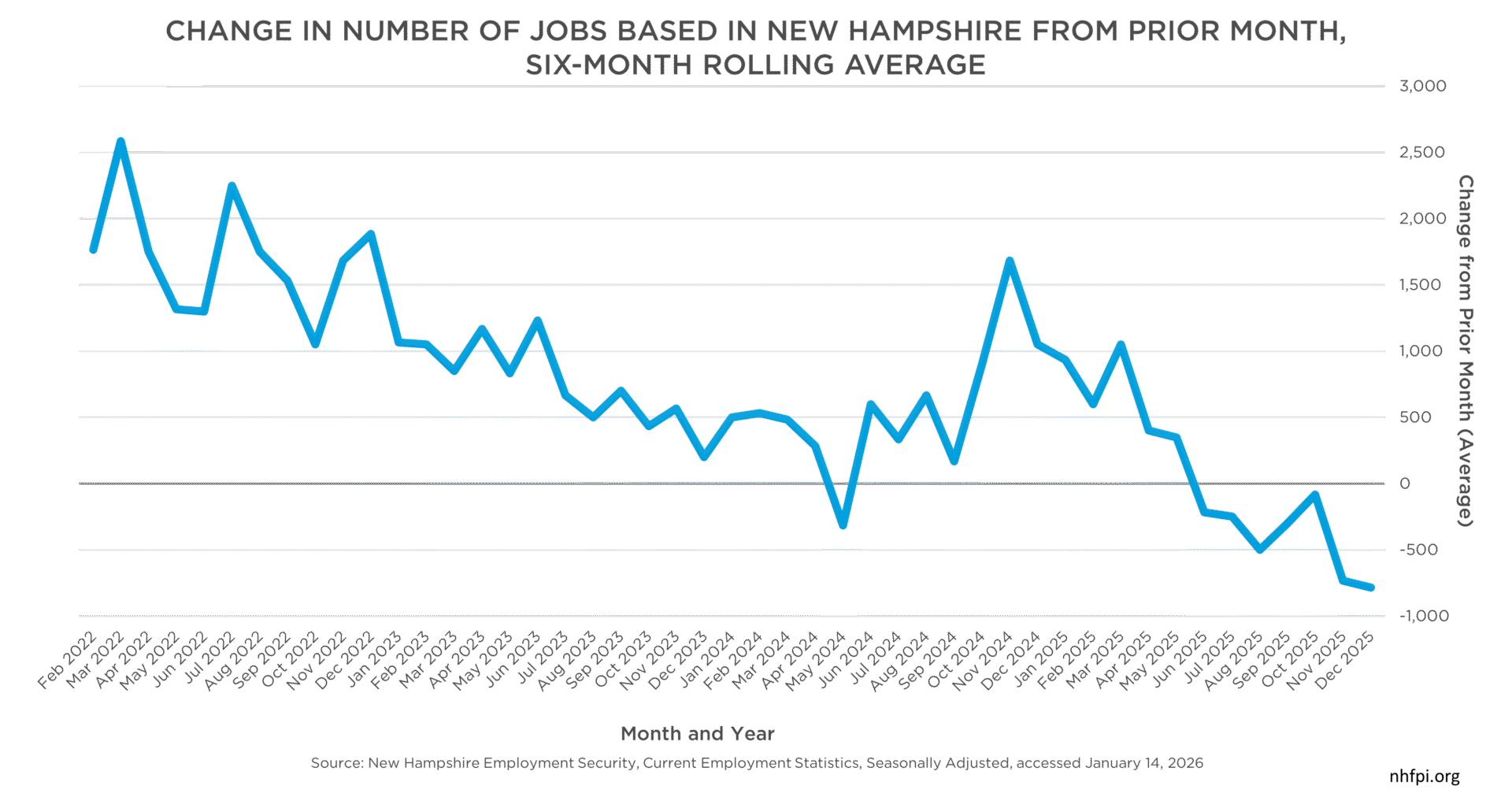
This pattern suggests that the slowdown in the second half of the year was not only from one or two weak months, but rather a gradual softening of the labor market beginning during the spring months, before the larger declines became apparent later in the year. This pattern indicates that 2025 saw weaker business confidence, softer labor demand, or slower economic activity.
Employment Gains and Losses Varied by Industry
Industry employment trends were mixed in 2025. Some sectors added jobs or held steady, while others declined. The data suggests that the slowdown was spread across several parts of the economy, rather than just one or two industries.
Health Care and Social Assistance, the state’s largest employment sector, grew by 2,200 employees (2.2%) and arts, entertainment, and recreation employment grew by a healthy 5.9%, adding about 900 workers.
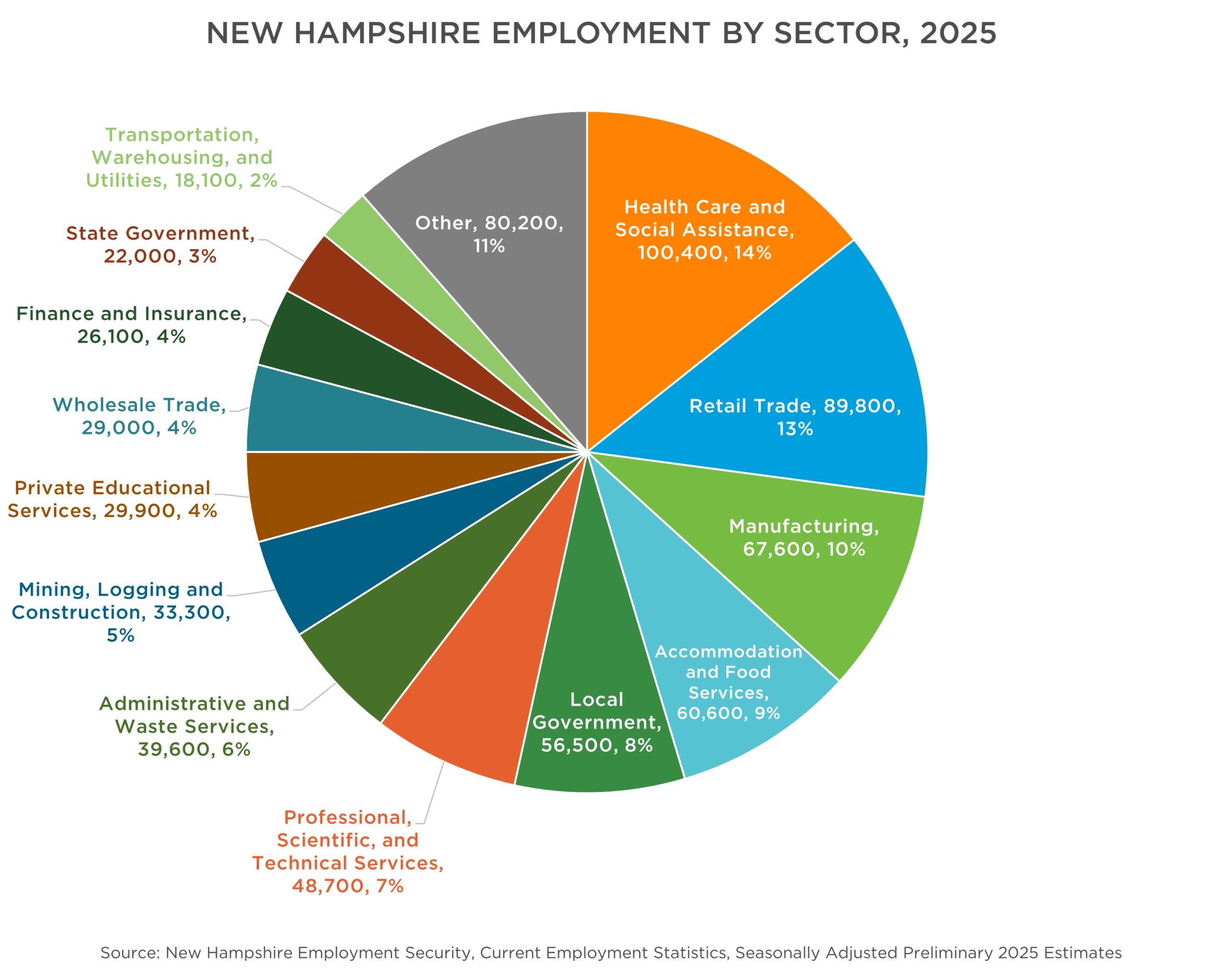
Manufacturing and wholesale trade experienced some of the largest year-over-year losses across all industries. Manufacturing employment declined from 68,800 in 2024 to 67,600 in 2025, a drop of about 1,200 jobs (1.7%). Wholesale trade also fell by about 1,200 jobs, decreasing from 30,200 to 29,000 (4%).
Retail trade employment comprised about 13% of employment in 2025, however this sector has been shrinking over time. Retail trade employed 90,700 workers in 2023 and 90,800 in 2024, but only 89,800 in 2025, which was a loss of 1,000 jobs (1.1%). Retail trade was previously New Hampshire’s largest employment sector until 2019, when health care and social assistance overtook it.
Government employment moved in different directions depending on the level of government. Federal (-2.2%) and state employment (-3.5%) both fell, while local government employment slightly increased (0.2%) between 2024 and 2025. Most other employment sectors remained relatively steady.
Wage Growth Fell Behind Inflation
Wage growth also slowed in 2025. New Hampshire’s average hourly wage nominally increased by less than 1% from 2024 ($35.22) to 2025 ($35.53). After adjusting for inflation, however, the average wage fell from $36.33 in 2025 dollars to $35.53, a 2.2% decrease.
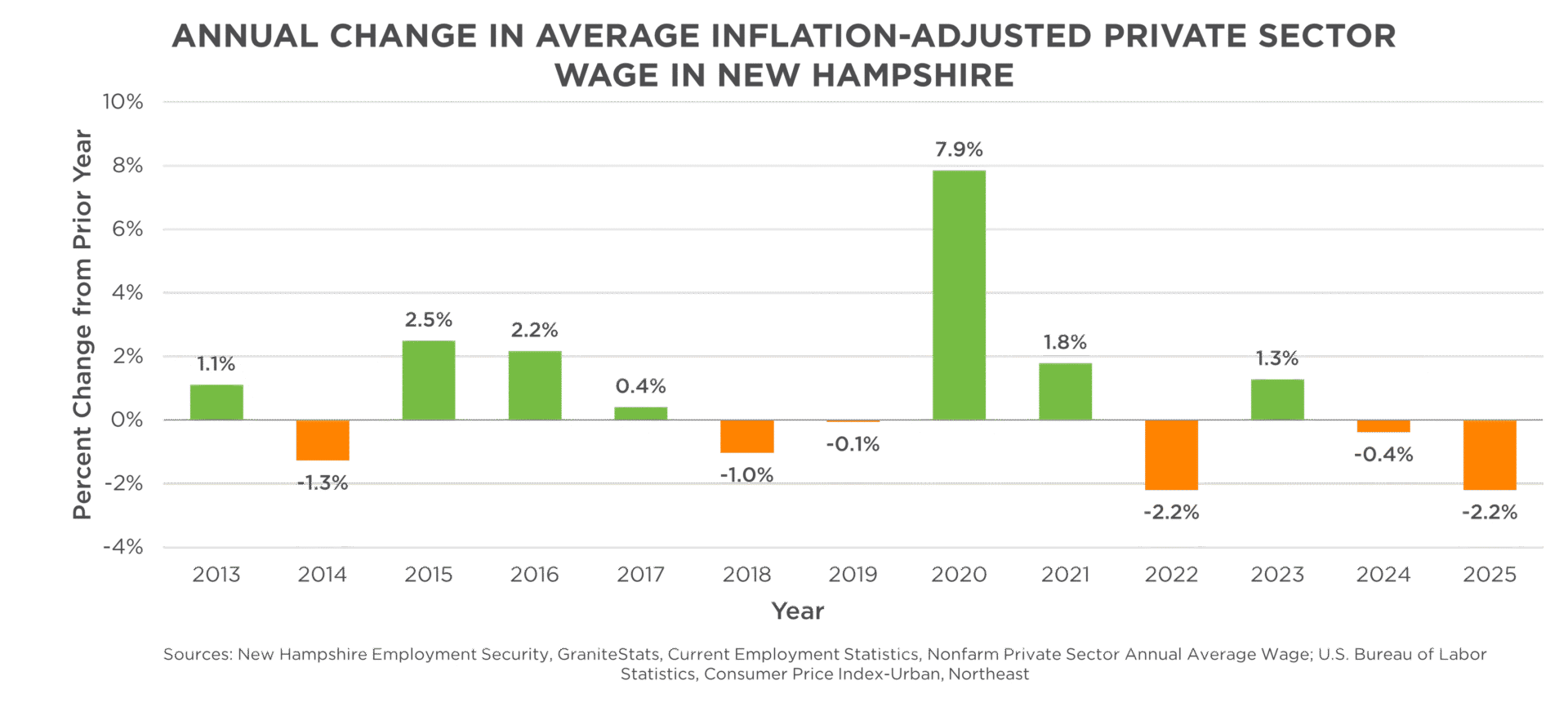
These trends suggest the average private-sector worker had less purchasing power in 2025 compared to 2024, even though their pay may have risen slightly. Across the last twelve years, this is the first time that inflation-adjusted private sector average wages have declined in back-to-back years since 2018 and 2019.
Real hourly earnings also declined across most major private-sector industry groups from 2024 to 2025. Inflation-adjusted hourly earnings for total private employment fell 2.2%. goods-producing industries saw a 2.3% decline, and private service-providing industries posted the same 2.3% drop. Real hourly earnings in manufacturing fell 1.9%, and leisure and hospitality also recorded a 1.9% decline.
The biggest real wage losses occurred in professional and business services and in private education and health services. Inflation-adjusted hourly earnings fell 4.5% in professional and business services and 4.9% in private education and health services. Trade, transportation, and utilities were the only major industries to record real wage growth, with inflation-adjusted hourly earnings rising 2.2% from 2024 to 2025.
Certainty and Uncertainty
New Hampshire’s labor market remained robust; however, it is not dealing with the tight conditions of the past few post-pandemic years. Hiring slowed and total employment softened over the second half of 2025. Unemployment crept up as more workers entered the labor force, and wage gains have not kept up with inflation. The data suggests that both employers and workers in New Hampshire are facing pressure because of uncertainty in the economy.
Continuing shifts in fiscal, geopolitical, and trade policy may have made employers more risk averse, slowing hiring in 2025 and potentially continuing in 2026. This uncertainty impacts the labor force, because when businesses cannot confidently forecast costs, demand, or other economic conditions, they are less likely to expand or make new investments.
Uncertainty extends beyond employers. Households also face greater difficulty planning or budgeting for expenses when wages lag inflation and the economic outlook is unclear. Nearly one in four Granite State households did not have at least $2,000 in emergency nonretirement savings in 2022, and national data suggest households are less prepared for a downturn now than they were four years ago. After a mild 2025, these economic headwinds pose a growing risk to the financial stability of families and businesses.

Ben Reynolds is a senior policy analyst at the New Hampshire Fiscal Policy Institute, a nonpartisan, independent research nonprofit that examines issues related to the state budget, the economy, health care, housing, and more. Read NHFPI’s full analysis, “New Hampshire’s Labor Market Slowed in 2025,” at nhfpi.org.