
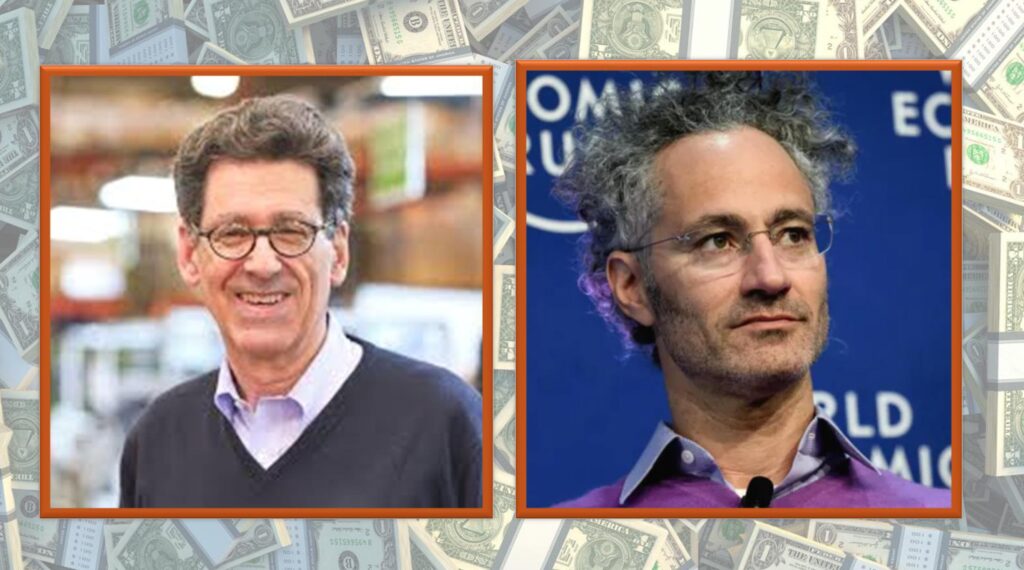
Two New Hampshire residents are listed this week by Forbes as among the world’s billionaires – one who expanded his grandfather’s grocery warehouse business, the other whose company’s revenue is skyrocketing thanks to government contracts with the U.S. Department of Defense and ICE.
The annual Forbes World Billionaires List, published Wednesday, lists Elon Musk as the richest man in the world, with a net worth of $839 billion. Joining Musk and more than 3,300 others on the list are grocery warehouser Rick Cohen, of Keene, at 97th, and Alexander Karp, of Lyman, at 228th, a cofounder of data mining company Palantir Technologies.
Both men were also on last year’s list, as well as the Forbes 400 Richest People in America list, which came out in September.
While Cohen’s net worth of $26.3 billion is twice Karp’s $13.1 billion, Karp’s name is much more likely to pop up in news stories. Karp is cofounder and CEO of Colorado-based data mining firm Palantir, which has hundreds of millions of dollars in government contracts, much of it connected to the Iran war, ICE immigration enforcement and IRS data gathering.
Karp is listed by Forbes as living in Lyman, a town of less than 600 in the northwest corner of New Hampshire. He also bought a $46 million mansion on a man-made island off Miami Beach in Florida in June, moving Palantir there in December, Bloomberg reported.
Palantir’s 10-year, $10 billion contract with the U.S. Department of Defense includes its Maven Smart System, which helps identify targets, and was praised this week by military officials for shortening the time it takes U.S. forces to select and hit targets with missiles in the war with Iran. This includes, possibly, a U.S. Tomahawk missile attack on a school Feb. 28 that killed as many as 180, most of them children. It’s still under investigation, but preliminary reports are that the AI-enabled Maven Smart System may have been used to guide the attack, though “outdated data,” and human error are also being reviewed, according to the New York Times.
Palantir’s $30 million contract with ICE includes software that uses artificial intelligence and data mining from government databases to target and track individuals for deportation. Its Gotham software, used by governments and law enforcement, integrates data “to identify patterns and connections between people, places and events” for surveillance and monitoring.
The company has also received more than $180 million in payments from the IRS since 2018 in connection with 26 contracts, according to public data on USASpending.gov, as reported by Business Insider.
Last June, a group of Democratic senators and representatives sent a letter to Karp raising concerns that the AI tools Palantir was providing the IRS would create “a searchable, ‘mega-database’ of tax returns and other data that will potentially be shared with or accessed by other federal agencies is a surveillance nightmare that raises a host of legal concerns, not least that it will make it significantly easier for Donald Trump’s Administration to spy on and target his growing list of enemies and other Americans.”
One of Karp’s Palantir co-founders is Peter Thiel, who is 87th on the 2026 Forbes list. The cofounder of PayPal and venture capital firm Founders Fund, is a longtime friend of Karp’s since their days together as students at Stanford’s law school. Thiel’s 2009 essay “The Education of a Libertarian” is considered a framework for Project 2025. In it, he blamed “the vast increase in welfare beneficiaries” and “the extension of the franchise to women,” as downfalls of the federal government, and called for an “end to diversity,” advocating for tech entrepreneurs to take charge. Thiel is a strong Trump supporter and was, according to many sources, the chief backer of J.D. Vance for vice president.
Karp has described Thiel in news reports as a close friend, and said they argue frequently about politics. Karp has described himself as “progressive, but not woke,” and in a 2024 article in Fortune said that he backed Kamala Harris for president. While Karp did not attend Trump’s inauguration like Thiel did, the New York Times reported that he did donate $1 million to Trump’s inauguration festivities and is also helping to pay for the new ballroom that is replacing the White House’s former East Wing.
Karp said that Thiel’s support of Trump hurt Palantir during the Biden administration as far as government contracts went. That’s no longer a problem. Palantir reported 66% year-over-year growth in revenue from government contracts in 2025, to $570 million, and $1.4 billion in overall revenue in 2025’s fourth quarter, a record 70% growth over the year before.
Karp described the company’s growth on an earnings call as “one of the truly iconic performances in the history of corporate performance,” The Guardian reported.
“We did this while supporting, in critical manner, some of the most interesting intricate, unusual, operations that the US government has been involved in – many of which we can’t comment on – but were the highlight of last year and highly motivating to all of us at Palantir,” Karp said, according to The Guardian.
He answered criticism about Palantir’s role in U.S. government operations, saying it supports the Fourth Amendment, which ensures the right to privacy and against government search and seizure. Karp said the company’s work makes sure “every institution that uses [Palantir’s] products is doing it within conformity of the law and ethics of America.”
Will Owen, communications director at the nonprofit Surveillance Technology Oversight Project, told The Guardian, however, that Palantir’s revenue” may be up thanks to Trump,” but “no one is buying that they hold ICE accountable.”
On March 12 Karp appeared on CNBC, describing his AI technology as something that will lessen the power of “highly educated, often female voters, who vote mostly Democrat” while increasing the power of working-class men, as detailed in this New Republic article.
“This technology disrupts humanities-trained—largely Democratic—voters, and makes their economic power less. And increases the economic power of vocationally trained, working-class, often male, working-class voters,” Karp told CNBC. “And so these disruptions are gonna disrupt every aspect of our society. And to make this work, we have to come to an agreement of what it is we’re going to do with the technology; how are we gonna explain to people who are likely gonna have less good, and less interesting jobs.”
Karp made local news in 2021, when he gave $180,000 to David “River Dave” Lidstone, a Canterbury man whose riverbank cabin burned down amidst a property dispute, and then refused to leave the land, getting him in hot water with the town.
At the other end of the spectrum, warehousing entrepreneur Cohen is 97th on the list, with a net worth of $26.3 billion, but seldom in the news.
Cohen is owner and CEO of Keene-based C&S Wholesale Grocers, the nation’s largest grocery wholesaler. The bulk of his family’s wealth comes from a company he created, Symbotic, which automates warehousing and is used at Walmart’s 42 regional distribution, according to Forbes.
Cohen launched Symbotic “after tinkering around with technology to solve his own distribution problems at the family grocery business,” Forbes’ profile says. His grandfather started C&S in 1918 in Worcester, Mass., and Cohen moved it to Keene from Vermont.
He is chairman, CEO and majority owner of Symbotic, which “he built largely in stealth,” Forbes says, taking it public in a $5.5 billion SPAC deal sponsored by venture-capital giant SoftBank that closed in 2022. Symbotic reported revenue of $2.2 billion in fiscal 2025, up from $1.8 billion the previous year.
Despite Karp’s six-figure donation to River Dave in 2021, both men get a Forbes Philanthropy Score of 1, on a scale of 1-5. The score measures how much of the money that goes into a company’s charitable foundation actually goes “out the door” to fund good works. A score of 1 is the lowest score, and means that less than 1% of the billionaire’s personal wealth went to charitable causes.
They aren’t alone. Of the most recent Forbes 400 richest Americans, 159 have scores of 1, including Musk, Tiel and Trump.