
Story Produced by New Hampshire Public Radio, a Member of

The U.S. Department of Agriculture recently released new maps that help gardeners figure out what plants can survive the coldest winter temperatures in their locations.
Like much of the rest of the country, the new maps reflect a reality that many growers in New Hampshire have been contending with for a while: Winters are getting milder.
“People are able to grow things that they never used to be able to grow,” said Ruth Smith, who coordinates the master gardener program at the University of New Hampshire’s cooperative extension.
“There are folks that are trying to grow figs and pawpaws and all kinds of southern things,” she said. “We keep joking about, ‘When are the citrus trees going to come in?’”
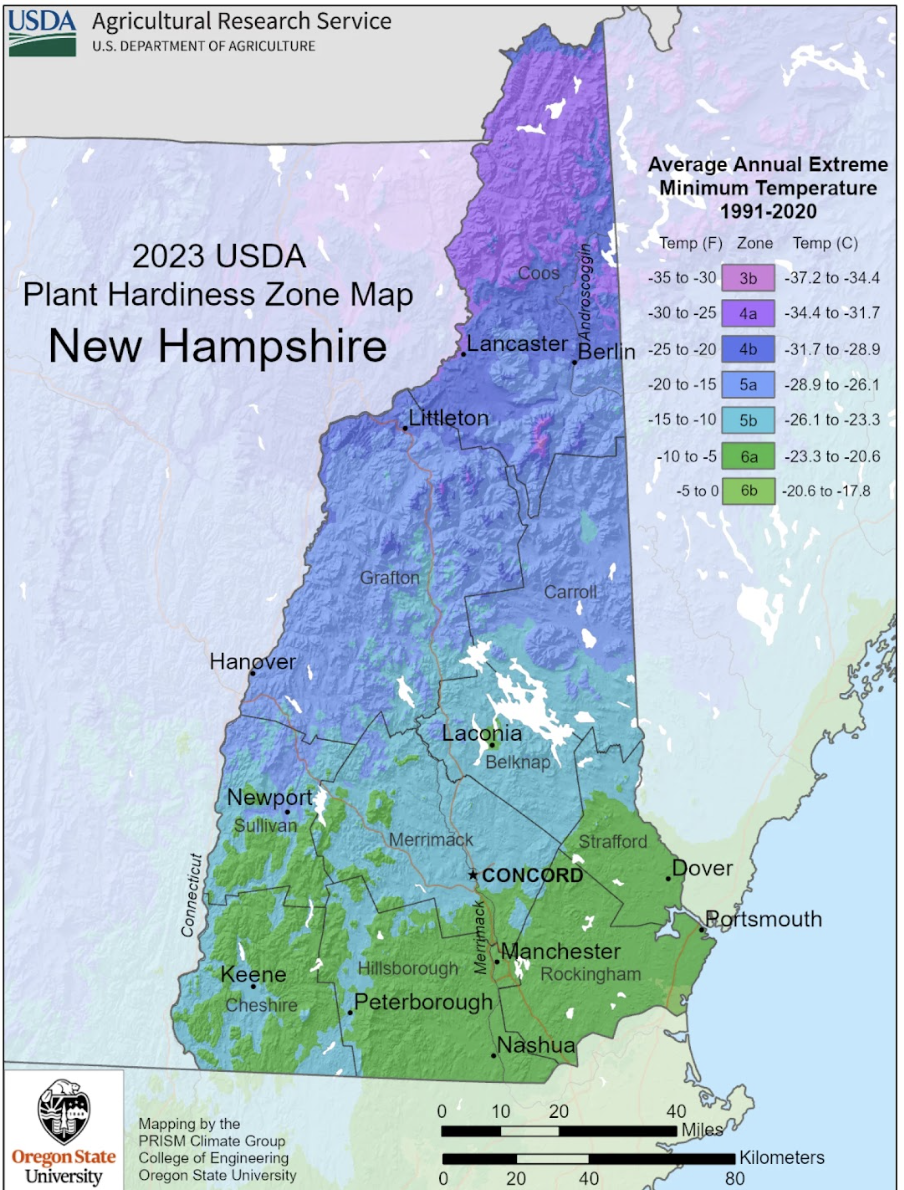
The maps, called plant hardiness zone maps, help gardeners determine which plants are most likely to thrive in their location based on the average extreme temperatures that place experiences in the winter.
The 2023 maps are updated from a 2012 version, and about half of the country has shifted half a zone – a five-degree difference in the lowest winter temperatures.
In New Hampshire, parts of the southern part of the state that in 2012 were in zones with winter lows of minus 15 degrees are now in a zone with lows of minus 10. Some zones in the state, particularly in northern areas, haven’t changed.
The new zones in parts of the state mean crops that are less familiar to New Hampshire, like peaches, have a better chance to thrive, said Steph Sosinski, the home horticulture program manager at UNH’s cooperative extension.
“We’re pushing the southern part of the state into a warmer zone,” they said. “That means peach trees have even more of a chance of not getting hit by winter injury at those deeper temperatures, because we’re not experiencing those deeper temperatures as often.”
But, Sosinski cautioned, that doesn’t mean New Hampshire won’t see those low temperatures ever again. We may still see extreme fluctuations.
“If you do, which we did this last winter, it doesn’t matter if you have a plant that’s made for the zone,” they said. “That low temperature can still cause winter damage, even if you have a plant that’s suited for that zone.”
It is well documented that New Hampshire is getting warmer as humans continue burning fossil fuels, emitting greenhouse gasses, and heating up the atmosphere. Winters are warming faster than other seasons, and faster in New Hampshire than in other parts of the U.S.
The USDA says the warmer zones are the result of a more recent temperature record. But they caution against using the maps as indicators of climate change. Plant hardiness zones are based on 30-year average temperatures, while climate change is generally measured on longer time scales. The new zones also take into account additional data sources and updated methods from the 2012 maps.
But for Smith and other growers she knows, the warmer zones in the state are just confirmation of what they’ve seen in their own gardens.
“We can be harvesting tomatoes well into October if we haven’t had a frost,” she said. “That’s pretty unusual. We never would have been able to do that in the past.”
And it’s not just the kinds of plants that thrive – Smith says her root cellar doesn’t get cold as quickly as it used to, so she has started leaving potatoes in the ground for longer.
“We like to say that gardeners are some of the first line of defense, or observation, at least, in terms of where the changes are happening and how climate change is impacting plant life, and really all life on Earth,” she said.
 These articles are being shared by partners in The Granite State News Collaborative. For more information visit collaborativenh.org.