
CONCORD, NH – Gov. Chris Sununu asked the state’s congressional delegation on Friday to push for more law enforcement at the state’s border with Canada, citing a surge in illegal crossings and drug activity, but there are still no New Hampshire-specific statistics to back up the request.
Sununu asked for help securing an agreement with U.S. Immigration and Customs Enforcement that would give local law enforcement more authority at the border, and to “identity funding to increase resources,” in a letter to U.S. Sen. Jeanne Shaheen, U.S. Sen. Maggie Hassan, U.S. Rep. Annie Kuster and U.S. Rep. Chris Pappas.
“Illegal border crossings, drug trafficking and other crimes are increasing in frequency, and a stronger response from the federal government is necessary to keep Granite Staters from becoming victims to these bad actors,” Sununu said in the letter.
Increasing security at the state’s northern border, and the ICE Delegation Agreement Sununu is asking for, have been hot-button issues, and the focus of the New Hampshire ACLU, for the past couple of years. The issue got hotter in June with passage of the state budget, which included $1.4 million to pay for a Northern Border Alliance program that will fund overtime, equipment, and more for law enforcement in the border region.
“There is still no publicly available data to show evidence of a significant number of unauthorized crossings in New Hampshire, yet politicians are still using fear-based rhetoric to justify a massive expansion of police power and surveillance,” Gilles Bissonnette, NH ACLU legal director, said Friday in a statement.
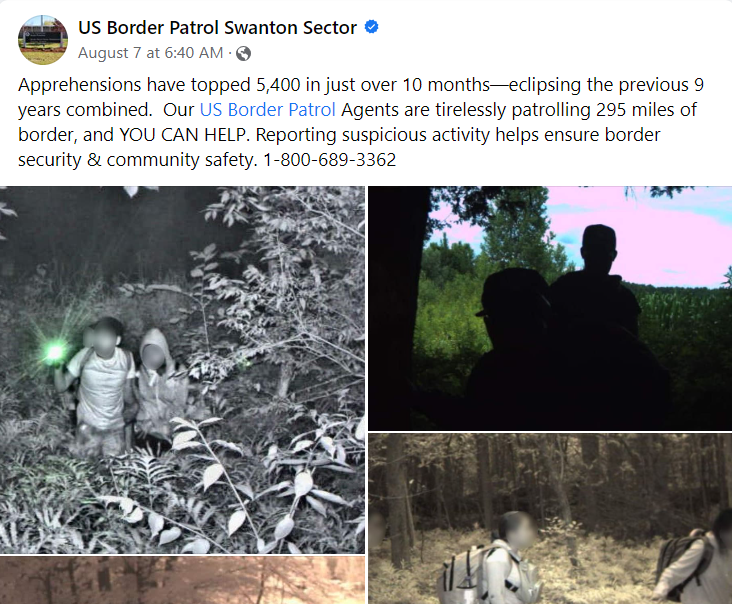
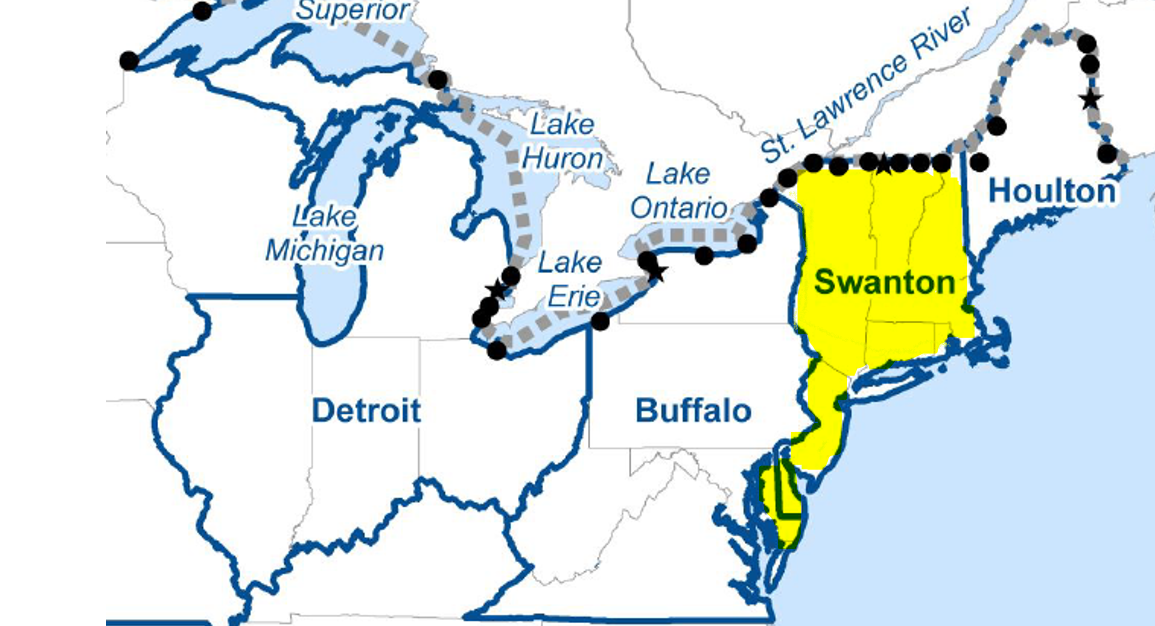
In his letter, Sununu cited more than 5,400 “apprehensions” in the last 10 months reported in a U.S. Customs and Border Protection Aug. 7 Facebook post for the Swanton Sector, which includes New Hampshire’s 58 miles of border with Canada, Vermont’s 90, and the rest the upper part of New York from Vermont to Massena. The sector also includes non-border states Massachusetts, Connecticut, Rhode Island, New Jersey and Delaware, though CBP doesn’t have any stations in those states, and the statistics are for the border states.
The number of Swanton Sector apprehensions for this fiscal year is higher than the previous nine years combined, according to the CBP, which is part of the U.S. Department of Homeland Security.
“Border activity has been increasing exponentially in both the entire Swanton Sector and locally in New Hampshire,” Sununu said. “Just this month, there have been reports that the 5,400 apprehensions in the Swanton Sector have eclipsed the last nine years combined. Law enforcement has consistently encountered large groups of people when individuals and pairs were previously the norm.”
CBP data show that most of the Swanton Sector activity is in New York. The Swanton Sector’s New York portion has three of the northern border’s most heavily traveled border crossings with Canada – Thousand Islands and Massena, at the western end, and Rouse’s Point, at the eastern end. All are major truck portals, according to federal traffic statistics.
On its website, CBP lists 5,258 encounters and apprehensions so far for FY 2023, which ends Sept. 30. Of those, 4,018 were in New York. The statistics don’t separate Vermont and New Hampshire. Of the 5,258, single adults comprise 3,969, family units are 1,272, and unaccompanied children 17.
There were 1,065 encounters and apprehensions in FY 2022, 678 of which were in New York. The overall number included 947 single adults, 117 family units and one unaccompanied child.
Encounter and apprehension data is for suspected violations of Title 8, which is entering the country without proper documentation, and Title 42, which allows expulsions for public health reasons.
Those numbers are just for suspects, not people officially found to be violating the law.
New Hampshire numbers not clear
The NH ACLU has pushed for state-specific statistics that would back up an increased law enforcement effort. In May, the organization filed a Freedom of Information lawsuit seeking New Hampshire data from CPB.
“Policies should be made on facts and data – especially considering these types of policies have been shown in study after study to have negative impacts on public safety,” Bissonette, of the NH ACLU, said Friday. “We believe Granite Staters have a right to know this information, and we’ll continue fighting in court for the full public release of this important data.”
New Hampshire ACLU says that people who are not in the country illegally, and are not committing any other crime, are frequently detained by CBP for no reason. The organization says that an increase in law enforcement along the New Hampshire border will continue to target people who are in the country lawfully and not doing anything illegal.
Earlier in May, the N.H., Maine and Vermont ACLUs withdrew a lawsuit against CBP that charged there were illegal searches and seizures at the Woodstock, N.H., checkpoint, with the stipulation the checkpoint, which has been closed since 2019, would not reopen before Jan. 1, 2025. If the federal government moves to reopen one, a law passed with this year’s budget requires the state to provide statistics showing the checkpoint is necessary.
The ACLU charged that the interior checkpoint – it was nearly 100 miles from the border – was beyond the scope of CBP’s authority. The suit was joined by ACLU clients Sebastian Fuentes, who lives near Woodstock, and Jesse Drewniak, of Hudson. Both are U.S. citizens who were detained by CBP.
Sununu, in his letter, said an ICE Delegation Agreement is necessary in northern New Hampshire because it allows state and local police to investigate federal law violations and detain suspects until they can be transferred to Border Patrol custody.
“As it stands now, unless a crossing occurs on private property or the suspect otherwise violates our state’s trespassing laws, there is little we can do to stop the suspect or prevent the crossing in the first place,” Sununu said.
The ACLU charges that increasing the scope of local police would basically be deputizing New Hampshire departments to do federal law enforcement work.
The Northern Border Alliance “a massive expansion of policing and surveillance in New Hampshire’s north country,” Devon Chaffee, NH ACLU executive director, said in June. “This measure was proposed, debated, passed, and signed into law through fear tactics and political games, and in reality, there is no data to support the claims that people are crossing the New Hampshire-Canada border without authorization. Make no mistake: we will closely monitor law enforcement’s actions in the north and hold accountable how every dollar is spent.”
New Hampshire has 58 miles of border with Canada, all of it in Coos County; the Swanton Sector also includes Grafton and Carroll counties, which are adjacent to Coos, but do not border Canada.
The sector has eight stations to monitor activity along the northern border with Canada, in Ogdensburg, Massena, Burke and Champlain, New York; and Swanton, Richford, Newport, and Beecher Falls, Vermont.
Hassan Has Focused on Border Issue
Sununu’s letter comes weeks after the state was awarded $200,000 by the federal government to help with border security.
The New Hampshire congressional delegation had not issued any public response to Sununu’s letter by Monday afternoon.
New Hampshire’s congressional delegation hasn’t formally responded to Sununu’s letter, but a spokesperson for Hassan told Manchester Ink Link, “Senator Hassan has strongly supported efforts to strengthen border security and increase federal resources at both our northern and southern borders.”
Hassan, a senior member of the Senate Homeland Security Committee, visited the Swanton Sector in April. She met with Border Patrol leaders in Vermont, who “updated her on challenges that they have faced with attempted border crossings and drug trafficking,” according to a news release after the visit. She also walked and drove along segments of the border, including in Pittsburg.
After the visit, Hassan “pushed the Homeland Security secretary in a hearing to address the issues she heard there from frontline law enforcement personnel,” spokesperson Laura Epstein said in an email.
Hassan raised similar concerns at the April hearing to the ones Sununu raised in his letter. She asked DHS Secretary Alejandro Mayorkas what specifically the department is doing to increase security at the northern border, including stopping drug trafficking; raised the issue of limited cellphone service in that area and the need to increase technology and communications infrastructure along the border; asked what DHS is doing to address an increase in individuals on the terrorist watchlist attempting to cross U.S borders.
Mayorkas, in response, said the department is working to increase personnel at the border and increasing biometric sharing with international partners to identify potential threats before a person tries to cross, and using the information in increased security investigations.
Hassan announced the $200,000 from the federal government earlier this month.
“Senator Hassan will keep pushing for additional federal support at the Northern border,” Epstein said.