
Story Produced by NH Public Radio, a Member of
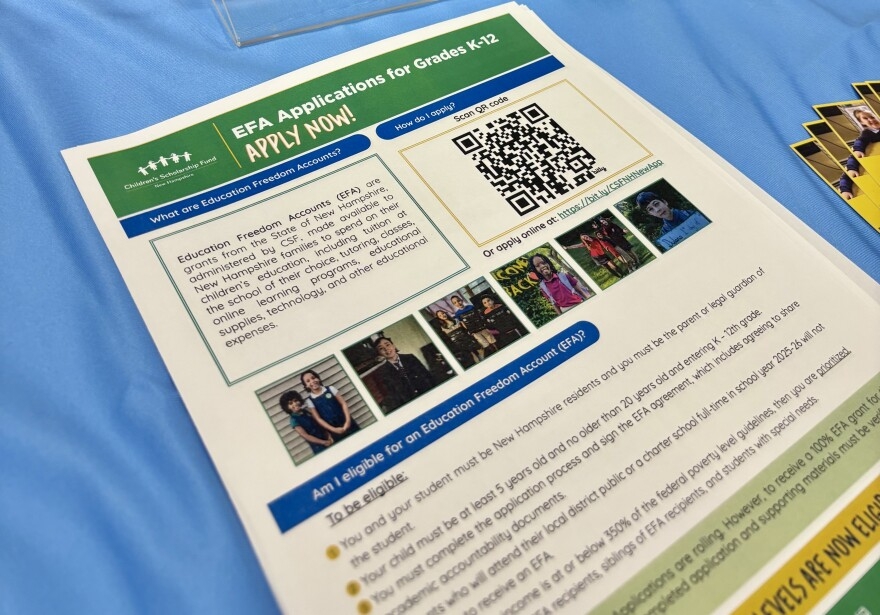
CONCORD, NH – New Hampshire lawmakers charged with overseeing the state’s $50 million school voucher program are raising concerns about how the program tracks academic progress for the nearly 10,600 students enrolled.
The Children’s Scholarship Fund New Hampshire, the private nonprofit running the state-funded Education Freedom Account program, says it does not require parents to demonstrate that their child is getting the educational supports needed to learn. That’s unlike public schools, which must monitor whether special education interventions are successful.
The nonprofit also does not publicly report how its students are performing academically, unlike public schools, which must publicly report student performance on standardized tests.
All parents receive an average of $4,200 for each student in the program. Parents of children with disabilities receive an additional $2,100 per child. They prove a disability by submitting a school evaluation or a note from a medical provider confirming the child’s disability. Public schools must complete a federally-mandated comprehensive assessment.
Rep. Rick Ladd, a Republican from Haverhill, questioned Matt Southerton, director of policy and compliance at the Children’s Scholarship Fund, about that during a legislative meeting Monday.
“That’s giving me heartburn,” Ladd said. “What we’re saying is that we’re going to allow any medical professional that’s licensed somewhere in this country by a separate set of regulations, set of regulations, separate criteria to make a decision here in New Hampshire as to if this child is eligible for a certain disability.”
Ladd asked Southerton: “Is there any identification showing, ‘Here’s the growth in that particular student?’” Southerton said no.
Instead, parents of all children receiving vouchers must submit a “record of academic attainment,” which can be a standardized test or letter from a licensed teacher who has reviewed the child’s work.
In the last year, when there were just over 5,100 students in the program, 10 families used the same standardized test public schools administer, Southerton told lawmakers. About 2,360 parents used a different standardized test and 2,800 chose to have a teacher review their child’s work.
Southerton said the Children’s Scholarship Fund is not comparing testing results year to year because parents are using so many different tests and portfolio reviews.
The nonprofit also does not report how its students are performing academically, unlike public schools, which report student performance on standardized tests. Lawmakers and public school critics often cite low test results as evidence that public schools are not sufficiently educating children.
Lawmakers from both parties have called for more public scrutiny of a program funded by public dollars.
The state is auditing the Education Freedom Account program. Southerton said he was surprised and concerned that lawmakers want to expand the scrutiny to include evidence of academic attainment. Records of the voucher program are private because it’s run by a private organization.
“If they increase the scope of the audit, that would be private financial information from those students and their testing data,” Southerton said.
Editor’s note: This story has been edited to clarify that while students with disabilities are evaluated under the state’s EFA program, that evaluation does not consider whether their education is tailored to their specific educational needs.
These articles are being shared by partners in the Granite State News Collaborative. Don’t just read this. Share it with one person who doesn’t usually follow local news — that’s how we make an impact. For more information, visit collaborativenh.org.