
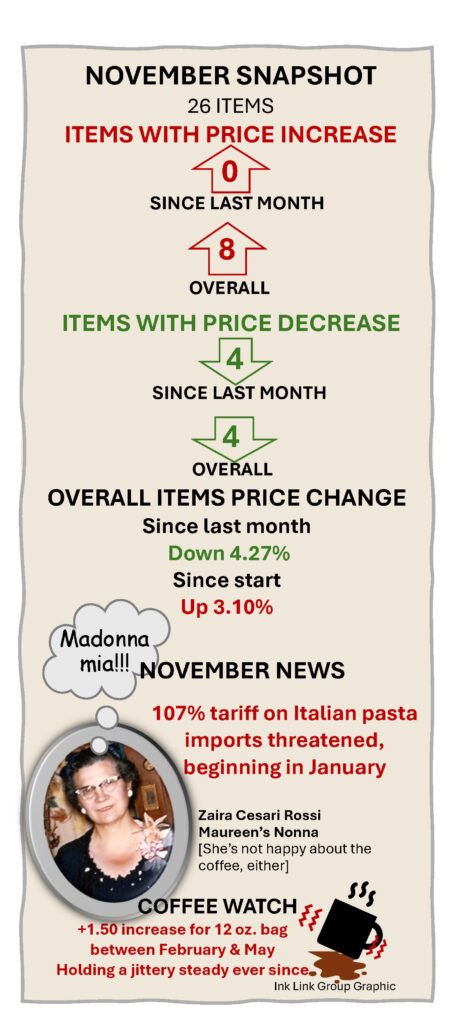
The November grocery snapshot was a first since we’ve been keeping track. Four items decreased in price, and not one item increased.
The overall picture, however, still shows prices are up. While my bill was down 4.27% from last month’s, item prices were still 3.10% higher than when I first bought them for the snapshot. [I calculate per item, or pound. For instance, I base bananas on the per-pound price rather than how much I spend on bananas, since the weight varies].
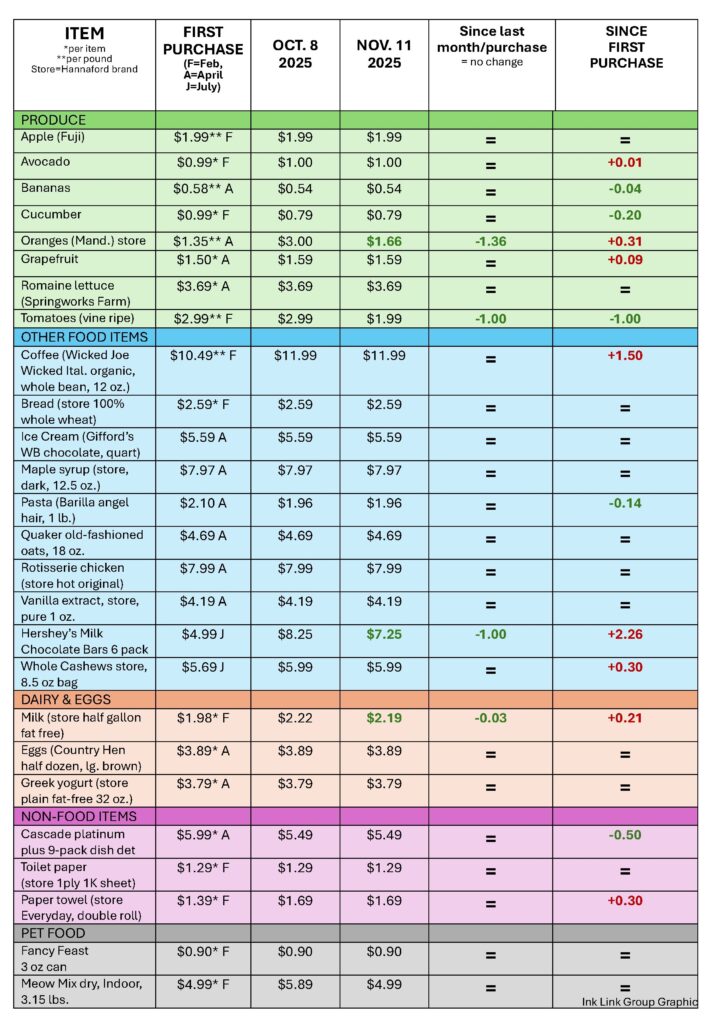
Some of this month’s decreases were a slight break on an overall larger increase (chocolate!), but still higher than the original. Few of the items that have increased in price since I began doing the snapshot are lower than their original price [see the chart for more].
But forget about that! Have you heard what’s going on with pasta? Stock up while you can. We’ll discuss it further below.
For now, the most changeable category on my grocery list – and probably yours – is produce. That makes sense, right? It’s a perishable seasonal product that is affected by weather, disease and availability.
The price of the oranges and tomatoes that I buy went down, and we’ll take a closer look at that below.
As always, a reminder – just because nothing on my Grocery Snapshot list increased this month, doesn’t mean nothing on your list did. This is just a way to discuss grocery prices and what affects them, not a scientific study.
What we’re watching
I usually save this topic for last, but, as my Italian Nonna used to say, “Madonna mia!” Or just “Madone!” when she was too upset to get the full phrase out.
As I was getting ready to shop the other day, I saw a news report that the U.S. Department of Commerce is proposing a 92% tariff on 13 Italian-import pasta brands. Added to the European Union tariffs already in place, it could mean a total tariff of 107% on Italian pasta. If it doesn’t go away, it would begin in January.
The tariff is on Italian-imported pasta, which most consumers on a budget probably don’t buy. It could also affect the price of U.S. brands indirectly, though.
As the daughter of a first-generation Italian mother, I find this totally unacceptable. Pasta, for me, is a go-to staple. It’s cheap, quick and easy to cook, and can be added to almost anything to make a meal. When I don’t have food in the house and don’t feel like trekking to the store, I know there’s a box of pasta in the cupboard, some butter and a wedge of parmesan in the fridge and some pepper on the table, for a poor girl’s version of cacio e pepe. Mix it with some broccoli or peas [always have bags of those in the freezer], and it’s even healthy-ish.
I’m not sure how the non-Italian world views pasta, but given the low cost and ease of cooking, my guess is that noodles, elbows, ziti, and the like are staples for many families.
Federal officials claim that Italian pasta importers are “dumping” their brands into the U.S. for below market price, undercutting U.S. brands. The Italian companies say that the U.S. investigation wasn’t done right, and that the pricing they’re being penalized for was miscalculated.
The tariff, as I said, is on pasta produced in Italy. Most of the brands affected are not the ones the average cost-conscious consumer buys.
The affected parent brands, according to media reports, are La Molisana, Pasta Garofalo, Rummo, Agritalia, Aldino, Antiche. Tradizioni Di Gragnano, Barilla’ s Bronzo imported brand, Gruppo Milo, Pastificio Artigiano Cav. Giuseppe Cocco, Pastificio Chiavenna, Pastificio Liguori, Pastificio Sgambaro and Pastificio Tamma.
I did a quick study on the world wide web and found that a pound of pasta made by these companies runs from a little less than $3 to close to $8 in the U.S., depending on type of pasta and brand. Barilla’s Al Bronzo pasta, imported from Italy, is $2.99 a pound. So is imported De Cecco, which my store sells on the shelf with the cheaper stuff. De Cecco’s parent company, F. lli De Cecco di Filippo – Fara San Martino S.p.A. isn’t on most of the lists I’ve seen, but I doubt it’ll slip through without the tariff.
I’m not sure how prices that are at least a dollar, and mostly much more, higher undercuts my $1.96 box of Barilla angel hair or my other go-to, Prince, which is $1.55 a pound at my store. A pound of store-brand pasta where I shop is $1.19 [I just can’t, Nonna would turn over in her grave. More than she already is]. Even the upcharge at my local “country store” when I have to buy an emergency box of Prince rigatoni doesn’t meet the imported pasta price level.
I’m not an economist, just an American consumer who knows maybe a little more about pricing and how it all works than the average shopper. As such, I have trouble figuring out how a $2.99 [or much higher priced] box of penne imported from Italy is undercutting a $1.19 or $1.55 box of penne made here in the good old USA. I bet the average consumer isn’t that discerning about the subtle differences in how the penne tastes or cooks, and is happy to pay less.
I read that the commerce department has been “keeping an eye” on Italian imported pasta for the past 30 years. As an Italian-American, I have some thoughts on this, but I’ll save that for another type of column another day. In general, though, if I were to speculate, my guess is that there’s simply more Italian imported pasta on the market now, foodie culture has expanded immensely in the past decade or so, and people who have a little more money to spend choose imported pasta because it is fancier. If that’s you, just a note: Nonna made the best food in the world, and she used Prince pasta when she didn’t make her own. It’s the quality of cheese and sauce – or butter cream sauce and pepper, or whatever – that makes the difference. You’re welcome.
Barilla, maker of my monthly pound of angel hair, makes its pasta in Avon, New York, and Ames, Iowa. It also makes pasta in Italy. It’s one of the biggest pasta-producers in the U.S., especially since it acquired Ronzoni. Still, the company said its U.S.-made pasta may have to rise in price because of the other rising costs from the tariffs.
Analysts have remarked that the 107% tax on Italian-imported pasta is the highest penalty since the U.S. began obsessing about imported pasta hurting the market 30 years ago. More punitive than helpful. The company that makes much of the pasta produced in the U.S. is Conagra. Conagra is a giant packaged food company that has more than 100 brands.
The Italian companies that will be affected by the tariffs say it could shut down a lot of their import business, or raise their prices.
The tariffs, if they go into effect, may affect U.S.-made pasta indirectly. If prices for some past on the shelf goes up, it’s a license for everyone to raise their prices, too.
It’s not time to panic yet, folks. There’s a hearing Dec. 4. We’ll take a look again with the December Grocery Snapshot.
Coffee. I have no confidence we’ve seen the end of the coffee price hikes. I’m monitoring the situation closely. Pasta. Coffee. Chocolate. I’m beginning to take it all personally.
What’s up?
Nothing this month!
What’s down?
Oranges. The two-pound bag of store-brand Mandarins wasn’t available, but there was a three-pound bag of name brand Mandarin oranges for $4.99, so, $1.66 a pound. That’s a little more than the original $1.35 a pound that store-brand Mandarins were in April. Last time the store brand was on the shelf, there were no three-pound bags, but the choice offered came to $3.00 a pound.
I go to a pretty big grocery store, but oranges were in short supply when I shopped this week. Part of that was to make room for all the apples. Tons of apples! But the orange growing season is underway, with harvesting just beginning. The oranges we’re seeing in the store in late October, early November aren’t the fresh, new ones. They’re what’s left from last season, or out-of-season picks.
We’ve talked about the tough times oranges are having lately. In May’s Grocery Snapshot I wrote about how a bacterial infection called citrus greening (huanglongbing), has caused a 92% drop in Florida orange production over the past two decades, and California is still scrambling to catch up. On top of it, the tariff back and forth has had a big impact on the South American countries that we get orange juice from [yes, orange juice and oranges don’t always come from the same place], as well as other fresh citrus fruit.
We get most of our imported citrus fruit and products from 13 countries. They are, in order of volume: Mexico, Chile, Peru, Morocco, South Africa, Colombia, Argentina, Uruguay, Israel, Vietnam, Guatemala, Dominican Republic and Spain. Agriculture products from all but Mexico are subject to tariffs of between 10-30%. Some have been jerked back and forth on how much the tariff is. Even when tariffs are imposed, then withdrawn, it causes disruption in the market.
I know it’s an obvious point, but most of the U.S. can’t grow oranges or other citrus fruit. Other countries with more tropical climates can, so we depend on them for those products. Imposing tariffs isn’t going to increase U.S. citrus production much, especially when crop disease and crazy weather have a big impact on the states that can produce those products.
Analysts are saying that tariffs will have an impact on the citrus fruit and products we import this winter, so we’ll see what happens.
Tomatoes. The price of those tomatoes on the vine that I like to buy were down a dollar a pound. It’s likely because tomato harvesting season just ended, and there are a lot of tomatoes around. Add into it that it’s November, and people are looking at the fall season vegetables more, especially with Thanksgiving coming up. A lower price incentives tomato buying if people are browsing the produce section looking for some bargains to fill out a healthy menu.
Chocolate. We will likely never see chocolate prices completely return to what they once were. The reasons that the price of chocolate is going up aren’t going to change – drought and crop disease in the countries that produce cocoa are made worse by climate change and that’s not going to turn around.
That said, candy companies and other manufacturers that use cocoa don’t want people to stop buying their products. That could be why my six-pack of full size Hershey bars dropped from $8.25 to $7.25 this month. After the $4.99 increase to $8.25 sticker shock last month [even though I knew it was coming], a price drop brings a sigh of relief. We’re funny that way, aren’t we? Oh look, it’s going down! We’re just so grateful. We totally forget that two months ago, it was several dollars cheaper.
Milk. My half gallon of store-brand fat-free milk was down three cents. I explained in August how milk pricing works, so I’m not surprised now with those fluctuations.
The Disclaimer
This monthly column is a snapshot of a variety grocery items I regularly buy, not a scientific analysis. It’s simply a way to look at prices and what affects them.
Aside from tariffs, a lot goes into price fluctuations, including seasons, weather, store preference and store decisions. I’ve included items likely to be affected by tariffs as well as some that may not be. There are likely different prices and fluctuations for similar items at other stores, but this is a reflection of my shopping list, not a comparison-shopping exercise or a definitive picture of what certain items cost everywhere.
This is not meant to be a brand endorsement or an advertisement for Hannaford. These are just the things I buy, and that’s just where I shop.